Table of Contents
TL;DR
- AI engines recommend named competitors over unnamed sites because they need a machine-readable identity to attribute facts safely.
- Pages with structured identity markup are 36% more likely to appear in AI-generated summaries, and 65 to 71% of pages ChatGPT and Google AI cite already have it.
- The identity block lists business name, address, phone, logo URL, founding date, and links to Google Business Profile, LinkedIn, Crunchbase, and directory listings.
- Auto-generated platform markup is usually incomplete — missing logo, founding date, and sameAs links — so "has markup" is not the same as "correctly configured."
- Open your platform’s business-identity settings, fill every field to match Google Business Profile exactly, then verify with Google’s Rich Results Test.
You run a search. You ask Perplexity, or ChatGPT, or Google AI Overviews, "What is the best [your category] in [your area]?"
Your business is not the first answer. It is not the second answer either. Your competitor, who is no better than you at the work, is.
This is not a taste issue. The AI did not prefer their style or their marketing. The AI could not be sure your business existed as a distinct, named thing in the world. So it recommended the one it was sure about.
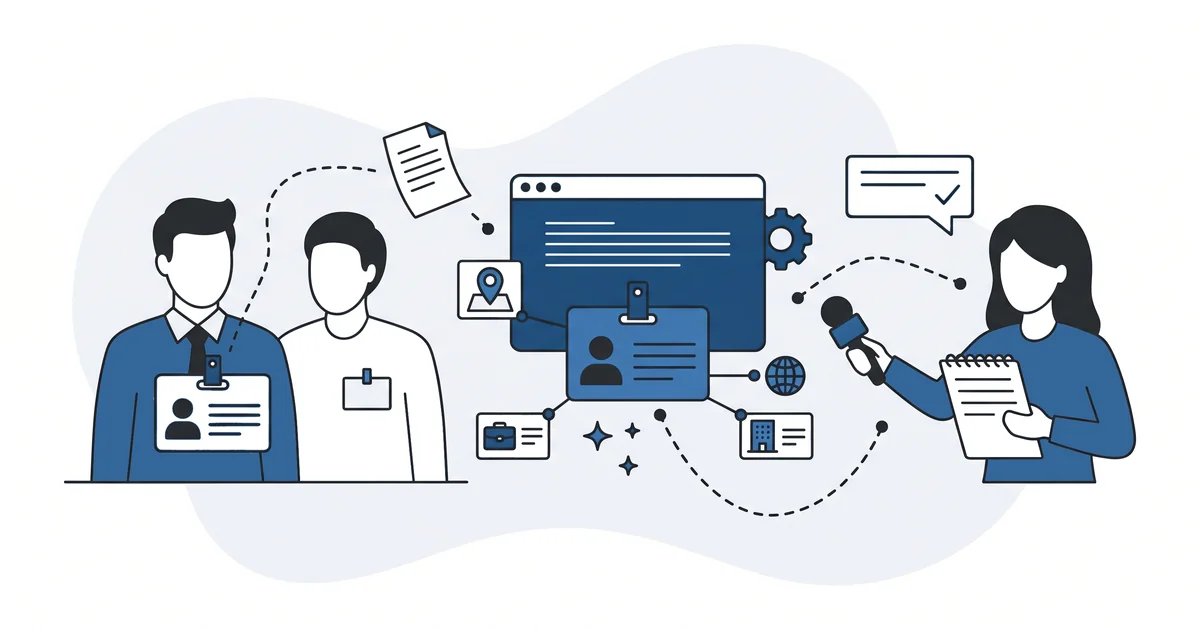
Think about walking into a crowded room. Everyone is talking about the same subject. Some people wear nametags. Others do not.
If a reporter comes in and needs to name a source, she will quote the people wearing nametags. Not because they are smarter. Because she can confirm who they are.
AI engines are reporters in that room. Your competitor wore a nametag. You did not.
Why does AI keep recommending competitors instead of me?
Because AI engines need to be certain about who they are recommending. They cannot risk attributing the wrong facts to the wrong business.
When your site has no machine-readable identity, the AI treats it as a page about a topic, not a named business in its own right.
Your competitor who set up their identity markup gets cited by name. You get described as part of the backdrop, or skipped entirely.
This happens quietly. You will not get a warning. You will just notice, over months, that your visibility in AI answers is lower than your visibility in traditional search. If a client mentions they asked an AI and were shown three other options, that is the symptom.
What does "entity" mean to an AI engine?
An entity is anything an AI engine tracks as a distinct thing in the world. A business, a person, a place, a product.
When the engine reads a page, it asks a simple question. Can I tell what named thing this page is about?
If yes, it can recommend that thing later. If no, it can only describe the topic and point readers at whichever nearby page does have a clear identity.
Your homepage might be beautiful and read perfectly to a human. To an AI engine trying to extract a named recommendation, a page with no identity block is ambiguous. Ambiguity is not what engines recommend. Clarity is.
The fix: give yourself a name the machines can read
Your site already has a name in human-readable form. The logo in the header. The footer copyright line. The about page.
AI engines cannot reliably read any of those.
They need the same information in a small block of structured data the page carries quietly in the background. That block names your business and its address. It lists your website, social profiles, and the few facts that distinguish it from every other business on the same topic.
It is not a new page. It is not visible to visitors. It is a few lines of machine-readable information. They turn your site from "a page about eye care" into "this specific eye-care practice, at this address, owned by this person."
That is what the AI needs to recommend you by name. The companion piece to the identity block is the About bio AI engines trust, where the same machine-readable facts get a human-readable home.
What goes in the identity block?
Business name exactly as it appears on your other profiles. If Google Business Profile has "Silverpine Eye Care" and your site has "Silverpine Eye Care LLC," pick one and match both.
Full address if you have one. Phone number. Website URL. Logo URL.
Links to your Google Business Profile, LinkedIn, Crunchbase, and any directory listings that describe you.
Founding date if it matters for credibility.
The more of these match across the web, the more confident the AI becomes that your site is the authoritative source on you. The identity block does not create that confidence on its own. It gives the AI the evidence it needs to reach it. The deeper version of this is why linked entities beat isolated ones when an answer engine decides whom to cite.
Does this actually work? What the data shows
One recent practitioner analysis reported that pages with structured identity markup are 36% more likely to appear in AI-generated summaries.
Another found that 65 to 71% of the pages ChatGPT and Google AI cite already have this markup in place, per Mentio’s analysis of AI citation errors.
A third survey of 47 local search experts weighted citation consistency at 13% of all AI visibility factors. Citation consistency means your identity matching across every directory.
None of these is proof of cause. Pages that get the markup right also tend to have clean content, real authority signals, and better information architecture overall. The markup is part of why they get cited. It is not all of why.
Three different measurements, all pointing the same way, is the practical signal worth acting on. This is one of the few AEO levers that shows up consistently across independent sources.
Why auto-generated markup usually isn’t enough
Most website platforms add a basic identity block by default. This is good news and a small trap.
The block they add is usually missing pieces. No logo URL. No founding date. No links to your other profiles.
No sameAs list. It ticks the technical box without doing the real work.
If you have a recent site, the markup is almost certainly there. Whether it is complete is a different question, and worth a short audit.
Run your site through Google’s free Rich Results Test tool. It will list exactly what is there and what is missing. Most small-business sites come back with half the fields blank. Those blanks are what separates "the AI knows this site exists" from "the AI knows who this business is."
Is this too technical for a non-developer?
Not any more. Modern WordPress plugins, Shopify apps, and most site builders let you fill in the identity fields in a plain form.
You do not edit any code. You type your address, upload your logo, and paste the URLs of your Google Business Profile and LinkedIn. The platform writes the markup in the background.
The harder part is knowing what to fill in, not how to fill it in. The form fields are deceptively simple. Getting them right means your name, address, and phone number match across every place you appear. That is an audit job, not a coding job.
If you can fill in a contact form, you can do this.
Other questions worth answering
How should I handle two brands with very similar titles online?
Two overlapping brand labels confuse the engines because they cannot tell which page belongs to whom. Pick a single canonical brand string and use it across your site, every profile, every Google Business Profile. Pick the exact match between your business filings, your website, and Google. Moburst’s February 2026 analysis frames clean attribution as the mechanism that lets engines cite a brand by label rather than skip the page.
Should solo consultants and authors set up Person schema as well?
Yes, especially for one-person operations where the practitioner is the brand. Person markup tells the engines who wrote the article and what credentials back it. Link your LinkedIn, your Crunchbase, and any speaker profile pages so the page-to-person trail is unbroken. Mentio’s April 2026 analysis frames identity markup as baseline for AI citation, not bonus.
How long before Perplexity or ChatGPT picks up my changes?
Perplexity often picks up new schema within days, while ChatGPT can take weeks for low-traffic sites. The change appears in each tool’s index first, then in cited answers. Moburst’s February 2026 analysis cautions that markup alone is not the full story. Better content and cleaner architecture matter alongside the technical setup.
What if I run several locations under one parent brand?
Three pieces matter. First, each location needs its own page with its own address, phone, and opening hours. Second, the parent brand sits above as a single umbrella organization. Advice Local’s December 2025 survey of 47 local search experts placed citation consistency at 13% of visibility weight.
How should you fix your directory listings first?
Open the settings panel of your site platform and find the business-identity section. Most platforms put it under general settings or SEO settings.
Fill in every field you have. Check that your name, address, and phone number match your Google Business Profile exactly.
Add the URLs of your LinkedIn, Crunchbase, and any directory where you are listed.
That is the first half. The second half is checking the result with Google’s Rich Results Test to see what the AI will actually read.
An afternoon of careful work, and your site stops being a page about a topic and starts being a named business. The AI still has to decide whether to recommend you. But at least it knows who you are.
If you open the form and the fields are empty, or you are not sure whether your current setup is complete, you can contact me. I will look at the identity block your site is giving the AI right now and tell you what is missing.
No pitch. No sales. Just the honest gap between what your site looks like to people and what it looks like to machines.