Table of Contents
TL;DR
- An AI draft with the right structure needs voice. An AI draft with broken structure needs a re-prompt — polishing hides the break instead of fixing it.
- Reverse-outline the draft: one sentence per paragraph, read the summaries in order. If the argument marches cleanly, humanize. If it wanders, re-prompt.
- Da Silva’s split: AI does 60 to 70 percent of the raw drafting. The quality gap lives in the human 30 to 40 percent — not in sentence smoothing.
- A vague re-prompt ("make it better") resamples the same average. A diagnosis-specific re-prompt names the missing step or wrong destination and rebuilds.
- Eight minutes of reverse-outline replaces three rounds of sentence editing. Try it on the next AI draft that feels off.
A draft sits on the screen. Two paragraphs work. One paragraph is almost right. The middle does not land.
You have been staring at it for 20 minutes.
The AI model wrote it in 40 seconds. Now the slow part begins. Do you sit here and hand-edit this into voice? Or do you throw it out and ask for another draft?
That question has become the whole job. For writers using AI tools, the choice now happens every day.
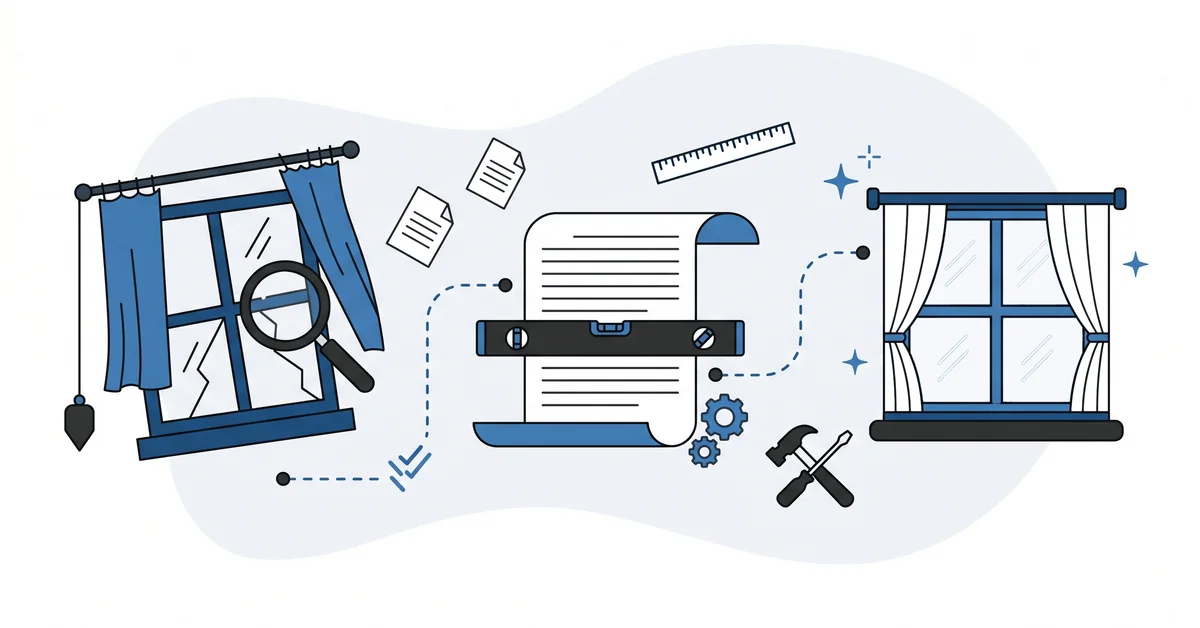
Think about a room where the curtains are wrong. You can spend three hours picking better curtains. You can upgrade the rod. The room still reads off.
Because the window is crooked.
Better curtains do not fix a crooked window. They dress up a problem. Humanizing a draft is curtain work. It polishes the surface.
If the window is straight, new curtains finish the room. Straight means the argument marches in the right order, to the right conclusion, past the right objection.
If the window is crooked, you are decorating a problem.
That is the question the rest of this piece is about.
Why does sentence polish sometimes make a bad draft worse?
Sentence polish assumes the bones are right. That the paragraphs are in the right order. That the draft is answering the reader’s real question. That the call to action belongs where it sits.
If any of those is wrong, polish makes the draft worse.
Because now the wrong argument sounds natural. The reader believes it longer before giving up.
A clumsy bad argument invites skepticism. A polished bad argument gets halfway down the page before the reader notices anything is off.
Polish does not fix structure. Polish hides structure.
Robin Da Silva, who writes about AI copy at Nest Content, put the split this way. AI does about 60 to 70 percent of the raw drafting work. The remaining 30 to 40 percent is where the quality gap lives.
That 30 to 40 percent is not sentence smoothing. It is the strategic work. What the reader needs to believe, and in what order, and with what evidence.
Rewording "innovative solution" into "works because of X" is still sentence polish. The real fix is asking whether the sentence belongs in the piece at all.
The fix is a different tool. Before you polish, check the structure. Before you humanize, reverse-outline.
How do you tell if the argument is wrong, not just the writing?
Reverse-outline the draft.
Read each paragraph. Write one sentence describing the job that paragraph does. Put those summaries in a list, in order.
You now have the skeleton of the draft. Read it out loud.
Does the argument march from the reader’s problem to a resolution the reader actually cares about? Does the objection show up where a skeptical reader would raise it? Does the proof appear before the ask, not after?
If the list reads as a clean argument, the bones are right. Humanize.
If the list wanders, skips the objection, or ends in the wrong place, the argument is broken. Re-prompt.
The reverse outline takes eight minutes. That is eight minutes of diagnosis instead of two hours of decoration.
This is the same move a working copywriter has always used to edit another writer’s under-baked draft. The AI era did not invent it. The AI era made it the deciding step.
When should you humanize the AI draft you have?
When the reverse outline reads as a clean argument and the bones hold.
Claim order makes sense. The reader’s objection shows up where they would raise it. The call to action belongs at the end.
At that point the draft needs voice, not surgery. Humanize sentence by sentence.
Trim the AI tells. Remove "innovative" and "cutting-edge" and "seamless." Cut any opener that starts with "today’s fast-paced."
Break a long rhythmic sentence with a short punchy one. Pick a specific noun where the AI picked a category.
Add the writer’s fingerprints. A metaphor only this writer would reach for. A number the AI model could not have known. A reference the brand uses in meetings that never made it into the style guide.
None of that is rebuilding the draft. It is finishing a draft whose structure already works. The three goals of humanization walkthrough names the priorities that this finishing pass should hit before the writer calls the draft done.
Ramesha Kamran, writing on humanizing AI content for SEO, frames the same rule in one line. "Use AI for speed, then apply human editing for accuracy, voice, and depth."
Speed came first. Voice comes last. Only if the bones in between hold.
When should you re-prompt for a new draft?
When the bones are wrong.
The argument skips a step. The draft addresses the wrong objection. The piece lands in the wrong place. The proof appears before the reader has a reason to care about the claim.
Humanizing that draft hides the break. Polish the sentences and the same broken argument reads smoother. The reader still hits the missing step, still feels the wrong-objection jar, still arrives at the wrong destination. Just more fluently.
Re-prompt with the diagnosis. Not "make it better." Not "try again." Name the specific break.
"The draft jumps from problem to feature list without naming the cost of doing nothing. Add that section before the feature list. The reader does not yet believe the problem is expensive enough to solve."
That prompt rebuilds. The AI model has something concrete to act on.
A polished broken draft is a crooked window with good curtains. A re-prompted draft built from a named diagnosis is a straight window with whatever curtains you like.
What goes into the re-prompt so the second draft is not also generic?
The diagnosis, in plain words. Specific, not vague.
"Make it more persuasive" sends the AI model back to the same average it pulled the first draft from. Same training data. Same median prose. Same generic output.
"The draft assumes the reader already trusts the brand. Most readers here are first-time visitors. Rewrite the introduction to earn trust before the first claim." That prompt rebuilds. It carries a named structural correction.
The re-prompt is not a rewrite request. It is an edit memo to the AI chat. The writing a brief for ChatGPT walkthrough covers what a working brief looks like before the first draft, and the same shape applies to the re-prompt edit memo.
Eric Fiske, who writes about AI use in teaching, frames this as the right instinct. "Writing with ChatGPT is a conversation, not a command." When the draft is off, the next turn in the conversation should name what is off. Not ask for a fresh attempt at the same unspecified target.
There is a thinner version of this instinct that runs the whole process wrong. Some writers re-prompt whatever they see, every time, on the theory that the AI chat will iterate its way into quality. It mostly does not. Three iterations into fuzzy re-prompting, the writer has three generic drafts.
The way out is to stop starting from scratch each time. A good instruction, saved and refined, beats a fresh guess on every draft. Keeping prompts you can reuse turns one good result into a repeatable one.
One specific diagnosis is worth ten vague re-prompts.
Other questions worth answering
How does the choice change for a short email versus a long-form page?
Short-form copy lives or dies on the opening line and the call to action. The middle has nowhere to hide a broken structural beat. Per Robin Da Silva’s 2026 Nest Content analysis, short-form needs tightening more than rebuilding.
Voice work usually wins on emails. Long-form pages hide more structural cracks behind smooth prose, where the diagnosis pass matters more.
What if some paragraphs hold together while the rest fall apart?
Mixed drafts are common. Split the work paragraph by paragraph. Keep the ones whose structure carries the line of thought forward. Mark the broken sections for targeted regeneration.
Ramesha Kamran’s 2025 Wellows guide recommends a line-by-line review pass. That review surfaces which sections hold and which need rebuilding. Treat them differently.
How does brand-voice training change which path you choose?
Brand-voice training mostly affects the surface layer. A custom GPT trained on the brand’s library produces text that sounds close from the first try. The structural choices are still the chatbot’s call.
Eric Fiske’s 2026 Hillsborough College guide frames revision as a conversation with ChatGPT, voice training or not. The skeleton check still happens first.
Where does the original brief fit in this decision tree?
The original brief decides the gravity of each broken bone. A clear brief makes diagnosis fast. You can compare the chatbot’s output against the named target.
A vague brief flips the work. The chatbot’s choices look defensible because the writer never set the bar. Da Silva’s 2026 Nest Content analysis names the CART framework here. Two minutes upfront on a clean brief replaces one round of regeneration later.
What should you reverse-outline before you edit?
Pick the next AI draft that feels off.
Before you reach for the polish, reverse-outline it. One sentence per paragraph, in order. Read the list out loud.
If the outline reads as a clean argument, humanize. Trim the tells, add the voice, keep the scaffolding.
If the outline wanders or skips or lands wrong, do not fix the sentences. Re-prompt with the specific break named.
Eight minutes of diagnosis replaces three rounds of editing. A straight window first. Curtains second.
The pattern works because it names what you are actually doing. Humanizing is finishing. Re-prompting is rebuilding. Polish is not a substitute for either.
If the reverse outline came out messy and you cannot tell whether the bones are broken, you can contact me here. Paste the AI draft and the outline. I will read both and tell you which layer to fix. No pitch.