Table of Contents
TL;DR
- AI-friendly headings mirror the exact phrase a customer would type into an AI, not filing-cabinet labels like "Overview" or "Our Services."
- Pages whose best heading matches the user query at 0.90+ cosine similarity are cited 41% of the time. Pages below 0.50 similarity are cited 30%.
- Question-format is a good default because most AI queries are conversational, but the underlying signal is query match, so short noun phrases win when customers use them.
- Real customer phrasing lives in ChatGPT follow-up prompts, Google’s "People also ask" panel, and three direct conversations with recent customers.
- Read every H2 on your most-visited page aloud and rewrite any heading a real customer would never type, leaving the section content unchanged.
The question a customer types into ChatGPT is short. Usually fewer than ten words. Always conversational. Usually starts with how, what, why, or when.
The heading above your best section, on most websites, is not any of those things. It says "Overview." It says "Our Services." It says "Pricing Information."
Those are filing-cabinet labels. The kind of heading a librarian would write to shelve the page. They are not phrases a real customer would type.
This article is about the gap between how we write headings and what AI engines are listening for.
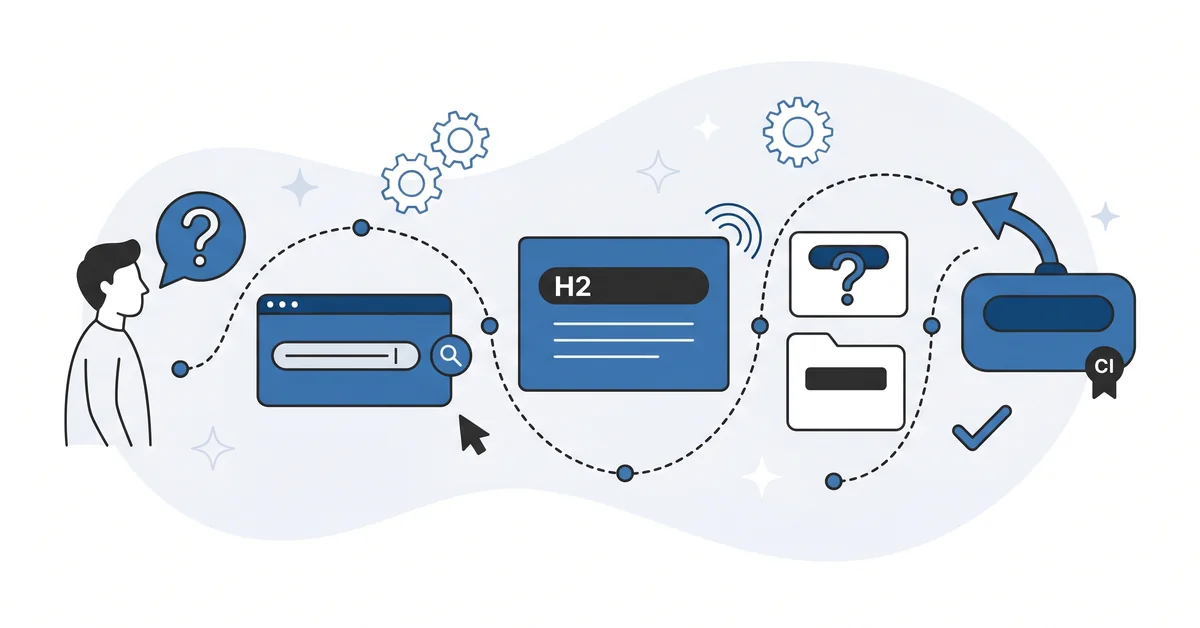
Imagine someone standing at the edge of a long hallway, calling out a question. "How much does flat-rate pricing cost?" Somewhere in the hallway, your page is sitting on a shelf. If the heading on your page echoes the question back, the AI walks toward it.
The words need to be nearly the same shape as the words just called out. If your heading says "Our Pricing," there is nothing to echo. The question passes by.
This is the thing most websites get wrong. Not the content underneath. The heading on top.
What kind of heading actually gets cited?
A heading that mirrors the exact question a customer would type into an AI. Not a concept label. "How much does email hosting cost?" beats "Our Pricing." "How long does AI citation cleanup take?" beats "Timeline."
The signal the engine is looking for is similarity between the heading and the real query. A heading that looks like the question gets reached for first. Once the heading earns the retrieval, the next decision is where to place answers underneath it.
This is a subtle but important shift. The old SEO advice told you to use the keyword in the heading. "Email hosting pricing" — four words, two of them the keyword. That was fine when search engines matched keywords.
AI engines match phrases. The difference matters. "Email hosting pricing" matches some queries. "How much does email hosting cost?" matches a whole family of them.
What is the data behind that?
Kevin Indig’s April analysis found that pages whose best heading matches the user query at 0.90 cosine similarity or above are cited at 41%. Pages below 0.50 similarity are cited at 30%. A separate February study by Victorino found H2s framed as questions correlate with roughly twice the citation rate of non-question H2s.
Two different studies, same direction.
Indig’s is the more rigorous number. Cosine similarity is a mathematical measure of how close two phrases are to each other in meaning. 0.90 is very close. 0.50 is loosely related.
The 41% versus 30% gap is not huge by itself. But citation rates at the page level compound. A ten-percentage-point lift on an H2-by-H2 basis changes the math.
You go from getting cited for two out of six questions on your page to getting cited for four. That is a real number of customers reaching you through AI answers.
So should I make every heading a question?
Not exactly. The underlying signal is matching the phrase the customer actually uses. If customers ask questions, your headings should be questions.
If customers use short noun phrases — "flat-rate pricing," "roof leak repair" — the best heading is that short noun phrase.
Match what customers type. Questions are a good default because most AI queries are conversational. They are not a universal rule.
This is where the simple version of the advice falls down. "Put a question mark on every H2" is a bumper sticker, not a rule. A page with seven question-format H2s nobody would ever type is worse than a page with seven concept headings that match real searches.
The rule is: match the phrase. Most of the time, that phrase is a question. Sometimes it is a noun phrase. Rarely is it a filing-cabinet label.
How do I find the exact phrases my customers use?
Three sources, all free. First, type your topic into ChatGPT and watch the suggested follow-up prompts at the bottom. Those are what the AI model thinks real users ask next.
Second, check Google’s "People also ask" panel for the topic. Those are real question patterns at scale.
Third, ask three recent customers how they first searched for what you do. Write down the exact phrasing. Use those phrases in your H2s, word for word where it fits.
That third one is the most useful and the most overlooked. Small business owners know what their customers need. They rarely know the exact words customers type when they go looking for it. The gap between the owner’s language and the customer’s language is usually where the heading goes wrong.
A plumber calls his service "emergency response." The customer types "24 hour plumber near me." Same service. Different words. The heading has to match the second one, not the first.
What about short, abstract headings like "Overview" or "Introduction"?
Rewrite them. "Overview" is a filler heading. It matches no real query anyone would type. The AI has nothing to reach for.
Replace it with the one question this section actually answers.
If a section has no single question, the section probably does not belong under its own H2. Merge it into a neighbor or delete it.
This is a small content-audit habit worth developing. Read your own H2s out loud as if you were a customer. Any heading that would never be typed into a search bar is doing nothing for AI visibility.
You do not need to delete the section. You need to rewrite the heading.
"Introduction" becomes "What is email hosting?" "Overview" becomes "How does AI citation work?" "Our Services" becomes a direct question about what you help people do. Same content below. Very different signal to the retriever.
Does question-format work for every kind of page?
Mostly. Service pages, how-to articles, and FAQ content benefit clearly. Category pages and landing pages are less clear. Those often need short noun-phrase headings because that is what customers search for them with.
The rule is not "always use questions."
The rule is "always match the heading to the phrase the customer would actually type."
For most content, that phrase is a question. For catalog-style pages, it is a noun phrase. The same plain-language standard applies to the body underneath the heading, which is why hedging hurts citations even when the heading is well chosen.
A page called "Emergency Plumbing Services" does not need to be rewritten as "What is emergency plumbing?" The first phrase matches real search patterns. The second phrase matches an onboarding quiz. Use judgment. The standard is customer language, not grammatical form.
Other questions worth answering
How long should each section be after I revise its title?
40 to 60 words for the answer block right under the title. Add supporting detail to round out the section. The Passionfruit 2026 analysis recommends each section be a self-contained extractable unit with definite, simple sentence structures. Kevin Indig’s April 2026 analysis of 815,000 query-page pairs found focused articles around 500 to 2,000 words win citations most often.
Should I revise old archived posts too?
Yes for posts that still drive AI traffic. No for archives no one reads anymore. Audit traffic and topic relevance, then revise the titles on the top ten or so. The Passionfruit 2026 analysis notes that AI engines favor definite language and simple sentence structures, so refreshing tired vague titles pays off most.
Does title mirroring apply to Perplexity and Claude, or only ChatGPT?
Yes for both, with caveats. Kevin Indig’s April 2026 analysis is ChatGPT-specific evidence. Perplexity and Claude both crawl the open web and chunk content by section breaks, so the mirroring logic carries over.
Perplexity weights recency heavily and prefers concrete numbers in the first hundred words. Claude tends to follow the same retrieval patterns ChatGPT uses, though no large-sample study has measured it directly yet.
How deeply should I nest subheads inside an article?
One or two levels deep, at most. Nested subheads under each main title create finer extraction units for long articles with distinct sub-topics. Victorino’s February 2026 analysis of 1.2 million ChatGPT responses found that retrieval systems chunk content by heading boundaries. Too many tiny chunks reads as thin coverage and dilutes the citation signal.
How should you rewrite your H2s to match real queries?
Pick your most-visited page. Read each H2 aloud. Ask yourself: would a real customer ever type this exact phrase into ChatGPT or Google? If the answer is no, rewrite the heading.
Use the customer’s actual words. Keep the section content unchanged. Publish.
Check the page’s citation pattern in three weeks. Most of the lift happens in the first pass.
Kevin Indig’s bigger point from the April study is worth keeping in mind. Build the page that is the best answer to one question. Not the page that adequately answers twenty. The heading is what tells the AI which one question your page actually answers.
An hour of heading rewrites on one strong page will usually do more than a full new article. You are not adding content. You are pointing the retriever to the content you already have.
The old photo and the new photo are both in the file. The echo decides which one the AI reaches for first.
If you rewrote your headings and are not sure whether they match real queries, you can contact me. Paste the list. I will tell you which ones echo a question a real customer would ask, and which ones are still filing-cabinet labels. No pitch.