Table of Contents
TL;DR
- AI copy defaults to press-release voice because the model trained on millions of press releases, product pages, and mid-range business writing — and without constraints, it reaches for that statistical middle every time.
- "Neutral voice" is not voiceless — neutral is the factory voice, the most common register the model learned to produce when nothing tells it to produce something else.
- Voice comes from five constraints stacked together: a persona reference, a reading-age target, a sentence-length cap, a refusal list of default phrases, and two examples of work that hit the voice.
- The refusal list must name the words the model actually defaults to — "leverage," "synergy," "streamline," "unlock," "utilize," "solutions," plus passive constructions like "is committed to" and "we’re excited to announce."
- "Write in a friendly tone" is a mood request, not a constraint — rewrite one prompt this week with all five constraint types and compare the output to your old version.
Feed the same AI model the same product, the same audience, the same offer on a Sunday evening. The draft comes back reading like a press release written by someone who has never used the product.
The AI model is not broken.
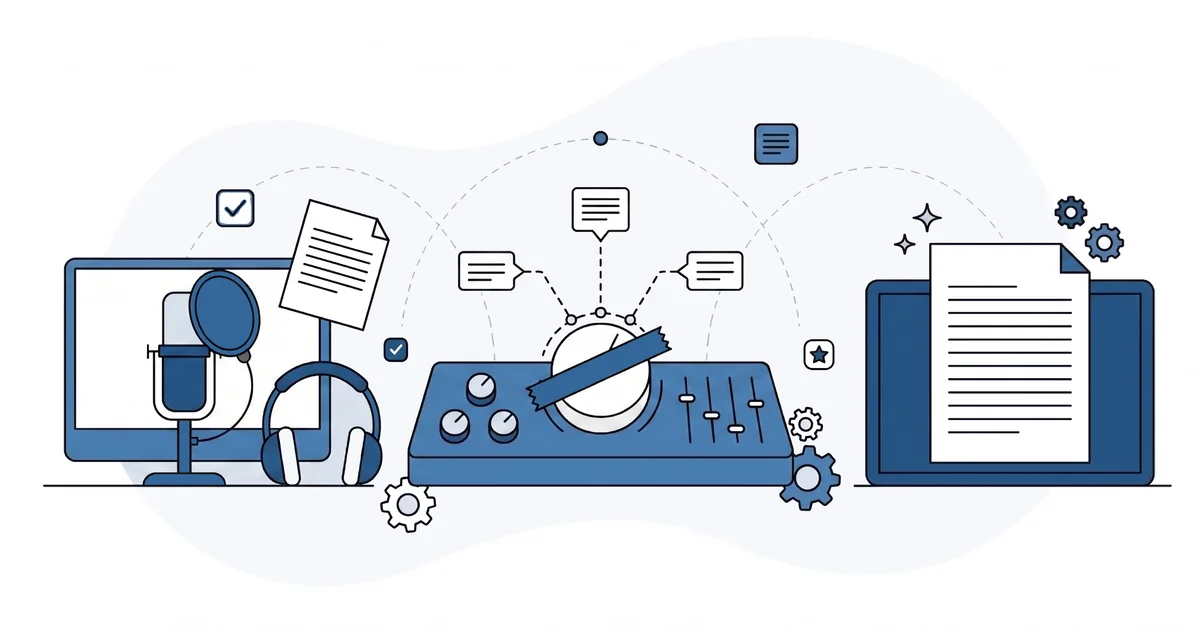
Think about the dial in a voice-actor’s studio. Between takes, if you don’t hold it at the setting you want, it springs back to neutral. Neutral is not nothing. It is the factory setting — the most commonly used voice that the studio was designed to produce by default.
The AI model has a dial too. The setting it springs back to is press-release voice — the statistical middle of every business document it trained on. Voice does not come from asking for voice. Voice comes from taping the dial in place.
Why does my AI draft always sound like a press release?
Because the AI model trained on millions of press releases.
It also trained on product pages, mid-range business blogs, LinkedIn posts, internal communications, and the kind of marketing copy that gets written by committee. Brandfolio’s February analysis names the training data plainly. "Thousands of press releases that say ‘pleased to announce.’ Millions of product descriptions with ‘innovative solutions.’ Endless LinkedIn posts about ‘driving growth and maximizing value.’"
That corpus is the statistical middle. It is what the AI model produces when you give it no other instructions.
The AI model is not choosing corporate register because it thinks corporate register is good. It is averaging. And the average of business writing is corporate register.
This is the part most writers miss. An AI model with no voice constraints does not write in no voice. It writes in the default voice, which happens to be the voice of the training-data middle.
"No voice" is a specific voice. It sounds like an annual-report executive summary because that is statistically what business text sounds like.
What does neutral voice even mean?
Neutral is the sound of everything averaged together.
Take every product description ever written for a mid-range B2B SaaS tool. Average them. The result sounds like every other B2B SaaS product description.
That is neutral. It is not an absence of style. It is the style of the training-data middle.
Neutral is also what happens when no single constraint in the prompt is strong enough to pull the AI model away from the middle. "Write in a conversational tone" is not strong enough. "Keep it friendly" is not strong enough. The AI model has read so much marketing copy that calls itself friendly and conversational that "friendly and conversational" is already part of the middle.
The dial springs back.
What does a persona reference actually do for voice?
It gives the AI model a specific register to imitate.
Research covered in The Register this March found something useful. Persona prompting — telling the AI model to write as a specific kind of person — measurably improves performance on alignment-dependent tasks.
Writing is one. Role-playing is another. Safety is a third.
"For alignment-dependent tasks, like writing, role-playing, and safety, personas do improve [AI] model performance," the piece summarized.
The same study found persona prompting hurts on knowledge-dependent tasks — math, coding, fact retrieval. MMLU benchmark accuracy dropped from 71.6% at baseline to 68.0% when told the AI model was an expert. So for claims, keep the persona out. For voice, put it in.
Why does persona prompting work for voice? Because a persona is a concrete register the AI model has seen enough of to imitate. "Write like Ogilvy’s direct-response letters" is a pointer to a specific cluster of text in the training data. "Write in a friendly tone" is a pointer to half the internet.
The more specific the persona, the tighter the voice.
What does a refusal list have to include?
The actual phrases the AI model defaults to.
Not tone adjectives you want to avoid. The literal words the AI model will reach for if you do not ban them. Search Engine Land’s January guide to brand-voice prompting names six of them with unusual precision.
- "synergy"
- "paradigm shift"
- "unlock"
- "skyrocket"
- "utilize"
- "in a world where"
Brandfolio adds "leverage," the whole "we’re excited to announce" family, and passive constructions generally.
From product-page work the list also includes "innovative," "high-quality," "seamless," "solutions," "streamline," "empower," "robust," and "world-class."
Ten to twelve banned phrases is the right size. Fewer and the AI model finds others like them. More and you spend the context window on a blocklist instead of on the actual prompt. A working starter list for that prompt slot lives in the AI-cliche list for copywriters, with the phrases grouped by where they tend to reappear.
The refusal list works because AI models are statistical. Removing the most-probable next word forces the AI model to pick the next-most-probable one. Often the second choice is better, more specific, and more recognizable as a voice.
The cliché was never the best option. It was just the easiest one.
What reading-age target should I set?
Fifth grade for consumer copy. Eighth grade for B2B. No higher than twelfth for technical copy.
Pair the reading age with a sentence-length cap. Twenty words maximum. Fifteen as a target.
These two constraints do more to defeat press-release voice than any tone adjective. Corporate register is structurally built out of long sentences and multi-syllable verbs. "The organization is committed to delivering comprehensive solutions that streamline operational efficiency across enterprise stakeholders" is a textbook press-release sentence. It is also thirty-one syllables before you get to the verb’s object.
Cap the length. Drop the reading age. The same idea becomes "Our tool saves your team time."
Different sentence. Different register. The constraint did the work.
Why does "write in a friendly tone" not work?
Because "friendly" is not a register. It is an adjective describing how copy should make the reader feel.
The AI model has no way to translate "friendly" into specific sentence patterns. It averages across everything it has seen that was described as friendly — which is, again, mostly marketing copy. So "friendly" returns marketing copy. The prompt did not actually constrain anything.
A real voice prompt stacks five constraints.
- A persona naming a specific writer, style, or publication whose voice you want to borrow.
- A reading-age target.
- A sentence-length cap.
- A banned-phrase list of eight to twelve items.
- Two paragraphs of writing that hit the voice, pasted in full.
Brandfolio’s guide recommends two to three brand-voice examples over adjective descriptions. Search Engine Land says the target is a 70 to 80 percent pass rate — three out of four drafts usable without major edits.
Both numbers point the same direction. Tone adjectives do not produce that pass rate. Stacked constraints do.
Adjectives are not constraints. Examples, reading ages, banned phrases, and specific personas are. Five of those together beat ten tone adjectives every time. The stacked constraints work best when they live in a maintained document — the voice bible as a living spec keeps the five rules current as the brand evolves.
Other questions worth answering
How many examples of past copy does the engine need before it stops averaging?
Brandfolio’s February 2026 analysis suggests two or three short samples pasted into the prompt itself. Search Engine Land’s January 2026 brand guide raises the bar for fine-tuning workflows. That guide names 5 to 15 strong samples for prompt engineering and 30 to 200 documents for retrieval-augmented setups. Pick the smaller number first.
How does an in-character framing affect factual claims inside the same piece?
The Register’s March 2026 coverage of role research found MMLU accuracy dropped from 71.6 percent baseline to 68.0 percent under an expert framing. The fix is structural. Keep numbers, product specs, and dated claims outside the character frame. Put the character around the rhythm sentences, then drop it before any factual paragraph.
Should I paste the brief’s brand examples or paraphrase them?
Paste them verbatim, between visible delimiters. Brandfolio’s February 2026 guidance treats two or three real samples as more useful than any adjective description. Paraphrased samples lose the cadence the AI model is supposed to imitate. The whole point is to give the engine a concrete cluster of text to copy.
Your paraphrase is already drifting toward the middle.
Where do I keep the banned-phrase roster so it stays current?
In a single shared document your team edits when a new cliche surfaces. Search Engine Land’s January 2026 guide frames the roster as living rules, not a one-time blocklist. Review the file every quarter.
Each draft you reject for sounding generic adds one phrase. Each phrase you stop seeing for six months can come off.
How well will a smaller language model obey these five rules versus a frontier one?
Mostly well for structural caps, less so for character imitation. A length cap or a banned word is mechanical, and any current chat assistant honors it. Character imitation depends on how much of that writer’s corpus the engine has seen.
Frontier engines from OpenAI, Anthropic, and Google carry deeper coverage. Smaller open weights miss niche characters.
What constraints should you stack in your next prompt?
Rewrite one prompt.
Take whatever product-page or landing-page prompt you used most recently. The one that produced copy you had to edit for two hours. Add five things to it.
- A persona reference naming a specific writer, style, or publication whose voice you want to borrow.
- A reading-age target appropriate to the audience.
- A sentence-length cap at twenty words maximum.
- A refusal list of eight to ten default phrases the AI model tends to reach for.
- Two paragraphs of writing that already hit the voice you want, pasted in full.
Run the same source copy through the old prompt and the new prompt. Read both drafts out loud.
The delta is what the five constraints were buying you.
Most writers are surprised by how much of the first draft is now usable. They are also surprised by how mechanical the fix was. The AI model did not learn anything new. The prompt finally told it what voice the page needed, in a form it could imitate.
The dial still springs back to neutral between takes. That is not a defect of the AI model. That is how the AI model works. Your job is to tape the dial in place every time.
If you rewrote a prompt with all five constraint types and the draft still reaches for press-release voice, you can contact me here. Paste the prompt and the draft. I will show you which constraint the AI model ignored and why.
I will also show whether the persona reference was specific enough to pull the dial off neutral. No pitch.