Table of Contents
TL;DR
- The AI draft arrives at 70 percent. The editing pass is the human 30 to 40 percent of the workflow Robin Da Silva named in his 2026 Nest Content piece. The pass closes the quality gap and the citation gap at once.
- Reverse-outline first. Read each paragraph, summarize in one sentence, read the list aloud. If the bones are broken, re-prompt — do not edit the wrong layer for the next two hours.
- Replace each AI cliche with the specific outcome it was hiding. "Lightweight design" becomes "carry it all day without shoulder fatigue." Same edit — better voice, better citation prospects.
- Add the named entity, the dated fact, and one lived-experience sentence per major section. Pages with named authors and full bios are cited 2.3 times more often per Search Engine Land via GenOptima.
- Three passes, thirty minutes per 1500-word draft. The page that ships reads as a human wrote it and earns citation lift on chat surfaces in the same edit.
The AI draft sits open on the screen. The cursor sits on the second sentence of paragraph one. Three words feel wrong, but the rest of the paragraph reads cleanly enough.
This is the moment most AI editing goes wrong.
The writer reaches for a synonym. The draft gets a polish pass. The page ships at 70 percent of what the page could have been because polish cannot fix what polish cannot see.
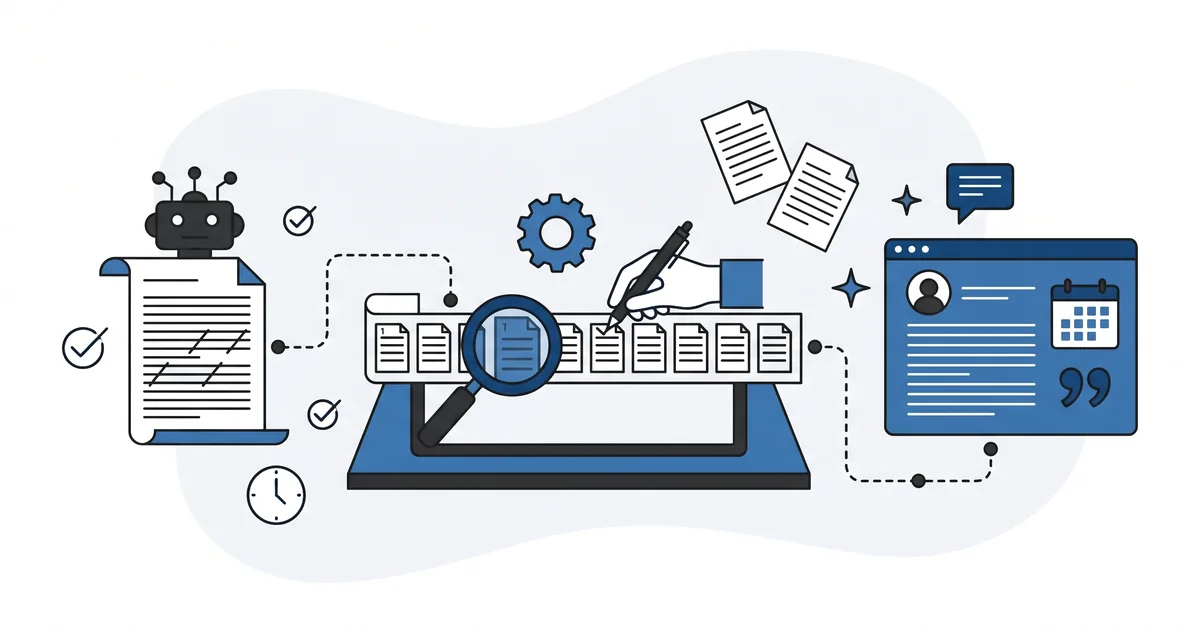
The editing pass that closes the gap is a different shape. It works on the structure first, the cliches second, the named entities and dated facts third, and the one lived-experience sentence last. Three passes.
Thirty minutes. A page that earns the buyer’s second read and the engine’s citation in the same edit.
Why does most AI editing produce bland copy with no AI tells but no voice either?
Most AI editing optimizes for one goal in isolation. Defeat a detection tool. Sand off the obvious cliches. Smooth the rhythm.
The optimized edit removes what stood out. The same edit also removes what made the page worth reading. The page ships flat.
No tells, no voice, no specifics. Bland in a different shape than the original draft was bland.
The fix is editing for two goals at once.
Voice integrity is the first goal. The page reads as a human at this specific business wrote it. The sentences carry the patterns the writer would have chosen on a hand-typed draft.
Citation quality is the second goal. The page contains the specific outcomes, named entities, and dated facts that answer engines extract when a buyer asks for options in this category.
The same edits serve both goals when the editor knows what to look for. The next sections name what to look for.
What does editing AI-generated content actually mean, in plain language?
Editing AI-generated content is the work that turns a 70 percent draft into a publishable page. Not a polish pass. Not a synonym swap. The structural-and-substantive work that closes the quality gap.
The draft arrives with the structure mostly right and the surface mostly wrong. The editor’s job has three parts.
Swap the AI cliches for specific outcomes the cliches were standing in for. Add the named entities and dated facts that ground the claims for human readers and answer engines alike. Inject the one lived-experience sentence per major section that makes the page belong to a real business with a real history.
Robin Da Silva, writing for Nest Content in April 2026, named the workflow split. AI handles 60 to 70 percent of the raw drafting. The human handles 30 to 40 percent of editing, fact-checking, experience-injection, and search-intent alignment. The editing pass lives entirely in the human share.
When editing is not the right move, see when to humanize an AI draft and when to re-prompt it.
How does the reverse-outline diagnostic decide whether to edit or re-prompt?
The reverse outline takes eight minutes.
Read each paragraph in the draft. Write one sentence describing the job that paragraph does. Put the summaries in a list, in the order the paragraphs appear.
The list is the skeleton of the draft. Read it aloud at the kitchen table.
If the argument marches from the reader’s problem to a resolution that fits, the bones are right. Humanize. The editing pass below does the rest of the work.
If the list wanders, skips the objection, or ends in the wrong place, the bones are broken. Re-prompt with the diagnosis. Name the specific break in plain words — the missing step, the misordered claim, the wrong destination.
The diagnosis gives the AI tool something concrete to act on. A vague re-prompt resamples the same average. A diagnosis-specific re-prompt rebuilds.
Eric Fiske argued in his 2026 guide to AI revision that "writing with ChatGPT is a conversation, not a command." The reverse outline is the move that decides which conversation turn comes next. Eight minutes of diagnosis replaces three rounds of editing the wrong layer.
Which AI-cliche phrases must come out before any other edit?
The cliche set dominates AI training data. The cluster shows up in nearly every raw draft regardless of the prompt.
"Synergy" and "utilize." "Innovative" and "cutting-edge." "Seamless" and "next-level." "High-quality" and "we’re excited to announce."
Each phrase replaces a specific claim with a generic placeholder. The edit replaces the placeholder with the specific outcome the placeholder was hiding.
"Innovative product design" becomes "the only carry-on bag with a removable padded laptop sleeve at this price."
"High-quality service" becomes "your homepage rewritten in three drafts over five business days."
"Lightweight design" becomes "carry it all day without shoulder fatigue."
The same edit improves voice (specific noun, no cliche) and improves citation prospects (a specific fact the engine can quote). The pattern works because the engine treats the specific phrasing as citation-worthy and the buyer treats the same phrasing as evidence rather than adjective.
One pass through the page, one cliche replaced at a time. The pass takes ten minutes on a 1500-word draft once the editor knows the cluster by sight.
Why do named entities and dated facts do double duty for voice and AI citations?
Named entities and dated facts are the parts of a sentence the AI engines cannot average away. The engine summarizing the page keeps the named entity intact because the name has no synonym. The engine keeps the date intact because the date has no abstraction.
Pages with named authors and full bios are cited 2.3 times more frequently than anonymous pages per Search Engine Land via GenOptima. 83 percent of AI citations come from pages updated within the past 12 months per AirOps. Sections with three or more statistics are cited 2.1 times more often than sections with zero statistics per the same source.
The voice payoff sits next to the citation payoff.
A page that names "Joanna Wiebe" rather than "a respected copywriter" reads as a page written by someone who has actually read Wiebe’s work. The same edit gives the engine a specific entity to cite.
A page that says "as of May 2026, the WordPress core release is 6.7" reads as a page written by someone who actually checked. The same sentence gives the engine a dated anchor that signals freshness.
The double-duty pattern is the practical case for the dual discipline. Voice integrity and citation quality are not in tension. Most edits that serve one serve the other.
For more on the voice-of-customer work that surfaces the named entities worth using, see how to identify customer pain points.
How does a single lived-experience sentence finish the edit?
The lived-experience sentence is the part of the page automation cannot supply. The customer the writer talked to last quarter. The test that ran for six weeks on the homepage. The spreadsheet that held the actual numbers.
One first-person sentence per major section is enough. More than one starts to read as performance. Less than one leaves the section sounding generic.
The sentence signals E-E-A-T to engines that weight Experience as a citation input. The sentence carries the voice tell that no AI model could have produced because the detail came from someone who watched the moment happen.
The cmswire 2026 piece on AI customer experience puts the underlying point plainly. "The first letter in AI stands for artificial," the piece argues. What customers reach for under stress is authenticity. The lived-experience sentence is the part of the page the buyer trusts most when the rest of the page is well-edited but unfamiliar.
The discipline is small. Pick one moment per section that the writer actually lived through. Write one sentence about it. Place the sentence inside the supporting paragraph below the answer block.
That one lived sentence is also where honesty lives. There is a quiet line between using AI tools well and letting them speak for you. Thinking through using AI honestly in copy keeps the page true to the person behind it.
The lived-experience sentence is the editor’s signature. It is also the citation-worthy detail the engines extract when the surrounding section reads cleanly enough to earn the extraction.
Other questions worth answering
Does it make sense to optimize for detection software like GPTZero or Winston?
No, and the case sharpens each quarter. Detection software is itself an AI model with contested accuracy and shifting criteria. Voice integrity and citation quality are the durable goals, while detection-pass chases a moving and unreliable target. Robin Da Silva’s April 2026 Nest Content piece puts the human 30 to 40 percent on the durable work, not on detection.
What shape of brief leads to the cleanest machine-drafted first output?
Six anchors carry weight: reader, awareness level, mechanism, proof order, example paragraphs, and banned-words list. Generic briefs make the cleanup harder because the writer fights missing context, not just surface polish. 5 to 15 example paragraphs land near the practical floor for voice prompting. Robin Da Silva’s April 2026 Nest Content piece frames the human 30 to 40 percent as the work that closes the quality gap.
How well does the staged polishing routine hold up if a writer ships 50 or more pieces a month?
It frays past about 50 pieces a month for a solo writer. Voice drift accumulates, the cliche radar dulls, and the lived-experience well empties. Honest scaling moves the work earlier, into the brief, where one tightened brief shapes several cleaner outputs. Whether the workflow survives at higher volume remains an open question across the 2026 practitioner literature.
How does the staged polishing routine change for short-form email versus longer landing pages?
Heavier on pruning, lighter on injection. An email runs short, so a single weak cliche carries more weight per paragraph than in a 1500-word page. The lived-experience sentence becomes a lived-experience clause, folded into the subject line or the opening greeting. Landing pages have room for the full pattern, while email has room for one anchor and one ask, well-chosen.
How does a brand spot stylistic drift across many months of human-machine collaboration?
Drift shows up early as flattening across pages. The cliches creep back, the lived-experience clauses repeat, and the rhythm narrows to one shape. A simple check helps: pull five pages shipped this month and five shipped six months back, then read aloud in alternating order. If the older pages sound more specific, the workflow needs a refresh, not the writer.
What three-step pass would you run on your next AI draft?
Three passes, in order.
Pass one. Reverse-outline the draft. Eight minutes.
Read the skeleton aloud. If the bones are broken, stop editing and re-prompt with the diagnosis named in plain language. The next two hours saved by this single pass are the difference between a productive editing session and busywork on the wrong layer.
Pass two. Replace every AI cliche with the specific outcome it was hiding. Ten minutes on a 1500-word draft once the cluster is familiar by sight. "Innovative" becomes the named feature.
"High-quality" becomes the verifiable outcome. "Seamless" becomes the actual workflow. The pass improves voice and citation prospects in one move.
Pass three. Add the named entity, the dated fact, and the one lived-experience sentence per major section. Twelve minutes. Each addition does double duty — the engine cites it, and the buyer reads it as evidence rather than adjective.
Three passes, thirty minutes per 1500-word draft. The page that ships after the three passes reads as a human wrote it and earns citation lift on chat surfaces in the same edit.
If you have an AI draft you have been polishing for an hour and the page still feels flat, you can contact me here. Send me the current draft and one sentence on the buyer the page is meant to reach. I will run the three-pass edit and explain the change in one paragraph.
There is no charge and no follow-up sales call. The page after the three-pass edit is the one that earns the buyer’s second read.