Table of Contents
TL;DR
- Search everywhere optimization is the recognition that customers no longer use one surface for every question. They use the chat surfaces, YouTube, Reddit, TikTok, and Google, and they pick the surface based on the question.
- Traditional Google top-10 results and chat-surface citations share only 8 to 38 percent of sources depending on the engine and the query category. Ranking first on Google does not guarantee being cited on the chat surface.
- Be everywhere is a budget answer to a focus problem. A small business should pick the two or three surfaces customers actually use for the question that matters and ignore the rest until those two are working.
- The two or three surfaces come from interviewing the last ten customers, not from a trade-press list of platforms. Three answers point at a pattern. Ten answers settle the question.
- Cross-surface consistency does more than new content for a small business. The same name, description, owner bio, and channel details on every surface stitches the entity picture together for both Google and the chat surfaces.
Be everywhere is the wrong play for a small business in 2026.
The trade press has spent a year selling the opposite. Be on TikTok. Be on YouTube. Be cited by the chat surfaces.
Be ranked on Google. Be present on Reddit. Build a Pinterest pipeline.
A small business with one or two people writing the content cannot do all of that. The math does not work. Six half-finished surfaces produce less business than two well-built ones. Search everywhere optimization, read honestly, is not a permission slip to be everywhere.
The honest reading is the recognition that customers have spread their search across surfaces. The deliberate choice is which two or three a small business will show up on, on purpose.
This piece is the short version of how to make that choice. How to figure out which surfaces your customers actually use. How to think about chat search inside the wider set without overweighting it.
What cross-surface consistency requires when you do show up. And which surface to start with when the budget for new content is small.
What is search everywhere optimization in plain English?
Search everywhere optimization is the recognition that your customer no longer types every question into Google.
They ask a chat surface for a summary of how something works. They search YouTube for a visual demonstration. They read a Reddit thread for honest opinions. They scroll TikTok for a quick product review.
They open Google to fact-check what the other surfaces told them. The same customer uses different surfaces for different intents inside the same buying journey.
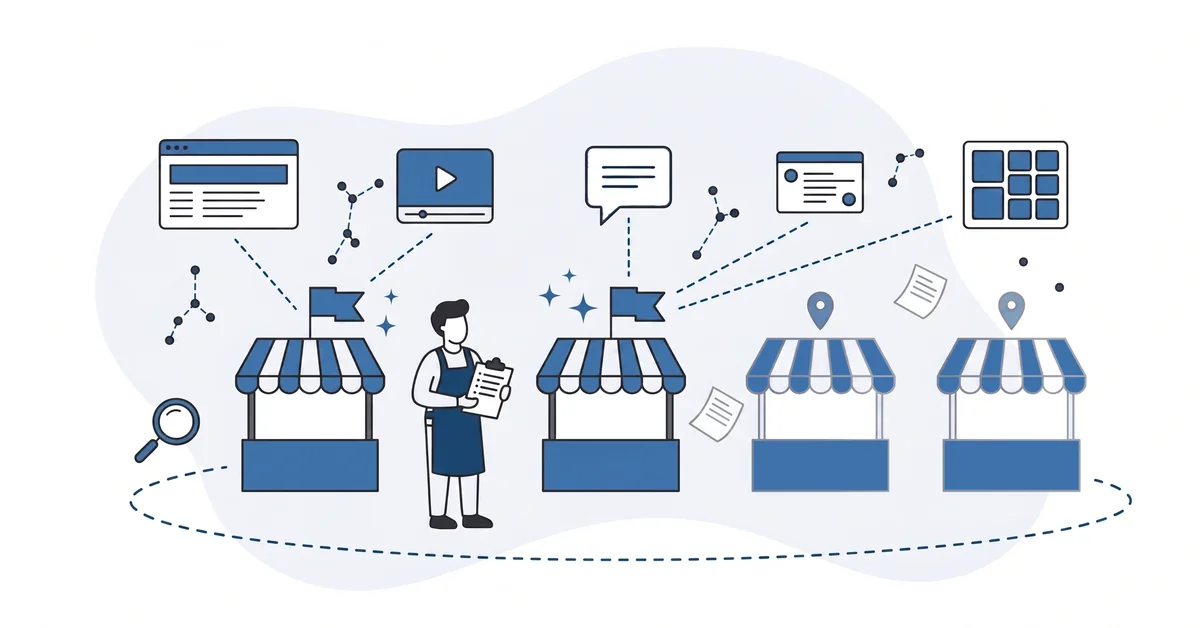
A small business that builds for one surface only is invisible on the surfaces the customer actually uses for the other steps. The good news is that the small business does not need to build for all of them. The honest version of search everywhere optimization is a deliberate pick of two or three surfaces. The pick depends on which surfaces the customer actually uses.
The phrase pretends to be additive. The practice is subtractive. You name the two surfaces that matter and let go of the rest.
Why has search fragmented across so many surfaces in 2026?
Customers stopped trusting any single source for any single question.
A buyer who relied on Google for every question in 2018 now reaches Google for the final fact-check. The chat surface gave the summary first. The YouTube tutorial showed the visual. The Reddit thread settled the trust question.
The change is not that one surface won. The change is that customers learned that different surfaces answer different intents better.
The data shows the consequence. Traditional Google top-10 results and chat-surface citations now share only 8 to 38 percent of sources depending on the engine and the query category. A site that ranks first on Google for a question may not appear in the chat summary of the same question at all.
The source pools have diverged. The shift has been quiet enough that many small business owners have not noticed it yet.
The implication for a small business is small but specific. The Google rank chart no longer tells the whole visibility story. A flat or declining Google rank can coexist with rising chat-citation visibility, or the opposite. The only way to know which is to look at both surfaces.
Why is be everywhere the wrong play for a small business?
Be everywhere is a budget answer to a focus problem.
A small business with one or two people writing the content cannot maintain a serious presence on every surface at once. Google, YouTube, TikTok, Reddit, the chat surfaces, Pinterest, LinkedIn — the labor budget does not exist. A presence on six surfaces with no real depth produces less business than a presence on two surfaces with real depth on both. The math is not subtle.
A small business with serious depth on one surface beats a generalist on six. The serious depth on YouTube means a channel with thirty videos all on the same narrow topic, a real schedule, and replies to comments.
The serious depth on chat search means a site with twenty anchor pages all answering questions inside the same niche. The pages carry the named author, the cross-linked structure, and the citations. Either of those produces inquiries. Six surfaces with three pieces of content each produce nothing.
The right question is not where could you show up. The right question is which two surfaces does your customer actually use to make this decision. The first version of that question is wrong on its face. The second version is the start of a workable strategy.
How do you find the two or three surfaces your customer actually uses?
Ask the last ten customers where they were looking before they found you.
Not where they think most people look. Where they personally looked, in order, before the day they reached out. Three customer answers point at a pattern. Ten customer answers settle the question.
The exercise takes an hour. It replaces a quarter of strategy reading with real certainty about your specific small business, not the abstract small business of the trade-press headline.
The same exercise applied to ten lost prospects often points at one surface you missed. A prospect who looked on YouTube before deciding to go with a competitor is a signal worth more than ten general posts about content strategy. The combined picture from won customers and lost prospects is your shortlist. Pick the two or three surfaces that show up most often and ignore the rest until those two are working.
The trap is the temptation to add a surface because someone in your network is doing well on it. Their customers may not be your customers. The interview method is slower than copying their list and orders of magnitude more useful.
How does chat search fit into the search everywhere mindset?
Chat search is one surface in the set, not the whole set.
For some businesses, it is the most important surface in 2026. A consulting practice whose customers research for two weeks before reaching out is reading chat-surface summaries during that research. A presence on that surface compounds quickly.
For other businesses, chat search is barely a factor yet. A coffee roaster whose customers walk in based on a Maps result almost never opens a chat surface. The honest answer depends on what the customer asks before buying.
Buying questions that look like research, comparison, or how-to belong on the chat surfaces. "Which CRM should a five-person consulting firm pick" is a chat question. "Best Italian restaurant near me right now" is still a Google or Maps question. The same split applies when you classify queries by intent for keyword research on the surface you do own.
Google AI Overviews prevalence, depending on methodology, sits anywhere from 13 to 50 percent across all queries. Honest articles report the range and the reason. The right share of effort on chat search comes from your customer interview, not from a trade-press number that picks the scariest end.
What does cross-surface consistency actually require?
Consistency is the part of search everywhere optimization most small businesses skip.
The same business name. The same owner name. The same business description. The same address and hours.
The same headshot. The same one-line tagline. On every surface where the business shows up.
The chat surfaces and the search engines build their picture of who you are by stitching mentions together across the public web. Mismatched mentions weaken the picture — matching mentions strengthen it.
The fix is unglamorous. Open every public profile that mentions the business. Rewrite the bios so they say the same thing in slightly different words but with the same name, the same role, the same one-line tagline.
Use the same headshot. Match the contact information. Add the sameAs property on the site to link the public profiles together as one entity.
A single afternoon spent reconciling the public profiles often does more for visibility than a month of new content. The reason is the entity confidence threshold. The chat surfaces and the search engines hesitate to cite a person whose public footprint reads like three different people. They cite, more readily, the person whose footprint reads as one consistent professional with a clear narrow expertise.
How do you measure visibility across the surfaces you picked?
Pick one number per surface and watch it monthly.
For Google, watch search impressions on the queries inside your topic in Search Console. Add a small set of branded queries to confirm the brand is being typed. The companion piece on free SEO measurement tools names the specific Search Console reports worth checking each month. For YouTube, watch channel impressions and the click-through rate on the videos that match your customer’s question.
For Reddit, watch for brand mentions in the subreddits where your customers gather. A saved search checked once a month is enough. For a chat surface, run the four-question prompt rotation. The rotation asks the chat for recommendations in your category and notes whether your name comes back.
Five minutes per surface per month is enough. A longer audit hides whether anything is actually moving. The five-minute version asks a single question per surface: did the number go up, stay flat, or go down compared to last month.
Three flat months in a row on a surface is the signal that the content is not landing. Revisit the topic scope before publishing more on that surface.
A high impression number with no inquiries is a vanity number, not a result. The same warning applies on YouTube views, Reddit mentions, and AI-citation counts. Inquiries are the bar. Everything else is the leading indicator.
Other questions worth answering
Should the chosen channels stay locked, or does the shortlist need a refresh?
Revisit the shortlist once a year, or sooner when an inquiry pattern shifts. Ten new buyer interviews replace guesswork. The 2026 source-overlap data shows AI engines and Google citations share only 8 to 38 percent of sources. A frozen shortlist ages fast.
What does the four-prompt rotation look like in practice on an AI engine?
Pick four phrasings of the same buying question your real customers ask. Run each prompt monthly on ChatGPT, Claude, and Perplexity. Note whether your name comes back, what competitors get named, and which sources the engine quotes. Three to six months of this log reveals whether your AEO work moved the needle.
When does a Reddit presence justify the time a solo owner spends building it?
Reddit earns a slot only when three or more recent buyers named it during interviews. The mention threshold matters. Per 2026 cross-platform-consistency guidance, your Reddit handle, bio, and link back to the site stitch the entity picture together. Without that match, posting volume buys little authority.
Does the sameAs property belong on every page, or only on the homepage?
Place sameAs once on the page that defines the entity. That is the About page for the organization entity and the author page for the person entity. Duplicating it across every post adds nothing for engines and inflates page weight. One clean declaration, linked from the schema graph, does the job.
How long before an inquiry on a new channel counts as a real signal versus noise?
One paid inquiry is a signal worth investigating. Two from the same channel inside three months is a real pattern. In 2026 monitoring practice, weeks bring the first hints, and three to six months settle the question. Silence past six months is the signal to drop that channel and try another one.
Which surface should you optimize for first?
Start with the surface that the most customers named in the interview.
Add the second one only after the first one is producing inquiries. Two surfaces working beats six surfaces partly built. The temptation is to feel productive by spreading the effort across all six.
The temptation is wrong. The math says concentration wins for a small business with finite writing time, every time the measurement gets done.
The first inquiry from a new surface is the signal to keep going. Six months of silence on that surface is the signal to drop it and try another one. The interview list gives you the order.
The inquiry test tells you when to add the next surface. It also tells you when to abandon a surface that did not work for your specific customers, regardless of what is supposed to work generally.
If you have ten customers and are not sure how to read the interview answers into a shortlist, you can contact me here. Send the list and one paragraph about what you do. I will name the two surfaces I would start with, with the reasoning. No pitch.