Table of Contents
TL;DR
- AI engines recommend businesses whose identity is confirmed by a web of linked profiles, not a single identity block on one page.
- A small business has four identity types worth linking: the Organization, the Person running it, the LocalBusiness if there is a physical address, and authored Articles.
- A vendor case study of 60+ enterprise customers measured a 46% impressions lift and 42% clicks lift for non-branded queries after entity linking, with 336% and 390% CTR gains on specific healthcare queries.
- The "300% accuracy lift" claim that circulates in AEO guides has no methodology, no sample size, and no traceable study — the direction holds, the multiplier does not.
- Fill the identity block, add a Person profile for the founder, and list every external profile in the sameAs field — LinkedIn, Crunchbase, Google Business Profile.
Two people apply for a loan.
The first hands the banker a business card. Name. Company. Phone.
The banker has one source for every fact on it.
The second hands the banker a folder. Business card, yes. Plus a LinkedIn profile that names the same company. A Crunchbase entry that names the same founder.
A professional certification that names the same person. A company website with an About page that names the same city. A Google Business listing that names the same address.
Same three facts, different weight. The banker can verify the second person six different ways. She can verify the first person once.
AI engines recommend businesses the way that banker approves loans. Not by the strength of any single claim, but by how many places the same story lines up. A site with one identity block is the business card. A site with linked identities is the folder.
This is why businesses with clean identity markup still get skipped when their competitors have linked identity markup. The first did some of the work. The second did the connecting work. The AI noticed the difference.
Why does one identity block not recommend me by name?
Because AI engines check identity claims the way people check references. One fact on a page is a claim.
The same fact repeated across your website, LinkedIn, Crunchbase, and Google Business Profile becomes a pattern the engine can verify. Each identity links to the next.
A single identity block makes the claim. A web of linked identities confirms it. Only the confirmed ones get cited by name.
When the AI decides whether to recommend you to a user, it does a quick sanity check. Does this business look like one real entity described consistently across multiple places? Or does it look like one lonely page making a claim nobody else has echoed? Loneliness loses.
What does "connecting entities" actually mean?
Every business has more than one identity worth naming.
The business itself. The person who founded or runs it. The physical location, if there is one. The product or service.
Each of these can carry its own identity block.
The connections between them are what AI engines read as the underlying story. This business is run by this person. Located at this address. Offering this service.
Facts in isolation are weaker than facts in relationship. "Alice runs a consulting firm" is one fact.
Now take a longer version. Alice worked at Vector Labs for eleven years. She founded Lambert Consulting in 2019. Lambert is based in Portland and serves healthcare.
That is a small graph.
The AI can check every segment of that graph against other sources. If the segments line up, the recommendation becomes safe.
The graph, not the piece
Think of your identity information as a graph, not a page.
The page is where a human reader lands. The graph is the invisible structure underneath, connecting named things to named things.
AI engines do not recommend pages. They recommend named entities. The graph is how they decide which named entity the page represents and how much to trust that identity. Writing a verifiable About bio is one of the most concrete places to start strengthening that identity-level trust signal.
One practitioner puts it plainly. Entity-based search lives in the internal linking between named things, not in any single hero post. You can have the best-written About page on the internet.
If it is not connected to your other named identities, the AI has to decide whether to trust it alone. Alone is rarely enough.
What does the data show?
A vendor that sells entity-linking tooling ran a study on more than 60 enterprise customers across healthcare, finance, and B2B technology.
One healthcare page saw click-through rate gains of 336% on the query Amoxicillin rash. It saw 390% on Rash from amoxicillin. Both lifts came after medical concepts were linked to known entities, per Schema App’s entity-linking case study.
A separate test tracked 11 location pages against four control pages over 85 days. The pages with full entity linking saw a 46% impressions lift and a 42% clicks lift for non-branded queries.
These numbers come from the vendor selling the tool. That matters. Vendor-measured data with a named sample and a control group is more credible than unsourced claims, but less credible than independent replication.
The direction is worth trusting. The exact multipliers should be read as indicators, not laws.
The important part is not the size of the lift. The important part is that the lifts happened on non-branded queries. The user did not type the company’s name.
And still got served that company’s page. That is the mechanism in action.
An example: a one-person consulting business
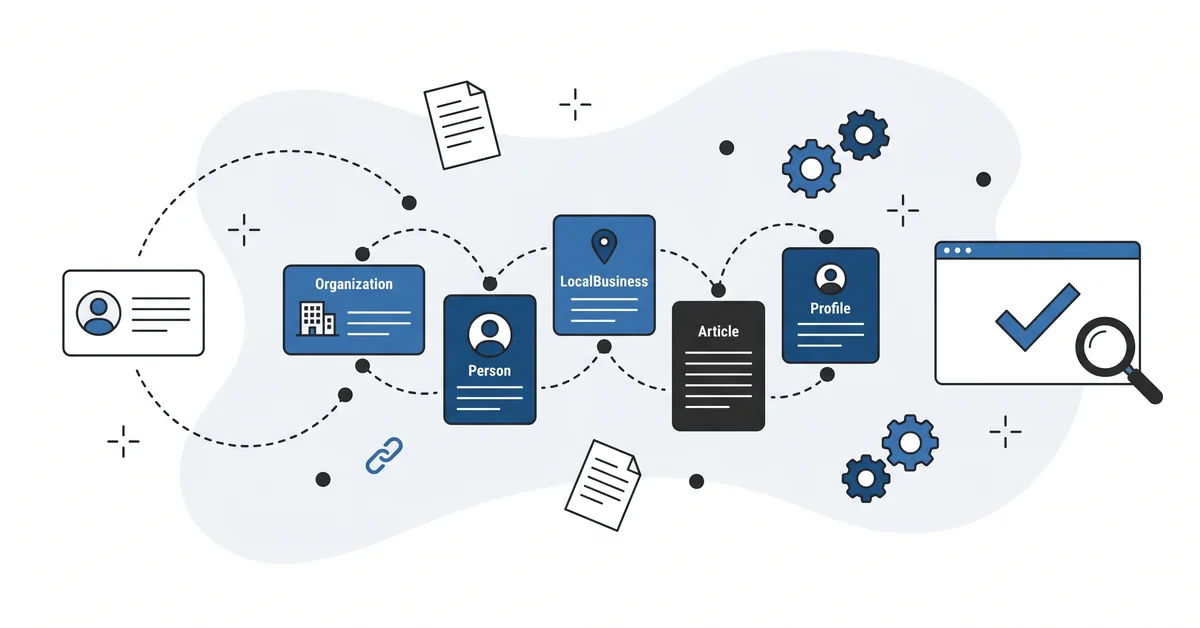
A consultant with a website can have four linked identities.
Her business, marked as an Organization. Herself, marked as a Person linked to that Organization as its founder. Her physical office, marked as a LocalBusiness. Her articles, marked with her as the author.
Each of those, individually, is a claim. Connected, they form a small graph the AI can verify against her LinkedIn, her Crunchbase profile, and any directory listing she appears in.
She moves from "a consultant with a website" to "this specific consultant, verified three different ways."
This is a one-afternoon job for a consultant. The technology is built into every modern SEO plugin. What takes longer is making sure the connecting information is accurate.
That her LinkedIn bio actually says the same thing as her About page. That the founding year on her site matches the founding year on Crunchbase. That her name is spelled the same everywhere.
Why the "300% accuracy" claim is worth ignoring
A few AEO guides claim that linking entities to a knowledge graph improves AI accuracy by 300%. The figure sounds striking.
It also has no methodology, no sample size, and no traceable study behind it.
The underlying direction — that linked entities outperform isolated ones — is supported by the vendor-measured healthcare and location data above. Practitioner consensus supports the same direction. The specific 300% number is not.
This is worth naming. AEO content in 2026 is full of confident-sounding numbers that fall apart when you look for the source. If a guide cites a percentage, check whether the source is named.
Check whether there is a sample size. Check whether there is a control group. If none of those are there, the number is atmosphere, not evidence.
Believing atmosphere is how you end up building a strategy on nothing. A direction backed by three different honest sources is worth more than a huge-sounding number backed by none.
How much of this can a small business realistically do?
Most of it.
The first two identities — the business and the founder-as-Person — are handled by any modern SEO plugin. The linking between them is often a single checkbox.
Adding a LocalBusiness identity takes another few minutes if you have a physical location.
Linking your profiles across LinkedIn and Crunchbase is a one-time sameAs list.
The real work is keeping the information consistent, not writing it. Small businesses are actually at an advantage here: fewer moving parts, less legacy inconsistency, fewer people to coordinate. A consultant with a WordPress site can do in one afternoon what a multi-location brand spends weeks coordinating. It is one face of the broader small-business advantage in AI search — the same agility that wins the entity graph wins the citation.
Other questions worth answering
What happens when your founding year on LinkedIn differs from the year listed on Crunchbase?
Per the 2026 Hypesuite guide, the trust signal lives in repetition across separate places, not in any single profile. AI engines lose confidence when sources disagree. The engine cannot decide which version is real. It picks a competitor whose dates match everywhere.
Profiles say different founding years. Fix the cheap stuff. Pick the true year. Update every profile to match.
The lift shows within a few weeks.
Which validators should you run after editing your site’s structured markup?
As of mid-2026, two validators handle the work. The Google Rich Results Test confirms what Google understands. Schema.org’s own validator confirms what every other engine sees. If both pass, your markup is safe across the spectrum.
Most modern SEO plugins also include a preview pane. Use that for quick checks during edits. Save the two external tools for the final pre-publish pass.
Does picking ‘Dentist’ as your tag instead of a broader healthcare label change how AI engines see your practice?
Yes, and the lift is steady. Specific tags like Dentist or Plumber tell the engine exactly what kind of work you do. Generic tags force the engine to guess.
In 2026, a user typing ‘root canal in Boise’ lets Google match a Dentist tag above a MedicalBusiness one. The engine prefers the precise option every time. Narrower tags win cleaner matches.
How long should you expect before AI engines start citing the updated profiles?
No public 2026 study measures this window directly. Some sites see lift within weeks. Others wait two months or more. The shape depends on how often Google re-crawls and how many directories you fixed.
A practical default: budget eight to twelve weeks before judging whether the work moved anything. That gives Google time to refresh, and AI engines time to absorb the refresh.
Which entity identities should you wire up first?
Open your site’s SEO settings.
Check that the business identity is filled in. Then check whether there is a separate Person section for you as founder or author. Fill that in too.
Add links between the two. You work for the business. The business was founded by you.
Then list every external profile you have in the sameAs field. LinkedIn. Crunchbase. A professional directory.
A bar association. Whatever applies.
An hour’s work, once. The payoff is that the AI has more than one fact to verify you against. The business card becomes the folder. The loan officer starts saying yes.
If you are not sure which identities apply to your situation, you can contact me. Same if you are not sure whether your plugin is actually writing them in the background. I will look at your site, see which identities are missing, and show you which external profiles should be listed.
No pitch. Just the map from the business card you have now to the folder the AI is looking for.