Table of Contents
TL;DR
- AI engines stopped rewarding scale and started rewarding depth, so a small site with ten pages on a narrow topic now outperforms a large brand with one shallow page on it.
- Kevin Indig found the top 30 domains own 67% of AI citations in a given topic, yet a single learn.g2.com page ranked for 65 prompts and earned 495 citations — more than major brand portfolios in the same category.
- Pages ranking first on Google are cited by ChatGPT 43.2% of the time, about 3.5x the rate of pages beyond Google’s top 20 — rank still signals but no longer gates citation.
- The E-E-A-T hierarchy has reshuffled: Experience and Expertise lead in AI citation data while Authoritativeness (domain scale, backlinks) now carries less weight, though peer-reviewed evidence on author signals remains thin.
- Pick the one topic your readers ask about most, publish ten linked pages on it with a named author and recent updates, and let depth do the work scale used to do.
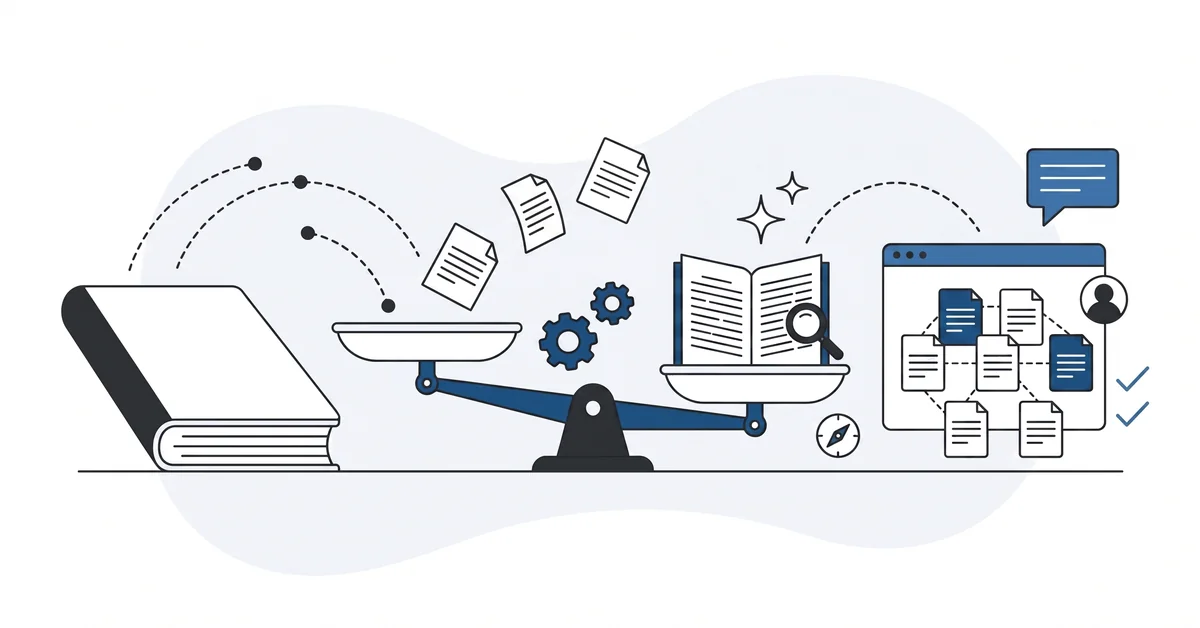
Imagine two books on the same shelf.
One is an encyclopedia. It has an entry on every topic — short, confident, competent. The entry on your subject is three paragraphs long.
The other is a field guide. It covers one subject only, written by one person who has spent forty years in one forest. The guide on your subject is two hundred pages.
It names specific species. It describes what the author saw in a specific year. It tells you why one thing happens in one place and not another.
If you need to identify a mushroom, which book do you open?
AI engines are reading the same way now. They used to reach for the encyclopedia. That was the era when scale won. They now reach for the field guide.
This is not metaphor. It is measurable, and it is the reason a small site with a real practitioner behind it can outrank a much larger competitor.
Why can a small site outrank a big one now?
Because AI engines stopped rewarding scale and started rewarding depth.
A big site usually covers a topic in one page. The page has a few paragraphs, was written once, and is rarely updated. A small site run by a real practitioner often has ten pages on the same narrow topic.
The AI engine reads both and cites the deeper one.
Scale built shelf space. Depth builds trust. The reshuffle is that trust is now the scarce resource.
What did AI engines actually change?
They changed what they look for. The old Google ranking rewarded authoritativeness — domain age, backlink count, site size.
AI engines still use those signals, but they weight them far less. The new weight is on experience and expertise.
That shift is not a small tuning. It reorders the entire hierarchy that SEO built over twenty years.
A page does not win by being on a bigger domain. A page wins by knowing more about a narrow thing than anything else online knows about that same narrow thing.
What does the data actually say?
Kevin Indig analyzed citation patterns across ChatGPT responses in early 2026. His findings are specific.
The top thirty domains own sixty-seven percent of citations in a given topic. Concentration is still real.
But the same study found something else. A single well-structured page on learn.g2.com ranked for sixty-five different prompts and earned four hundred and ninety-five AI citations on its own. That single page outperformed the citation portfolios of well-known brands in the same category.
The headline is not "small always wins." The headline is "depth beats scale, even when scale still has more inventory."
His one-line summary of the whole paper is the one to remember. Breadth of topic coverage matters more than domain authority.
Does domain authority still matter?
It matters. It just matters differently.
In the same data, pages ranking first on Google are cited by ChatGPT about forty-three percent of the time. Pages beyond position twenty are cited roughly one-third as often.
Rank still works as a signal.
What changed is that being on a big domain does not automatically put you in the rank-one slot for your customer’s specific question. The big domain covers a thousand topics shallowly.
You can own one topic deeply. That is a different game, and it is now the game AI engines reward first.
What kind of small site actually wins?
The kind with a real person behind it.
Named author, named experience, specific claims that could only come from someone who has done the work. A page might say: I have been repairing vintage typewriters for eighteen years. Here is what usually goes wrong with a Smith-Corona Silent. That page will beat a generic topic summary every time.
AI engines are trained to recognize the difference between that kind of page and a collection of stitched-together paragraphs.
The specific one gets cited. The generic one gets read and passed over. The companion piece on writing an About bio is the practical version of this — how to write the named-author signal so AI engines pick it up.
How does a single page outperform a whole brand?
The learn.g2.com example is worth sitting with for a minute.
One page. Sixty-five different customer questions answered on that page. Four hundred and ninety-five citations collected by that single page over the study window.
It worked because the page covered its topic so completely that an AI engine had no reason to stitch together three different sources. One page, one answer, every adjacent question resolved on the same screen.
That is the template you can copy.
Not "write more blog posts." Not "publish weekly." Write one page that covers everything a customer might ask about one topic, and keep updating it.
Is this reshuffle permanent?
Honestly, nobody knows yet.
The peer-reviewed evidence on author-level authority signals in AI citation is thin. The Princeton and Georgia Tech team that published the first rigorous AEO paper in 2024 tested content optimizations, not author signals.
What we have is strong practitioner consensus plus one or two large-scale studies.
That is enough to act on. It is not enough to call permanent.
Building for depth is low-risk either way. The reshuffle may evolve. The habit of owning a narrow topic deeply will still pay. Readers benefit from that kind of page regardless of how any algorithm weights it.
Other questions worth answering
How much do citations overlap between Google’s Overviews and Google’s Mode surface for the same query?
Ahrefs’s December 2025 analysis of 730,000 AI-generated responses found only 13.7% of citations overlap between AI Overviews and AI Mode for identical queries. The two Google surfaces cite substantially different sources. A page that wins one may lose the other entirely. Treating Google as a unified channel hides the difference.
Where should the writer’s experience be documented for citation lift?
Two surfaces matter: a dedicated About page and a custom author profile, not the default CMS archive. InPress International’s 2026 read on E-E-A-T finds Experience and Expertise lead while Authoritativeness has dropped. Both surfaces feed Google’s Knowledge Graph and what ChatGPT extracts as raw text.
How does freshness affect a published essay’s citation likelihood?
More than 70% of pages cited by ChatGPT and Google were updated within the prior 12 months. Pages going three months without an update lose visibility quickly. Quarterly review costs little. Touch each piece in 2026, refresh the date, and correct what changed since publication.
Which narrow topic should you build a cluster around?
Pick the one topic your readers ask you about most. Not the topic you wish they asked about. The one they actually keep raising.
Write ten pages on that topic, not one. Each page answers a related question a real customer has asked.
Name the author on every page. Show the experience plainly. Link the ten pages into a small cluster. Those links form the kind of entity graph AI engines recognize — ten connected pages read as one coherent expertise signal.
That cluster is your depth.
It is the thing a big brand cannot fake by spending more budget. It is also the thing AI engines now reward before they reward anything else.
The encyclopedia still exists on the shelf. It is not going anywhere. But the reader who actually needs to identify the mushroom is reaching for the field guide.
If you want help figuring out which one topic your small site should own, you can contact me. I will read your site with you and point at the narrow thing you already know deeply. No pitch, no sign-up, no sales.