Table of Contents
TL;DR
- GA4 can only report what the browser hands it, and most AI apps pass no referrer, so AI-driven visits land in Direct instead of AI Referral.
- Loamly dataset of 446,405 visits found 70.6% of identified AI traffic arrived with no referrer and was filed as Direct in GA4.
- Dark AI traffic converts at 10.21% versus 2.46% for non-AI traffic — 4.1x higher — and that performance disappears into the Direct channel.
- ChatGPT began appending utm_source=chatgpt.com to desktop citation links in June 2025, but mobile app traffic still passes nothing and Google AI Overviews clicks arrive as google/organic.
- Stop relying on GA4 for AEO measurement, pick ten customer questions, and run them monthly in ChatGPT, Perplexity, and AI Mode, logging citations in a simple table.
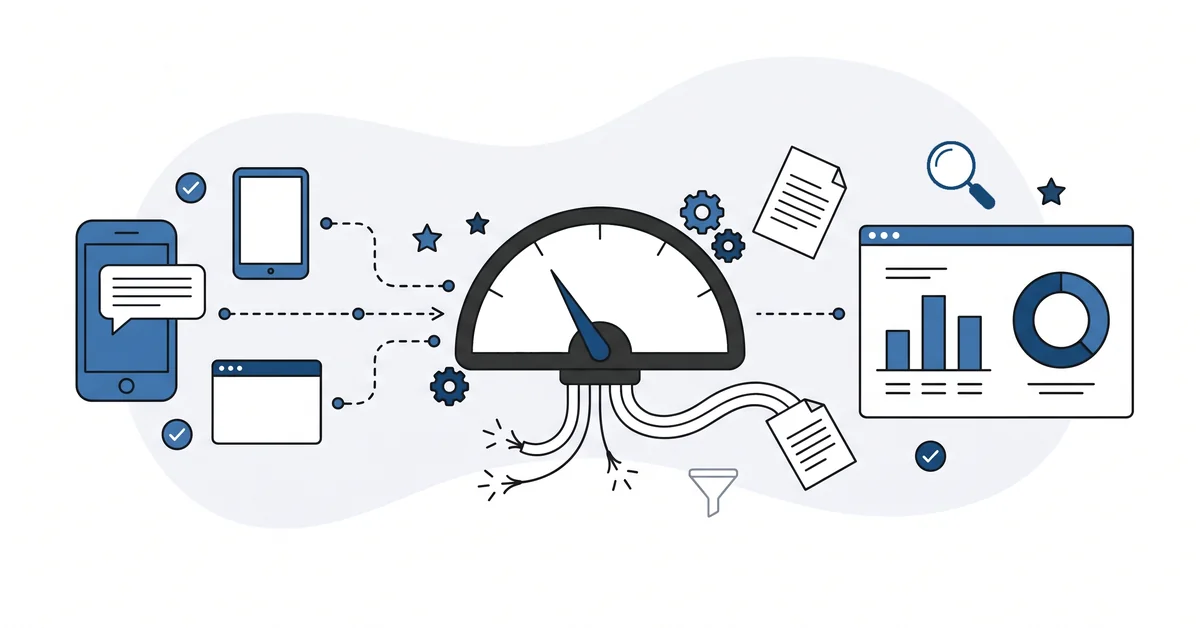
Imagine a speedometer with half the wires cut.
The needle still moves. The numbers still look believable. Glance at it and you would never guess anything was wrong.
But only half the signal is making it through. The other half is happening under the hood, uncounted, invisible to the dial.
That is Google Analytics, in 2026, measuring AI traffic.
You see the floor. You do not see the ceiling. If you trust the dial and decide AI traffic is small, you are mistaken about something the dial was never built to measure.
Why does GA4 show almost no AI traffic?
Because GA4 can only report what the browser tells it.
A reader clicks a link inside a ChatGPT app. Or pastes a URL from a Claude conversation. Or clicks a Google AI Overviews answer. In each case, the browser often passes no referrer at all.
GA4 then files those visits under Direct. That is the default for any session with no origin.
The visit happened. The source did not.
How much AI traffic is actually invisible?
About 70 percent, in the only large-scale published dataset.
The analytics platform Loamly looked at 446,405 visits. It isolated 20,428 AI-driven ones. Of those, 14,413 arrived with no referrer and were filed as Direct.
That is 70.6 percent.
In other words, for every AI visit GA4 shows you, roughly two more arrived and got filed somewhere else.
If your Direct channel looks larger than it used to, this is most of the reason.
What is "dark AI traffic," exactly?
It is AI-driven traffic GA4 cannot see as AI-driven.
A reader asks ChatGPT a question. ChatGPT cites your page. The reader clicks, reads, and buys. GA4 sees a session with no referrer and files it under Direct.
The visit is real. The conversion is real. The credit goes nowhere.
In the Loamly dataset, dark AI visitors converted at 10.21 percent. Non-AI visitors converted at 2.46 percent. That is 4.1 times higher.
That performance gets averaged into the Direct channel. The Direct channel still looks boring. The actual driver is hidden inside it.
One industry write-up called GA4’s Direct channel "an error state, not a channel." That is close to literally true for AI traffic today.
Why do mobile apps lose the referrer at all?
Because mobile apps open links in a sandboxed browser that does not pass the referrer header.
ChatGPT on iOS and Android does this. So does the Atlas browser OpenAI ships inside ChatGPT. Claude and Gemini behave inconsistently — sometimes they pass, sometimes they strip.
Perplexity’s Comet browser is the outlier. It passes the referrer cleanly. A Comet visit shows up in GA4 with source perplexity.ai and medium referral, the way a normal website link would.
None of this is a GA4 bug. It is how the apps were built. GA4 can only report what the browser hands it.
What about Google AI Overviews and AI Mode?
Those are worse.
Google does not pass a distinct referrer for AI Overviews clicks. The click arrives at your site labelled google / organic — the same label a regular Google search click gets. AI Mode behaves the same way.
You cannot tell AI Overviews clicks and regular search clicks apart in GA4. The traffic is there. The attribution is not.
And a visit that never happens, because the AI answered the reader’s question in full and they never clicked, never shows up at all. That is the zero-click case. It is the largest category and the least measurable.
This is also where old habits trip people up. You might see your business named inside an AI answer and count it as a win. But a mention is not a click, and a click is not a sale. It helps to understand why impressions are not visits before you judge your numbers.
Is this getting better on its own?
Slowly.
ChatGPT began appending utm_source=chatgpt.com to desktop citation links in June 2025. That made desktop ChatGPT visits visible in default GA4 reports as Referral for the first time.
Mobile app traffic still passes nothing. Historical citations from before June 2025 remain unattributed. Claude, Gemini, and Perplexity have not matched the change at the same level of consistency.
The floor is rising. The ceiling is still mostly hidden.
You will probably see GA4 become less wrong, over years, as the major apps add attribution. You should not wait for that to happen before you start measuring AEO.
If the data is broken, how do I measure AEO?
With a manual monthly pass, not with a dashboard.
Pick ten queries a real customer would ask. Not branded. Ask them in customer language.
Run each one in ChatGPT. Run the same one in Perplexity. Run the same one in Google AI Mode.
For each result, record four things.
Was your business cited? Was the answer accurate? Which competitors appeared? Which sources did the engine quote?
Save the results in a simple table. Repeat the same pass next month.
Over three to six months, the pattern tells you whether the work is moving. A new citation is a signal. A lost citation is a signal. A competitor appearing where you used to is a signal.
If you want the single-query version as a starting point, I wrote about how to actually check AI citations a few weeks ago. That piece walks through one query end-to-end. This one extends the habit to a monthly routine across three engines.
Other questions worth answering
Which pages on a small business site pull the biggest share of citation clicks?
Industry, tools, and pricing pages. Per Nadia Mohamed’s March 2026 analysis, industry pages pull 1.14 percent of total visits from AI engines. Tools pages pull 0.95 percent. Pricing pages 0.46 percent.
Site-wide baseline is 0.13 percent. That is 4 to 9 times the baseline rate. The visible floor misleads if you read only the site-wide number.
Why has the Direct channel become unreliable as a sign of typed-in visits?
Because every browser session arriving without a referrer header gets dumped there. Per SearchSignal’s January 2026 framing, the Direct bucket has become an error state, not a channel.
The composition has changed underneath. A growing Direct number usually means more silent attribution loss, not more genuinely direct visitors.
Can server logs fill the gap that browser-level analytics leaves behind?
Partly. Server logs record the user-agent string of every request, which is harder to strip than a referrer header. A request from ChatGPT-User or PerplexityBot shows up plainly in raw logs, even when the front-end session lands in Direct.
The catch: most small business sites do not retain raw logs by default. Useful as a spot-check, not a daily habit.
Which surfaces besides search engines also strip origin headers and end up filed under Direct?
Per SearchSignal’s January 2026 analysis, in-app browsers and encrypted messaging are the big culprits. Instagram, TikTok, and LinkedIn open links inside their sandboxed browsers that pass nothing through. WhatsApp, Signal, and iMessage behave identically by design.
When you see Direct climbing, AI engines are one source. The chat apps and the platform browsers are likely a much larger one.
How should you replace GA4 for AEO measurement?
Open GA4 once.
Check the Direct channel. Notice that it is larger than it used to be. That is your floor of dark AI traffic.
Then stop relying on GA4 for this question at all.
Open a clean document. Write ten customer questions across the top.
Run each through ChatGPT. Then Perplexity. Then AI Mode.
Record the results in a table. Save the document somewhere you will open it again in a month.
That is your real dashboard for AEO. It is more work than a chart in GA4. It is also the only dashboard that currently sees what you need it to see. The four-surface test for AI visibility extends this dashboard with chat, search, AI Overviews, and the citation graph as separate surfaces.
The speedometer is fine for the highway. It is not fine for the other half of the engine.
If you want a second pair of eyes on a first-pass table, you can contact me. I will help you pick queries, watch the right competitors, and read the patterns. No pitch. No sign-up.