Table of Contents
TL;DR
- ChatGPT and Perplexity share only 11% of cited domains for the same query, and 71% of AI-cited sources appear on exactly one platform.
- Google’s own AI Overviews and AI Mode overlap on just 13.7% of citations — two products, two different answers.
- Each engine has a different preferred source pool: Wikipedia (ChatGPT, 47.9%), Reddit (Perplexity, 46.7%), YouTube (AI Overviews, 23.3%).
- A one-engine check feels conclusive but describes about a quarter of your real AI visibility — often less.
- This week, run one non-branded customer question three times in all four tools and write down the four different lists you get.
Eleven percent of the domains ChatGPT cites for a given question also appear on Perplexity.
That number is the reassurance problem. Most owners test one AI engine, see their name, close the tab, and feel covered. The single engine they tested describes about a quarter of their real AI visibility.
Not because ChatGPT got the answer wrong. It may have got it perfectly right. The problem is that ChatGPT is one of four places a customer might ask the same question.
And the other three answer differently. Sometimes very differently.
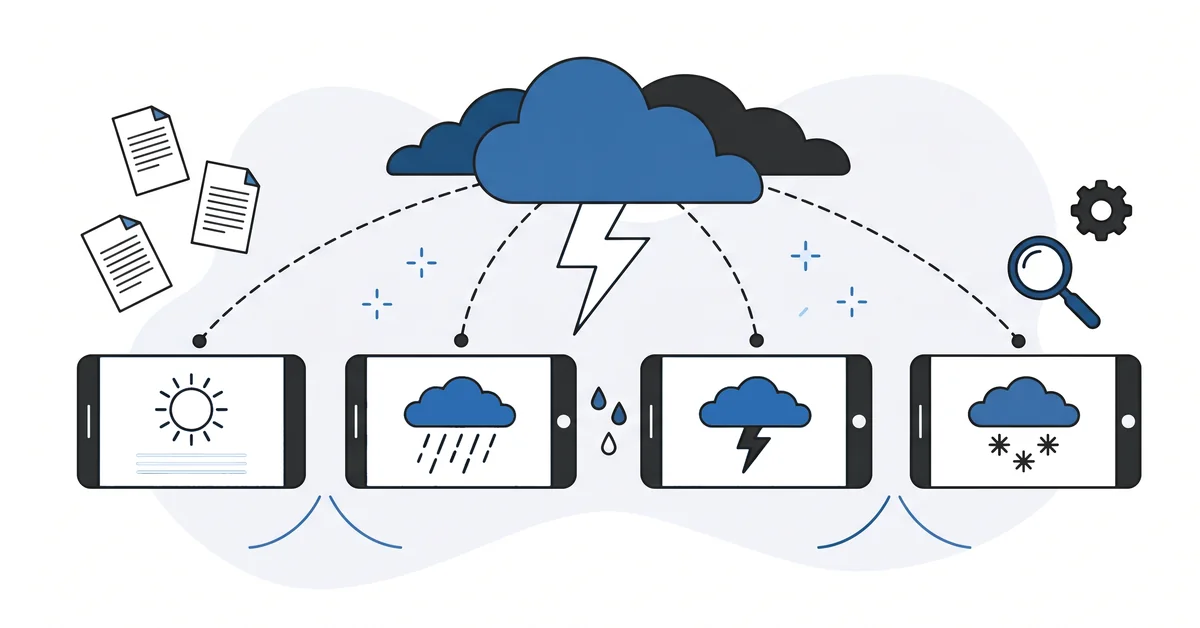
Think of four weather apps forecasting the same storm. They pull from overlapping but not identical data. They weigh recent readings differently. The app on your phone says sunny.
The app on your partner’s phone says heavy rain at three o’clock. Both are real forecasts. Only one of them matches what actually happens.
Your AI visibility is like that. Testing one engine is checking one app. It tells you a story. It does not tell you the weather.
What does "four-surface test" mean?
Four surfaces means four different AI tools that customers actually use — ChatGPT, Google AI Overviews, Google AI Mode, and Perplexity. Each has its own index, its own preferred sources, and its own citation style. Testing only one of them tells you what that one tool thinks of you. It does not tell you what the other three think, and the other three disagree more than most owners expect.
ChatGPT sits at chat.openai.com. Most people have used it.
Google AI Overviews is the summary box that sometimes appears above regular Google results. You have seen it without looking for it.
Google AI Mode is a separate Google product, reached by clicking the "AI Mode" tab in Google search or visiting google.com/aimode. Most small business owners have never opened it, even once.
Perplexity sits at perplexity.ai. Free. No account required.
Inline citations on every answer. If I could only send a small business owner to one AI tool for their first audit, I would send them here — because it is the engine they have never checked, and checking it always teaches something.
How much do the four engines actually disagree?
Only 11% of domains cited by ChatGPT are also cited by Perplexity for the same query. Google’s own AI Overviews and AI Mode overlap on just 13.7% of citations. Seventy-one percent of sources appear on exactly one platform and nowhere else. The four engines are not variations of the same answer — they are four different answers.
Read those numbers slowly.
Eleven percent. When ChatGPT and Perplexity answer the same question, they agree about where to get the answer only about one time in nine. The rest of the time, they are pulling from different sources entirely.
And the 13.7% figure is the more surprising one. Google AI Overviews and Google AI Mode are both Google products, running on related Gemini models, drawing from Google’s own index. They still disagree about source selection for the same query seven times out of eight.
If you had to describe AI visibility in one sentence, it would be this: there is no such thing as general AI visibility. There are four separate visibilities, and they do not average out.
Why do they diverge so sharply?
Because each one looks at the web through a different lens. ChatGPT leans heavily on Wikipedia and Bing’s index. Perplexity runs a live search and favors Reddit, YouTube, and community-verified sources.
Google AI Overviews draws from Google’s standing index. Google AI Mode decomposes the question into many sub-queries and synthesizes across them. Different paths, different destinations.
Each engine’s path determines what it can find.
ChatGPT does not crawl the whole live web for every question. It leans on Bing’s index and its own crawler’s snapshot. If Bing has not indexed you, most ChatGPT answers will not either. Wikipedia shows up in 47.9% of ChatGPT’s top citations because Wikipedia is deeply indexed and trusted.
Perplexity is different. It runs a live web search for every single query. That is why recent content can appear in Perplexity within days.
It weights community voices heavily — Reddit is its top source at 46.7% of citations. A YouTube explainer about your industry can outrank your own site there.
Google AI Overviews uses Google’s own index, the same one behind regular search. YouTube is its top source at 23.3%. Google AI Mode goes further — it breaks one question into eight or more sub-questions and searches them in parallel, then stitches a synthesized answer. The sources it reaches are often ones that would never rank in a plain Google search.
Four tools. Four different reading habits. The how AI engines find content walkthrough lays out each engine’s index, crawler, and retrieval mode.
What happens if I only test one?
You get a confident answer about one-quarter of your visibility. Maybe less. You might see your business cited on ChatGPT and assume AI in general knows you. Meanwhile Perplexity and both Google surfaces might show nothing.
Or the reverse. A one-engine check feels conclusive because there is no reference point. Its main failure mode is false reassurance.
The common pattern looks like this.
The owner tests ChatGPT because they have heard of it. Their business name gets mentioned. They feel covered.
Six months go by. A customer asks Perplexity the same question and gets a competitor. The owner never knew, because they never looked there.
The reverse pattern is just as common. A business owner tests ChatGPT, sees nothing, panics, and writes off AI as unreachable. Perplexity was actually citing them correctly the whole time. They did not know to look.
One-engine testing produces two kinds of error. False comfort and false alarm. Only a four-surface test produces a real picture.
The same caution applies to the advice you read about all this. A confident claim built on one engine, or one test, or one client, is a single snapshot dressed up as a rule. Learning to judge if AEO advice is trustworthy saves you from chasing tips that were never measured well. Ask what the claim was tested against.
Which engine should I start with if I only have thirty minutes?
Perplexity. Not because it matters most, but because it is the engine most small business owners have never opened. It is free, no account needed, and it shows inline citations for every answer. Thirty minutes in Perplexity teaches you more about AI visibility than thirty minutes in any other tool, because you have never seen your gap there.
The point is not that Perplexity is the most important engine. It is often the smallest of the four in terms of user count.
The point is that Perplexity is the clearest teacher. Every answer shows you the sources it used, right there, numbered inline. You see exactly which sites fed the answer about your industry. If your business is absent from the list, you can see who is there instead.
ChatGPT hides most of this. You see a clean answer with a "Sources" button that most users never click. Perplexity puts the sources in your face. That is why it teaches faster.
Thirty minutes in Perplexity is a reading lesson in how AI picks sources in your niche. Take it first.
What does a real four-surface test look like?
Same query. Same week. Run three times in each of the four tools.
Write down whether your business appears. For one prompt that is 12 runs. For five prompts that is 60 runs — roughly ninety minutes total.
The number that matters is not ranking but frequency. How many of the 60 runs mention you? That is your baseline.
Why three runs per tool? Because AI responses are not fixed.
SparkToro’s January 2026 study ran 2,961 queries across ChatGPT, Claude, and Google’s AI tools. They found less than a 1-in-100 chance that the same prompt returns the same brand list across two runs. One run is a dice roll.
Three runs start to show a pattern. Five runs is solid.
A single snapshot will lie to you. A pattern across runs will not.
The spreadsheet is simple. Columns for engine, query, run number, whether you appeared, and which competitors appeared. Twenty cells per run, 60 runs, under two hours spread across a few sittings.
No tool, no subscription, no dashboard. Just the view from four windows and a record of what you saw. The companion checking if AI cites you guide walks through the exact prompts and the same spreadsheet shape.
Other questions worth answering
How frequently should I refresh my AI visibility audit once I have a baseline?
Three months. SparkToro’s 2026 study of 2,961 query runs found less than a 1-in-100 chance the same prompt returns the same brand list across two runs. That kind of noise means a monthly re-test mostly catches drift. Re-run after any major site change, and otherwise plan a refresh quarterly.
What does it indicate when an AI answer about your business contains a wrong fact?
Three failure types hide under one surface.
(1) The engine hallucinated — a plausible-sounding fact with no real source. (2) It read a stale or wrong source that confidently misstates you. (3) Your About page or schema is ambiguous enough that the answer engine drew a reasonable but wrong inference.
ZipTie’s 2026 source-overlap data shows engines fail differently. Diagnose which of the three happened first.
Should I add Bing Copilot, Claude, or Meta AI to my audit set?
Short answer: Not yet.
Long answer: Bing Copilot largely mirrors ChatGPT’s index logic, so it duplicates effort. Claude search is still narrower than the four main engines. Meta AI inside WhatsApp and Instagram matters for some niches but lacks public citation data as of May 2026. Revisit next quarter — the field moves fast.
Why might my site rank well in Google but go uncited by ChatGPT, Perplexity, and Google’s AI Overviews?
Because Google ranking and AI citation run on two different sets of signals. The 2026 Averi summary of Ahrefs Brand Radar (roughly 15,000 prompts) found only about 8% of ChatGPT short-tail results overlap with Google’s top 10. The same study found 80% of LLM citations do not rank in Google’s top 100.
Treat AI citation as its own project, not as a Google extension.
How should you run the four-surface citation test?
Pick one non-branded question a customer would actually type, like "best [your service] in [your city]." Run it three times in each of the four tools. Write down what shows up. You will almost certainly see four different lists.
That is the finding. The test is not about passing — it is about replacing an assumption with data.
Twelve runs. Under thirty minutes. One week from now you will know something specific about your visibility that almost no competitor has bothered to measure.
You will probably find you are visible on one surface and missing on another. That is normal. That is what the 11% overlap figure means in practice.
The gap between engines is the map of your next work. The tool that cites you tells you which path to the web is currently open. The tools that do not cite you tell you which paths are closed and need attention.
Every fix starts with a real before-state. This is how you get one.
If the results confuse you — cited in one place, invisible in another, named wrongly in a third — you can contact me. I will give you a calm read on what each pattern means and what kind of work it points toward. No pitch. Just the view from someone who has looked at a lot of these.