Table of Contents
TL;DR
- Four AI surfaces need separate checks: ChatGPT, Google AI Overviews, Google AI Mode, and Perplexity — their citation sets overlap as little as 14%.
- SparkToro’s January 2026 research of 2,961 query runs found less than a 1-in-100 chance two runs of the same prompt return the same brand list.
- Test both branded queries ("what is [business name]?") and non-branded queries ("best [service] in [city]") — the second tests real customer discovery.
- A spreadsheet covers the first audit: five prompts times three runs across four engines equals 60 runs and about ninety minutes of work.
- Run the 60-query baseline this week, date the spreadsheet, and save it so future audits have a real before-state to compare against.
Most small business owners have never asked an AI tool about their own business. They read articles. They hear about AI visibility.
They worry in general terms. But they have not actually typed their own business name into ChatGPT and watched what happens.
The first time they do, something useful changes.
Sometimes it is relief. The AI knows about them, mentions them by name, gets the basics right. Sometimes it is quiet dread.
The AI has never heard of them. Or it has confused them with a competitor. Or it describes them using an old address from a website they took down three years ago.
Finding a wrong answer is its own kind of useful. Now you know the exact sentence to correct. There are steps to fix wrong information about you once an engine has it, and most of them are slower than you would like. Knowing about the error is the first move.
Either result is good news. You now have a before-state. A real one, not a guess.
This article is about how to do that check. Not once. Not in only one tool. The honest version, which takes about ninety minutes and costs nothing.
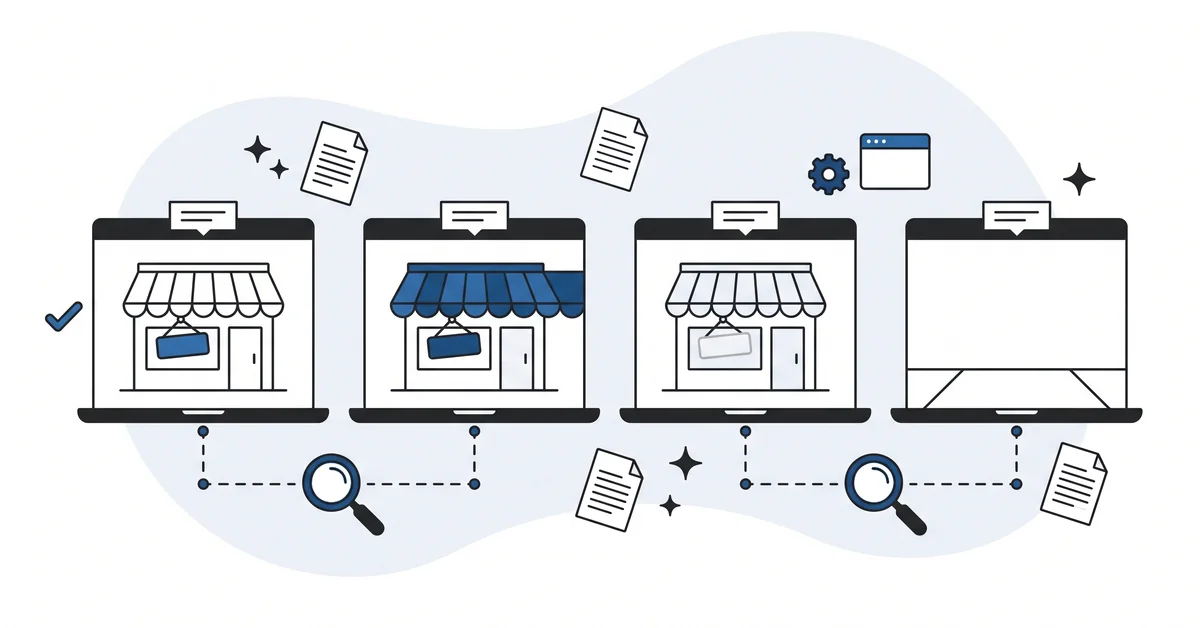
Imagine a small business on a street. You can look at it from four windows, in four different buildings, and see four different scenes. One shows the sign clearly.
One shows a competitor’s awning blocking the view. One shows the building, but with an old name on it. One shows nothing at all.
That is what four AI tools look at when a customer asks about your business. Same street. Four windows.
Which AI tools should I check, and where?
Four surfaces, four separate checks. ChatGPT at chat.openai.com. Google AI Overviews on google.com — the summary box above results.
Google AI Mode on the AI Mode tab. Perplexity at perplexity.ai. They cite different sources for the same query, so one-engine checks tell you a fraction of the picture.
If you only check ChatGPT, you are seeing through one window.
Google AI Overviews and Google AI Mode are both Google products. It is easy to assume checking one covers the other. That assumption is wrong. The two cite the same sources for the same query only about 14% of the time.
Perplexity is the one most small business owners have never opened. It is free. You do not need an account.
Type a question in, and you get the answer with inline citations. Thirty seconds per query.
Four tools. Four browser tabs. Set them up once. Keep them open for the whole audit.
What should I actually ask them?
Both your brand name and the questions your customers ask without knowing your brand. "What is [your business name]?" tests whether the engines know you exist. "Best [service] in [city]" or "how to [what you help people do]" tests whether you show up when real customers are searching.
You need both. Most owners stop after the first.
The branded question is the comforting one. It usually returns something. Even if the answer is partly wrong, at least your name showed up.
The non-branded question is the useful one. This is the question a real customer would type. A person who does not know you exist yet. The person you are actually trying to reach.
If your business shows up when someone types your exact name, that is good. If your business shows up when someone describes what they need without knowing you exist — that is where the money is.
Write five questions in each bucket. Five branded, five non-branded. Keep them natural. The way a person talks, not the way a marketer writes.
Why does the same question give different answers each time?
AI responses are not fixed. SparkToro’s January 2026 research ran 2,961 query runs across ChatGPT, Claude, and Google’s AI tools. There is less than a 1-in-100 chance the same prompt returns the same list of brands on two runs. 1-in-1000 for the same order.
Your audit cannot be one run. It has to be a pattern.
This is the single most important thing to understand before you start.
A small business owner runs a query once, does not see their name, and concludes they are invisible. Or sees their name once and concludes they are visible. Both conclusions are unsafe.
The fix is simple. Run each query at least three times. Write down the result every time. Count how many of the runs cited you.
If you appeared in three of three runs, you are solidly in the pattern. If you appeared in zero of three, you are solidly out. If you appeared in one of three, the picture is fuzzy.
Run it two more times. A pattern emerges after about five.
This is not perfectionism. It is how the tools work. A single run gives you a snapshot of a dice roll.
What does it mean when only one of the four cites me?
It means you have one map working and three unknown. Not a failure — useful. ChatGPT leans on Wikipedia and Bing. AI Overviews pulls from Google’s standing index.
Perplexity does a fresh live search every time. Each engine has a different path to your site. If one is open, the others can usually be opened too.
Pay attention to which one cites you. It tells you something.
If only AI Overviews cites you, Google already knows who you are. Your regular SEO is doing work. The other engines do not know because they use different paths to the web — paths your site may not be on yet.
If only ChatGPT cites you, you are probably indexed in Bing. That is a good signal and a rarer one than you think.
If only Perplexity cites you, something about your recent content has caught Perplexity’s freshness bias. That is worth understanding — and easier to replicate than it looks.
If none of the four cite you, the starting point is not content. It is whether each engine’s crawler can even reach your site. The reasons AI crawlers get blocked usually come down to robots.txt rules, staging-host residue, or pages rendered only in JavaScript.
Do I need to buy a tracking tool?
Probably not for the first audit. A spreadsheet with columns for engine, query, run number, whether you appeared, and which competitors appeared covers most of what a small business needs. Paid tracking tools help once you have dozens of queries and want weekly data. For a first check, manual is enough.
Here is the spreadsheet layout I use.
One row per run. Columns for: engine, query, run number, did-I-appear yes or no, competitor names that appeared, short note on how the answer framed the topic.
Twenty queries times three runs times four engines is 240 rows. It looks like a lot in description. It takes under two hours in practice, split across a few sittings.
Paid tools become useful later, when you are running the same check every week across fifty queries. For a business that has never done this before, the spreadsheet beats the tool. The learning is in the doing. A dashboard number does not teach you what your customer sees.
Other questions worth answering
Which third-party platforms appear most often as ChatGPT and Perplexity sources?
Short answer: ChatGPT pulls 47.9% of its top citations from Wikipedia, Perplexity pulls 46.7% from Reddit, and Google AI Overviews pulls 23.3% from YouTube. Source: ZipTie’s March 2026 cross-platform analysis.
Long answer: the same study found only 11% of domains cited by both engines. A Wikipedia presence lifts your visibility on ChatGPT. A Reddit profile lifts visibility on Perplexity.
Is it worth adding Claude as a fifth engine to test alongside ChatGPT and Perplexity?
Yes, the picture gets fuller. SparkToro’s January 2026 study of 2,961 query runs included Claude alongside ChatGPT and Google’s AI tools. Claude often returns different brand lists than ChatGPT for the same question. A fifth tab adds about twenty minutes to your audit, and skipping it leaves one blind spot you cannot see.
If I block OpenAI and Perplexity crawlers in robots.txt, does my business disappear from those engines?
Not always. Independent cross-engine audits in early 2026 found about 70% of ChatGPT citations still came from sites blocking its own crawler. ChatGPT can lift content through Bing’s index even when that crawler is turned away. Perplexity is stricter, and blocking its crawler usually reduces answer engine citation sharply.
Why does ChatGPT often respond without showing any sources?
Because as of early 2026, ChatGPT includes inline citations in only about 16% of its responses, while Perplexity cites sources in roughly 97%. An empty citation list in ChatGPT does not mean you are uncited — it means the engine answered from training data without invoking search. Run the same query in Perplexity for a second read.
How should you build your AI-citation baseline?
Pick five questions your customers would actually ask. Run each one three times in each of the four AI tools. That is 60 runs — about ninety minutes of work spread over three sittings.
Write down whether your business appeared. Count how many of the 60 runs cited you.
That is your baseline.
Save it. Date it. A baseline nobody writes down cannot be compared to anything later.
Now you know. One hour and a half, and a spreadsheet. You have moved from guessing about your AI visibility to describing it.
You can say exactly where you stand across four different windows onto the same street. The hidden AI traffic in GA4 is the other half of the picture standard analytics will not show you.
Some of the windows will be blocked. Some will be open. A few might show the wrong picture. Each one points to a different kind of next step, and that is a different article.
For now, you have done the one thing most owners in your situation have not done. You looked.
If the audit turned up something confusing, you can contact me. Cited in one place but not the others. Named correctly in half the runs and wrongly in the other half.
Invisible where you expected to show up. I will give you a calm read on what each result means and what kind of fix it points toward. No pitch.