Table of Contents
TL;DR
- At I/O in May 2026, Google made AI Mode a more prominent surface alongside AI Overviews and named Gemini 3.5 Flash as the default AI model behind it.
- AI Mode runs query fan-out — one prompt becomes several sub-queries, each pulling a different source from the same Google index.
- The fan-out rewards short answers to smaller sub-questions over long pages optimized for one head term.
- The default is real, not universal — long-tail and local-intent queries still fall back to a regular results page.
- The homepage adjustment is small — one clean extractable answer at the top, marketing copy below, and a weekly check in AI Mode itself.
You opened Google last week and the AI panel at the top of the page looked different. Sharper. More confident. Asking it a question felt less like checking a forecast and more like talking to someone.
The change is real. At I/O in May 2026, Google moved AI Mode from a tab you had to click into to a default surface that runs alongside AI Overviews. The AI model behind it is now Gemini 3.5 Flash — the smaller, faster Gemini variant, chosen for the query volume AI Mode handles. The fan-out behavior that was already inside AI Overviews now drives the AI Mode answer too.
You did not get a memo. The shift was quiet.
It changes the calculation for a small site, even though the calculation is gentler than the loud takes claim. AI Mode is not yet the only way most users search. It is one of the rooms in the building, and it now has a wider door.
The job is to figure out whether your homepage is visible in that room.
What did Google actually change at I/O 2026?
Google made AI Mode a more prominent surface and named Gemini 3.5 Flash as the default AI model behind it. AI Mode is no longer a tab you have to discover. It sits beside AI Overviews on the main results page and runs by default for a growing share of queries.
The framing matters.
Before I/O 2026, AI Mode was a destination. A user had to know the tab existed, click into it, and stay there. Most casual searchers never did.
The default-on flip removes that step. The AI panel now expands on the same results page for many prompts, without a separate click.
That is the surface change. The deeper change is what is running inside.
Gemini 3.5 Flash is built for speed at scale. AI Mode runs across query volume that the larger Gemini variants would struggle with. So Google picked the smaller, faster Flash variant and tuned it for the fan-out workload. That choice has implications for what kinds of pages get cited.
Why did Google make AI Mode the default surface at all?
Three reasons.
Users were already drifting toward chat-style answers in ChatGPT and Perplexity. The fan-out architecture handles long, conversational questions better than the ten-blue-link layout. And AI Mode is where Google can compete on answer quality rather than on legacy ranking signals.
The competition piece is the quiet driver.
For two decades, Google’s moat was its index plus its ranking. Both still exist. But for the questions that look like conversation — "what is the best WordPress host for a small WooCommerce store, including support quality and a free SSL" — the ranked-link layout is the wrong product. Chat-style answers win the user, and Google would rather win the user inside its own AI Mode than lose them to ChatGPT.
The shift also lines up with the official Google AI search guidance Google published the same month. The guidance treats AI Mode as a peer surface to AI Overviews, not a beta variant. The default-on flip is the operational version of that framing.
What is Gemini 3.5 Flash actually doing inside AI Mode?
It is doing the fan-out.
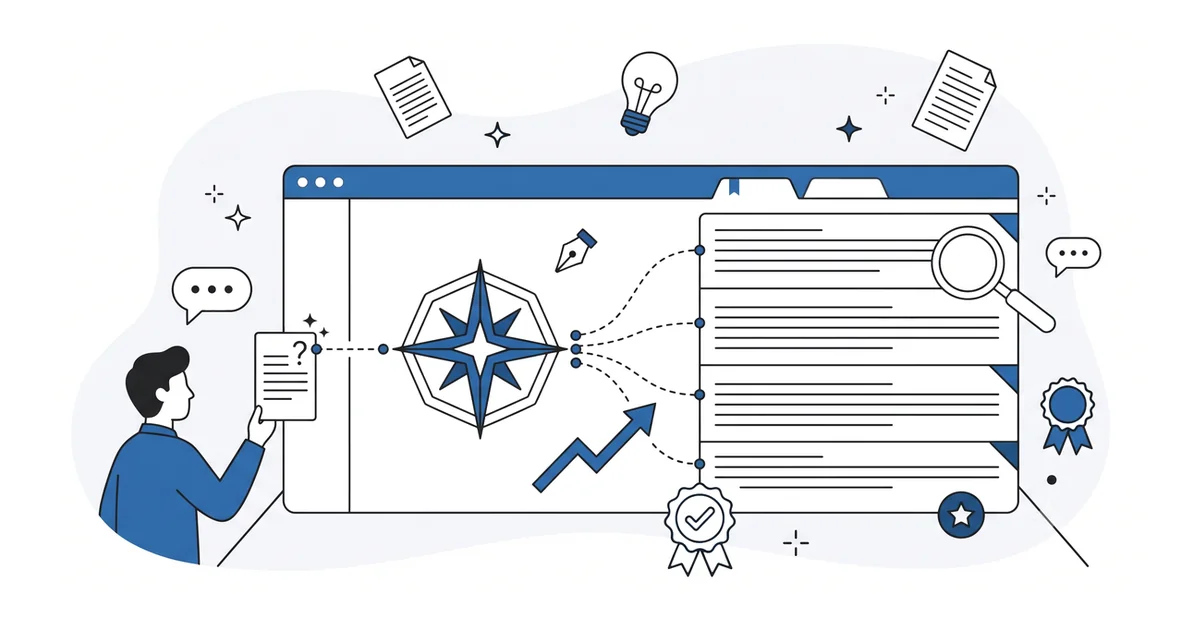
The user types one question. Gemini 3.5 Flash breaks it into smaller sub-queries. It runs each sub-query against Google’s index, picks a source per sub-query, and stitches the answer together. The Flash variant is chosen for speed — AI Mode runs across high query volume, and the larger Gemini models cost more to serve.
The fan-out is the part most small sites have not adjusted for yet.
A head question like "how do I speed up my WordPress site" might fan out into six or eight sub-questions. Caching plugins. Image weight. Hosting choices.
Database queries. Theme overhead. Each one fetches its own source. The final AI Mode answer is a collage.
Your page can be a clean answer to the head question and still get skipped. The sub-question that would have surfaced you may never have been one of the six that ran. The way AI engines find content at the discovery layer is the surface story. The fan-out is the deeper one — each section of your page needs to carry its own answer to its own smaller question.
How does AI Mode pick which page to quote from?
From the same Google index that powers regular Search. The page must be crawlable. Structured data helps but is not required. Each sub-query picks its own source.
A page can be cited once in an AI Mode answer or not at all, even when it ranks well for the head term. The match is the sub-question, not the head one. That is the part that surprises most site owners.
You can see this from the outside. Pick a head question that should obviously surface your page. Type it into Google with AI Mode on.
Read the answer. Note whether your page is one of the cited sources. Then look at the question itself and ask — which sub-questions did the AI Mode answer actually cover?
Often the sub-questions you can see in the answer are not the ones your page is best at answering. The page that wins is the one whose H2s line up with the sub-questions the engine ran.
What changes for a small site when AI Mode is the default?
Three things.
The window for a head-term ranking to drive traffic shrinks. The window for a clean answer to a smaller sub-question grows. And the audit gets harder — the same query can produce a different AI Mode answer the next day, so a one-day check is no longer a baseline.
The shrinking head-term window is uneven. Long-tail informational queries fan out hard. Transactional and product queries still favor the regular results page.
Local queries are mixed — AI Mode sometimes answers, sometimes falls back. There is no single rule that fits every category.
The growing sub-question window is real. Pages with clean answer blocks under each H2 — the kind that read like a single self-contained answer — get cited inside AI Mode in patterns the old SEO playbook would not have predicted. A small site with five clean answers can outperform a much larger one with two long unanchored articles.
The harder audit is the part that bites. AI Mode answers vary across runs. The same prompt on Monday and Friday can pull different sources. A single check is no longer a baseline — a baseline now takes three or four runs across a week, and even then the picture is fuzzier than a regular SERP audit was.
Where does the AI Mode default still break down?
Long-tail queries and local-intent queries are still mixed.
AI Mode sometimes falls back to a regular results page when the question is ambiguous or geographically scoped. A question with a city name, a phone-number lookup, a hyper-specific product SKU — these still often land on the old layout. The default is real, not universal.
There are also failure patterns inside AI Mode itself. Sometimes the fan-out picks sub-questions that nobody on the open web has actually answered yet. The result is a thin, hedged AI Mode response that names a few generic ideas without citing strong sources. That gap is where a small site with one genuinely deep answer can land a citation.
And there is the ceiling on AI search overall.
Brand Radar’s 108M-query dataset puts AI Overviews on roughly 20% of US Google searches in 2026. AI Mode is on top of that, not a multiplier of it. AI search is real and growing.
It is not yet most of search. Treat the default-on flip as a faster lane, not a replacement freeway.
Other questions worth answering
How can a business owner check whether an answer engine cites their content?
Three quick steps work. Type your customer question into ChatGPT, Perplexity, and the Google panel, then read each result. Note which sentence from your website matches the returned answer text. Per the pillar-expansion June-2026 digest, AI Overviews appear on roughly 20% of US searches.
How does fan-out compare across answer engines like ChatGPT and Perplexity?
Cross-engine fan-out varies sharply. The pillar-expansion June-2026 digest names the May I/O event where Google promoted its conversational answer surface and named a faster default AI model behind it. ChatGPT and Perplexity rely on separate indexes and route prompts through their own retrievers. So fan-out behavior differs engine by engine.
How can a business confirm whether answer engines can read its content online?
A plain-text crawler view is the cheapest test in 2026. OpenAI’s crawlers do not execute JavaScript, so client-side rendered text stays invisible to them. View source in your browser to inspect what the engine sees. If your customer-question sentence is missing from the HTML, the engine cannot read it either.
Which sub-prompt shapes tend to appear when an engine fans out a customer query?
Per the pillar-expansion June-2026 digest, four recurring shapes appear: semantic variations, follow-up prompts, comparison pulls, and attribute pulls.
A prompt about a CRM might fan into pricing, features, alternatives, and reviews. Each sub-prompt fetches its own source. Map the likely fan before drafting your customer-facing content.
How should you adjust your homepage for an AI-Mode-first reader?
Keep the homepage short.
Carry one clean answer to the question your customers actually ask, written as a paragraph an AI Mode chunker can extract. Move the marketing copy below it. Test the homepage prompt in AI Mode and watch which sentence it pulls.
You will know the homepage is working when AI Mode quotes a sentence you can read on the page in the first scroll. If the quoted sentence sits below the fold or inside a long marketing paragraph, the fan-out is finding it but the layout is fighting you. Move it up.
If you read all of this and still are not sure where on your own homepage to put the one clean answer, that is normal. Most small business owners are looking at their site through years of habit. You can contact me here, and I will read the homepage with you against three AI Mode runs of your own customer’s question. There is no charge, and there is nothing for sale on the other side of it.
I will tell you which one sentence you already have on the page is closest to the answer AI Mode would extract, and the smallest move that gets it from "almost" to "the one quoted." That is usually enough to make a homepage visible in the new default surface without rewriting it.