Table of Contents
TL;DR
- A copywriting framework is an ordered list of beats a piece of copy walks through. The framework supplies architecture. The writer supplies voice. Both have to land or the page reads as mechanical.
- Two frameworks compress cleanly into the 50-150 word blocks that AI engines extract from pages — PAS (Problem-Agitate-Solution) and BAB (Before-After-Bridge). Their three-beat structure was already terse.
- AIDA, PASTOR, and StoryBrand lose load-bearing structure below roughly 150 words. Each act receives too few words to carry weight — the framework collapses on the answer surface.
- The PAS-with-definition pattern resolves the conflict between framework rhetoric and engine extractability. Definition leads. PAS structures the prose underneath the definition.
- Pick the framework based on the buyer’s awareness level, not on personal preference. Problem-aware buyers need PAS. Solution-aware buyers need BAB. Most-aware buyers need a plain offer with no framework.
A printed-out list of copywriting frameworks sits on the desk. The list names eight of them. PAS, BAB, AIDA, PASTOR, the 4Ps, FAB, StoryBrand, and one more whose initials nobody remembers.
PAS is the easiest to type, so PAS gets picked. The next homepage hero block goes up the same morning, written to fill the slots. Problem, agitate, solution. Three sentences, in order, with the offer as the solution.
The new hero reads like a robot wrote it. The structure is technically correct. The voice is mechanical. The buyer who lands on the page scrolls straight past.
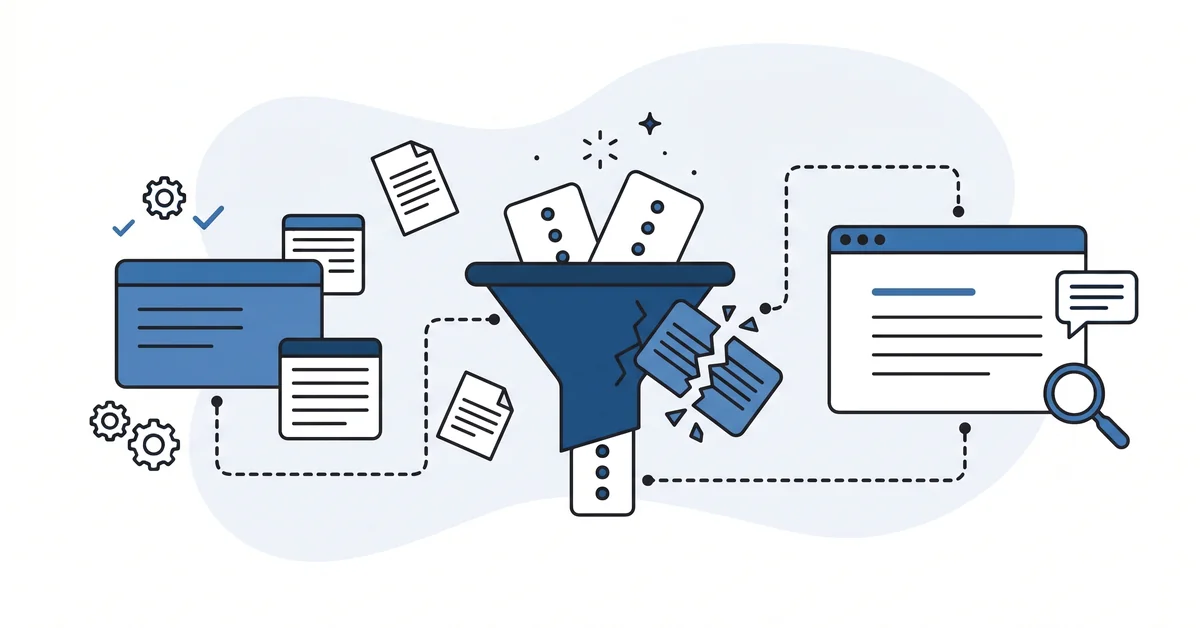
The framework was not the problem. The framework was the guide rail. The writer was treating the rails as the path.
Why does framework-driven copy often sound like a robot wrote it?
A beginner reads the abbreviation, reads a one-paragraph explanation, and writes a paragraph that fills the slots. Problem sentence in the problem slot. Agitation sentence in the agitation slot. Solution sentence in the solution slot.
The structure passes the test. The voice fails the room.
Frameworks supply architecture. Voice supplies music. Both have to land or the buyer disengages.
The robotic-sounding copy is what shows up when the framework is treated as a fill-in-the-blank exercise instead of a guide rail. The fix is not a different framework. The fix is reading the result aloud and asking whether a person could have said this at a kitchen table without flinching.
What is a copywriting framework, in plain language?
A copywriting framework is a short ordered list of beats. The copy walks through the beats to move a reader from cold attention to a decision.
PAS walks the reader from a problem through agitation to a solution. BAB walks from a before-state through an after-state to the bridge that connects them. AIDA walks from attention through interest and desire to action. The 4Ps walk from picture through promise and proof to push.
The frameworks differ in beat count and emphasis. They share a job. Each one gives a beginner a sequence to follow when staring at a blank page. The framework saves the writer from inventing a structure for every section.
The framework is the rail, not the path. The prose between the rails is what the buyer reads.
Which three-beat frameworks survive AI summarisation?
Two frameworks compress cleanly into the 50-150 word blocks that ChatGPT, Claude, Perplexity, and Gemini extract from web pages.
PAS, with its three beats, fits a 60-word answer block cleanly. One sentence on the problem, one on the agitation, one or two on the solution. The brevity PAS forces in long form is the same brevity that carries it through compression.
BAB, also three beats, fits a 60-word block as the before-state, the after-state, and the bridge mechanism. The before-after pattern is one of the oldest shapes in direct-response copywriting. It survives compression because each beat is already a single thought.
Underneath every one of these shapes is a small story. Before, after, and the moment something changed. Learning telling a simple story makes the framework feel like a person talking, not a template.
The four-act and five-act frameworks do not survive the same compression. They were built for longer forms. Compressed into a paragraph, each act gets too few words to carry weight.
Why do AIDA and StoryBrand lose load-bearing structure on an answer surface?
AIDA has four acts. PASTOR has five acts plus a story element. StoryBrand walks a character through problem, guide, plan, and action — five beats again.
Each was built for long-form direct-response copy where the writer has 800 to 2000 words to walk a reader through. The architecture works at that length. The architecture stops working at 60 words.
Compressed into an answer block, AIDA gives each act fifteen words. Attention becomes a hook fragment. Action becomes a CTA stub. The buyer reading the compressed AIDA paragraph cannot tell which act they are in or which act they are reading.
StoryBrand reduces to "you have a problem, here is the guide, click the CTA," which is just BAB plus a guide reference. PASTOR is long-form territory and stays there. None of these are bad frameworks. They are simply built for a different deployment surface than the answer block.
How does the PAS-with-definition pattern resolve the AI-extractability conflict?
The conflict is real. AI engines extract definition-led, plain-prose paragraphs more reliably than persuasion-framework-formatted blocks. A PAS opener that begins with the problem statement may have the engine extract its downstream sentence instead.
The fix is structural rather than rhetorical.
Open the answer block with a one-sentence definition of the topic in plain language. Follow with the problem the buyer is having, the agitation that names the cost of inaction, and the solution. The block reads as PAS for a human reader. The engine sees a definition first and extracts it.
A 60-word block can carry both jobs without sounding forced. The shape goes "X is [definition]. Without it, [problem expanded]. With it, [solution]." Definition leads, and the framework structures the prose underneath.
The pattern is the practitioner-grade move on the AEO surface. Most framework content tells writers to lead with the framework. Most AEO content tells writers to lead with the definition. The synthesis was the work that needed doing.
Where do Cialdini’s principles fit when the block is sixty words long?
Robert Cialdini named seven principles in his work on influence. Reciprocity, commitment, social proof, authority, liking, scarcity, and unity.
Each principle survives at sentence level as a single line of flavour inside the chosen structural framework. A 60-word answer block can carry one principle as embellishment. Stacking principles compresses awkwardly, and the block stops sounding human.
Pick one principle per block. Deploy it as a single sentence inside the PAS or BAB shape.
Authority signals — named author, named credentials, named experience — survive compression most reliably and correlate with citation lift on chat surfaces. Social proof — a specific number with a named entity attached — compresses next-best because the number is the part the engine cannot average away. Reciprocity, scarcity, and the rest survive at sentence level when used sparingly.
The honest hedge belongs here too. The 2026 named-source literature does not contain controlled studies on framework conversion lift inside answer blocks. The framework-adaptation guidance in this section is reasoned synthesis from named sources on adjacent topics, not a direct empirical claim. A practitioner using the patterns should keep their own measurement.
How does a beginner pick the right framework for the page job?
The framework follows the buyer’s awareness level. Not the writer’s preference, not the framework abbreviation that was easiest to remember.
Eugene Schwartz introduced the five-level awareness spectrum in his 1966 book Breakthrough Advertising. The framework still anchors conversion craft sixty years later because the right copy follows the level. Same buyer, different products, different levels. The page that lands at the wrong level falls flat regardless of framework.
A problem-aware buyer who has not yet considered solutions needs PAS. The pain named in their own words. The cost of inaction named clearly. The path forward named without jargon.
PAS does that work in three beats.
A solution-aware buyer comparing options needs BAB. The before-state of the alternative they considered first. The after-state of the path this offer represents. The bridge that connects the two.
BAB does that work in three beats.
A most-aware buyer ready to decide needs the offer plainly stated. No framework required. The framework that adds beats at this stage adds friction.
For more on placing a buyer on the awareness spectrum from the inputs you already have, see how to identify customer pain points. For more on the value-proposition layer that sits underneath every framework choice, see how to write a simple value proposition for small business.
The cmswire 2026 piece on AI customer experience put the underlying point plainly. "The first letter in AI stands for artificial," the piece argues. What customers reach for under stress is authenticity. A framework-formatted block reads as authentic only when the prose underneath sounds human.
The framework supplies the rail. The writer supplies the voice that walks the path between the rails.
Other questions worth answering
Where does proof belong on a hero area when the reader gives just one minute?
Near the headline. Specific results out-pull generic adjectives because the reader can verify them in a single glance.
A working proof ladder leads with the strongest item. Named-customer testimonials, with full role and company, come at the top. Logo bars come next. Star ratings sit at the bottom of the credible set.
When does a recorded customer call matter more than another round of revisions?
Always, on a stuck headline. Awareness diagnosis and the actual phrases a buyer uses cannot be invented by a writer staring at a draft.
Joanna Wiebe’s voice-of-customer methodology reads this as the upstream work that no machine assistant can replace. Six minutes on a recorded call usually beat six hours of solo revision because the call returns the exact phrases your buyer uses.
Why does headline testing still outperform clever phrasing today?
Short answer: because a specific outcome named to a specific reader has out-pulled clever phrasing in every documented test cycle.
Long answer: Claude Hopkins built the testing discipline into salesmanship literature in 1923. John Caples then documented roughly 19x lifts on identical body prose from headline swaps alone. The same rule still anchors conversion testing in 2026.
How should objection-handling thread through a marketing rebuild?
Three positions matter. Lead with the value claim, then the worry that immediately follows met with proof, then the cost worry met with risk reversal, then the ask.
Silence on objections reads as the biggest leak in conversion copy. A reader who senses a missing answer scrolls past the close.
Which framework would you try on your weakest landing-page section first?
Pick the section a buyer scrolls past without stopping. Most often it is the hero block under the headline — the paragraph that was supposed to explain the offer and instead listed adjectives.
Rewrite the paragraph as PAS in three sentences.
Problem sentence — name the pain in the buyer’s own words, the way the buyer would say it on a call. Agitation sentence — name what continues to cost them while the pain stays unsolved. Solution sentence — name how the offer changes the situation, in plain language, without product jargon.
Read the result aloud. If the paragraph sounds like a person talking, the framework did its job. If it still sounds mechanical, the voice work is the part that is still ahead of you. The framework cannot fix voice — voice has to be written and revised at the sentence level.
If you have a homepage section that fits a framework on paper but sounds robotic on screen, you can contact me here. Send me the current paragraph and one sentence on the buyer the section was meant to address. I will rewrite the paragraph in plain language and explain the change in one paragraph. There is no charge and no follow-up sales call.
The work is small. The voice is the part the framework left to you.