Table of Contents
TL;DR
- The unit of deployment for marketing copy is no longer the long-form page. The unit is the 40-60 word answer block the engine lifts from the page and presents directly to the reader.
- A workable answer block has three structural moves — a definition-led opening, one quantified supporting fact, and plain prose without a callout-box or blockquote wrapper.
- The 200-400 word section around the block carries proof, examples, and adjacent context. The block earns the cite. The section earns the trust if the reader clicks through.
- Per-engine citation behaviour is real but not infinite. Different engines reward different content shapes. The page that combines a definition block, a comparison table, and an FAQ block wins more cites across surfaces than the page that picks one shape and commits.
- Test against the engines themselves, not against the markup. A clean answer block beats a heavily-marked-up callout box every time the engine is the audience.
A small-business owner runs the question their best customer asks first into ChatGPT. Then into Perplexity. Then into Google AI Overview.
Three different answers come back. Each one cites somebody. Two of the three cites are competitors.
The owner opens the page on their own site that ought to have been cited. The page is fine. The headline is the question. The body answers the question.
The page even has a tinted callout box near the top. The box summarises the answer in one paragraph.
The callout box is the problem.
The engines did not lift from the box. They lifted from the competitor’s plain second paragraph. Plain paragraphs are what the parser carries off cleanly. The box was a wrapper the parser treated as a separate element and skipped.
Why does an answer engine lift one paragraph and skip the rest of the page?
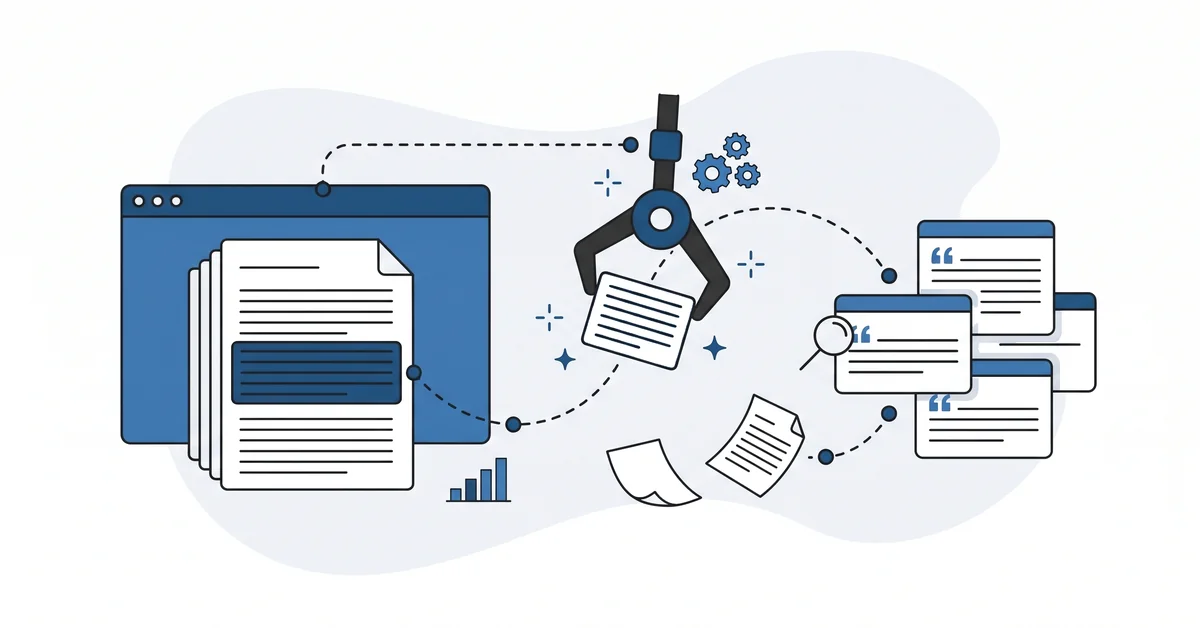
An answer engine reads a page as a sequence of liftable units. Each unit is a self-contained paragraph the engine can carry off, attribute, and present without paraphrasing. The unit that carries cleanest is the unit shaped for the lift.
The rest of the page is context. Useful for ranking. Useful for trust signals. Not the bone the engine carries off.
The lift is mechanical. The engine looks for a paragraph that answers the implied question of the heading. The paragraph fits inside roughly 40-60 words. It reads as standalone prose.
If your page has one of those, the engine cites you.
If your page wraps the answer in a tinted box, an icon-and-headline component, or a blockquote, the parser skips it. Frase’s 2026 AEO guide names the rule directly. A 40-60 word direct answer immediately under each H2, kept inside 200-400 word sections.
The implication for the writer is uncomfortable. The page has to be designed for two readers. One is the buyer who lands on the page and reads the prose. The other is the engine that visits the page once, lifts the answer block, and never comes back.
Both readers want different things from the same prose. The block has to read as natural copy. It has to parse as a clean lift. Both jobs at once.
What is a forty-to-sixty word answer block, in plain language?
An answer block is a single paragraph that answers a specific question completely. Roughly 40-60 words. It does not refer back to anything earlier on the page. The paragraph stands alone.
It opens with a definition or a direct claim. It includes one quantified supporting fact. It uses plain words. It does not call out, side-rail, or blockquote itself.
The 60-word ceiling is empirical, not theoretical. The convergence appears across multiple named-source 2026 guides because the engines that drive AEO surfaces today lift paragraphs in roughly that band.
Shorter blocks read as fragments and fail to carry a complete answer. Longer blocks force the engine to summarise across sentences, which introduces synthesis errors. The engine flags those errors internally — the brand pays for them in lost cites.
The convention is older than AEO. Caples published Tested Advertising Methods in 1932. The headline-construction principles in that book reward direct, single-claim openings. Hopkins’s Scientific Advertising (1923) framed the same discipline as "salesmanship in print."
The answer block is what those principles look like when the deployment surface is an answer-engine lift rather than a magazine half-page. The discipline did not change. The deployment unit got smaller.
Which three structural moves make a block carry cleanly?
A block that carries cleanly does three things in order. The order matters because the parser walks the prose top to bottom and stops once it has a complete answer.
Move one — definition-lead opening. The first sentence names the thing the page is about. It gives a one-clause definition the reader can carry away. The pattern reads as Entity is a category that differentiator.
A small-business landing page about a forms plugin opens with the name, the category drag-and-drop form builder, and the differentiator for WordPress sites. The pattern is direct. The pattern lifts.
Move two — one quantified supporting fact. Place a specific number, a named entity, or a sourced claim in the second sentence. Sections with three or more statistics are cited 2.1x more often than sections with zero statistics. The figure comes from GenOptima’s 2026 GEO techniques study, which is vendor-affiliated.
The order inside the block matters as much as the fact. A definition can open, but a problem-first shape can open too. Using PAS shaped for answer blocks lets the block name the pain and still carry the lift.
The directional signal is corroborated across other named sources. One number per block is the floor. Two or three is better.
Move three — structural plainness. The block is a paragraph — not a tinted box, a side-rail callout, or a blockquote. Plain prose lifts more reliably than wrapped prose. The parser treats wrappers as separate elements and may skip them entirely.
The honest move is to write the block as plain copy. Let the page’s CSS handle visual treatment after the engine has already done its work.
Why does plain prose outperform callout boxes and blockquotes?
A callout box reads as helpful to a designer. The box draws the eye on the visual page. The buyer who scrolls past finds the box first and reads it first. The instinct is to put the most important sentence in the box.
The instinct works against the engine. An answer engine’s parser reads HTML. An HTML container with its own class signals to the parser that the content inside the container is a separate component.
Some engines treat the container as page furniture rather than as body prose. Others read the contents but rank them lower for lifting because the surrounding markup signals the content is decorative.
Plain paragraphs carry no such signal. A <p> element under an <h2> reads to the parser as part of the section’s main answer. The same sentence that fails to lift from a tinted box lifts cleanly from a plain paragraph because the markup around it is invisible.
The fix is structural, not visual. Write the answer block as plain prose. If the page needs a visual treatment, apply it through CSS that styles the paragraph itself rather than through a wrapping container.
The buyer still sees the visual emphasis on the page. The engine still sees a clean paragraph it can carry off. Both readers get what they need from the same sentence without the markup forcing a choice.
How long should the section around the block actually be?
The section that holds an answer block runs 200-400 words. The block opens the section. The rest of the section carries the proof, the examples, and the adjacent context the buyer who clicks through wants to read.
Frase’s 2026 guide names the band. AirOps and GenOptima land within the same range.
The reason for the upper bound is mechanical. An engine that lifts a 60-word block from a 200-word section sees the block in context and confirms the surrounding prose supports the claim.
An engine that lifts the same block from a 1,500-word section may need to synthesise across multiple paragraphs. That synthesis raises the rate at which the engine drops the cite. It also raises the rate at which the engine substitutes a different source whose claim is easier to verify.
The reason for the lower bound is trust. A 50-word section reads as too thin to carry the proof a buyer who clicks through will look for.
The section needs at least one example. It needs at least one piece of evidence. It needs at least one transition to the next section.
The honest range. Sections from 250 to 350 words land most often in the work that wins citations across the engines that matter. Sections under 200 words fail the trust test for the human reader. Sections above 400 words fail the synthesis test for the engine.
The band is narrower than it looks. The discipline of staying inside it is what separates pages that win citation from pages that almost win citation.
What does the named-source data say about per-engine citation behaviour?
The Profound 2026 citation-patterns dataset gives the cleanest view of per-engine behaviour available in May 2026. Wikipedia accounts for roughly 7.8% of total ChatGPT citations and 47.9% of citations among the top-10 source domains. Reddit accounts for roughly 6.6% of total Perplexity citations and 46.7% of top-10 sources.
Google’s overview surface cites top-3 organic results almost exclusively, per GenOptima’s 2026 review. Microsoft Copilot cites sources in 28% of answers, against the 3-5% rate of Google’s overview surface, and favours Bing-indexed table-formatted content.
The pattern is real but not infinite. The first engine rewards encyclopedic, factual content. The second rewards community-sourced peer-to-peer information.
The third rewards strong organic SEO. The fourth rewards FAQ-formatted pages and tables.
The differences mean a single page can win one engine and lose another based on which content shape the writer chose. The compounding move is to combine shapes on the same page.
A definition block at the top earns the encyclopedic-engine cite. A comparison table mid-page earns the table-favouring cite. An FAQ block at the bottom earns the long-tail community-engine cite.
The page that combines three shapes outperforms the page that picks one and commits. Each shape serves a different audience. The picking-one strategy was the SEO-era move. The combining strategy is the AEO-era move.
The honest hedge. The Profound dataset is one snapshot of per-engine behaviour as of early 2026. Citation distributions change as the engines themselves update their retrieval.
The directional patterns above are durable enough to plan against. The specific multiples are best treated as orientation, not as targets you optimise toward sentence by sentence.
Where does the disconfirming evidence say AEO falls short?
The same research that documents how the engines cite also documents how often they get it wrong. The Tow Center for Digital Journalism reported error rates above 60% for news queries on the engine surfaces. AIvsRank audited one engine configuration and found more than half of references surfaced in answers were fabricated. Citations pointed to URLs that did not exist or to sources that did not contain the claim attributed to them.
The implication is not that AEO is futile. The implication is that engine citation is not a perfectly truth-tracking process. A brand that wins citation today is winning a lottery weighted by content shape, freshness, and per-engine retrieval rules. The lottery has non-zero false-positive rates from the engines themselves.
The honest planning move. Set citation as a leading indicator rather than as a target. Track citations the way a senior marketer tracks email deliverability. A signal that the discipline is working, not a metric you optimise for at the expense of the underlying craft.
The pages that earn citations consistently are the pages that would earn buyer trust without the citation. The discipline of writing clean answer blocks is a discipline of writing clear prose. The clear prose is what the buyer rewards. The citation is what the engine rewards in addition.
The 83%-from-the-past-12-months freshness signal that AirOps reports is the second piece of disconfirming evidence to plan around. A page written in 2024 that won citations in 2024 may quietly stop winning them in 2026 even if the prose has not aged.
Refreshing the dated facts inside the answer block buys back the freshness signal without rewriting the page. "As of May 2026." "In Q1 2026." "The 2026 dataset." Sentence-level moves that signal recency at the level the engine lifts.
Other questions worth answering
How does buyer awareness level change which fact you put in the lead sentence?
Most Aware buyers want the offer and the price. A Most Aware lead names a guarantee or the bonus.
Problem Aware buyers want the cost of inaction. A Problem Aware lead names the loss the buyer eats today. Eugene Schwartz mapped these five awareness levels in 1966.
When should I test a different opening against the existing version of a landing URL?
In 2026, test when traffic exists and citations do not. Open Google Analytics for any page that earns visits but no AI Overview mention. Those pages have proven buyer intent and a measurable gap. A fresh opening drafted against the current AI Overview shape returns the highest yield.
Where should I place an internal link inside or after the lead sentence?
Place internal links after the lead sentence, never inside it. The lead sentence is the unit AI Overview lifts in 2026. Adding a link disrupts the parser and reduces extraction. Put your links in the supporting prose that follows, where they pass authority without breaking the cleanest extraction surface.
Why do narrative-led essays and storytelling pieces resist extraction by AI assistants?
Narrative resists extraction because each sentence depends on the ones before it. ChatGPT and Perplexity cannot extract context-dependent prose without losing meaning. A standalone unit must read as complete on its own. Storytelling deliberately breaks that property, which is why narrative essays earn human readers in 2026 but rarely earn machine citations.
Which page on your site should you rewrite first?
Pick the page that gets traffic in your analytics today and is not getting cited in any of the three engines you actually care about. That is the page where the cost of inaction is highest. It is also the page where the work to fix it is lowest.
Open the page. Find the section that should have been the answer block. It is usually the first section under the H1. The one that summarises the offer in a paragraph.
Read it aloud. If it runs longer than 60 words, trim it to 50.
If it sits inside a tinted box or a blockquote, move the paragraph out of the wrapper. Let CSS handle the visual emphasis through paragraph styling.
If it lacks a quantified supporting fact, add one in the second sentence. A specific number. A named entity. A sourced claim.
Read the rewritten section against the question your buyer asks first. If the section answers that question completely in plain prose, the work is done. The framework you reach for to structure the prose is a separate decision. Some copywriting frameworks for beginners survive AEO compression and others do not.
If the section does not answer the question completely, the gap is voice, not structure. Voice work begins by reading what your buyer actually says about the problem, not by reaching for the next adjective on the brand-voice document.
The block earns the cite. The voice earns the click after the cite. The page after the click earns the buyer.
If you would like another set of eyes on the block before you ship, you can reach me here. I will read the section against the three engines I track. The first round is free, and the rewrite is yours regardless of whether we work together after.