Table of Contents
TL;DR
- The share of AI Overview citations coming from pages in Google’s top 10 fell from about 76% a year ago to about 38% in early 2026 (Ahrefs), with BrightEdge measuring it as low as 17%.
- Roughly two-thirds of AI Overview citations now come from outside Google’s top 10 — 31% from positions 11 to 100 and 31% from pages not in the top 100 at all.
- The mid-ranking advantage is engine-specific: ChatGPT overlaps Google’s top 10 at low single digits, Perplexity at 82% URL overlap, AI Overviews sits between them.
- Cited outside-top-100 pages share three traits: a clear answer near the top of each section, a named author or organization, and recent updates.
- If your page is well-structured and answers a single question clearly, position 12 is no longer the quiet death it was — rewrite for clarity before you chase rank.
For years, the goal was the same. Get into Google’s top three. Failing that, the top ten. Failing that, the bottom of page one.
The site that ranked twelfth was almost invisible. The site that ranked third had a real business.
That gap is closing. Not closed. But closing fast enough that "I never broke into the top ten" is no longer the sentence it was.
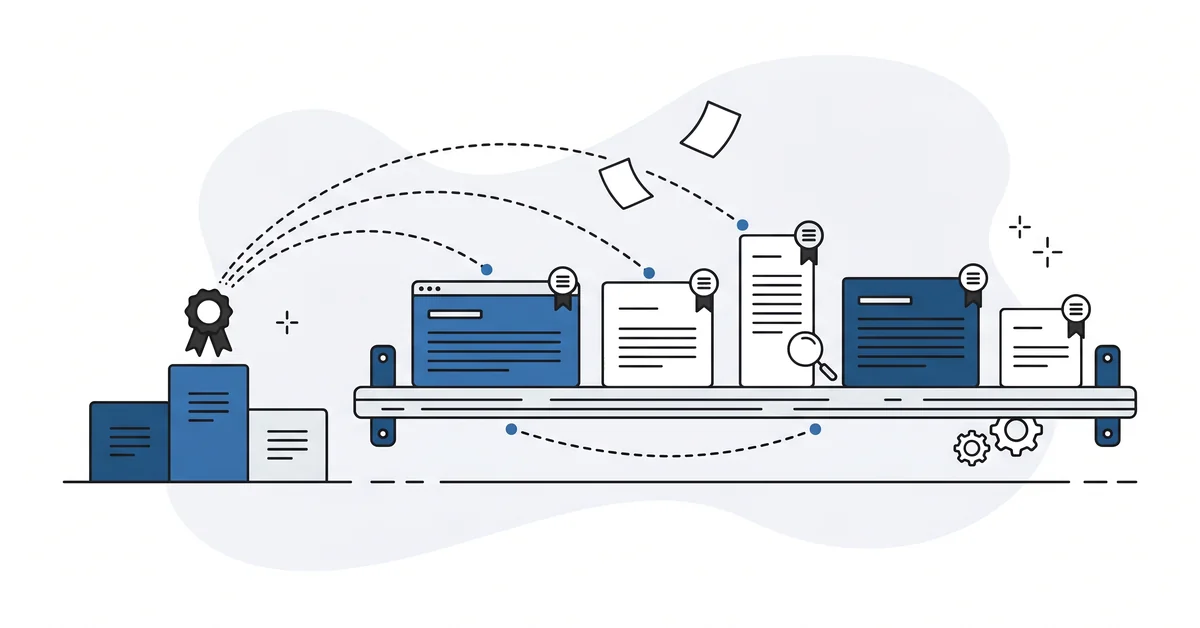
For a long time, Google was a podium. Three winners. The rest watched.
The world AI engines are building looks more like a long shelf. There is still a best position. But there is now room for many more names. A steady share of those names belongs to sites that never came close to the podium.
If your business has been on page two for years and you have quietly given up, this post is for you.
What changed for mid-ranking sites in the last year?
About a year ago, roughly 76% of AI Overview citations came from pages also ranking in Google’s top 10 for the same query. The top ten and the AI summary were almost the same set.
By early 2026, that share has fallen sharply. Ahrefs measured it at about 38% in their March update. BrightEdge measured it as low as 17% in February. Different methods, different samples, same direction.
The simple version: the gap that used to protect top-three results from page-two competitors has narrowed enormously inside AI answers.
This is the shift most "AI search killed my traffic" articles miss. For the small site that never broke into Google’s top ten, this is a structural opening that did not exist two years ago.
Where do AI Overview citations actually come from now?
About 38% from Google’s top 10. About 31% from positions 11 through 100. And about 31% from pages that do not appear in the top 100 for the same keyword at all.
Read that last number twice. Roughly one in three AI Overview citations comes from a page that should not be visible to that searcher at all. By any normal SEO measurement, that page is invisible.
The user typed a query. AI Overview wrote a summary. Inside the summary, it cited a page that ranks 200 for that keyword — or does not rank at all.
That page got the visibility. The page in position one did not.
This is not how the old system worked. It is also why "rank tracking" has become a partial picture instead of the whole one.
Is this true for every AI engine or just Google?
It varies sharply by engine. The mid-ranking opportunity is bigger for some, smaller for others.
ChatGPT cites pages that are very weakly related to Google’s top 10. Different studies put the URL overlap at the low end of single digits up to roughly the mid-teens. Every study agrees ChatGPT has the lowest overlap of any major engine.
ChatGPT routes much of its retrieval through Bing rather than Google, which is part of why the lists look different. For a small site, this is the engine where being clearly written matters far more than being highly ranked.
Perplexity is almost the opposite. Recent Semrush analysis found Perplexity overlapping Google’s top 10 at about 82% URL overlap and over 90% domain overlap. If your customers mostly ask Perplexity questions, your top-Google-ranking competitors are still mostly the ones being cited there.
Google’s own AI Overviews sit in the middle and have been moving steadily toward the long-shelf pattern over the last twelve months.
So the practical version of this advantage is engine-specific. Where do your customers actually go? If they mostly use ChatGPT, the door is wide open.
If they mostly use Perplexity, the door is the same one Google has always been. If they mostly read AI Overviews on Google, the door is opening — slowly but steadily.
What kinds of pages get cited from outside the top 100?
YouTube is one of the most-cited single domains across AI Overviews. That is not an accident. Google owns YouTube.
Videos have transcripts. Transcripts are answer-shaped — short, clear, addressing one thing at a time. The platform has trust signals AI engines weight heavily.
Most small-business sites cannot match YouTube’s reach. But the pattern is useful for understanding why some sites get cited from far outside the top 100.
The qualities that put YouTube transcripts inside AI answers are the same qualities a small site can copy on its own pages. Short, clear, one-thing-per-section, identifiable author, recent enough to look maintained. None of that requires a video. It requires writing the way a clear video transcript reads.
You do not have to start a YouTube channel. You can write the way good transcripts read.
What does this mean if I’m stuck on page 2?
Page two used to be the quiet end. You ranked. You almost mattered. You did not get the click.
In a citation-driven world, page two can be the start of a new game.
If your page answers a clear question with a clear answer near the top of each section, something shifts. Your business also needs to be identifiable as a real organization with a real author behind it. When both are true, your page competes for AI Overview citation against pages it could never have caught for the top blue link.
Two pages can rank twelfth and twentieth on the same query. The clearer one gets cited. The other does not. Ranking is no longer the only filter.
This is not a guarantee. It is a real shift in what the next twelve months reward. If you stopped trying because Google’s first page felt out of reach, the rules under which you stopped trying are not the rules anymore.
Other questions worth answering
How often does ChatGPT cite the same domains as Perplexity for similar queries?
Not often. Only about 11% of domains appear in both ChatGPT and Perplexity citations for the same kind of question, per Profound’s June 2025 analysis of 680 million citations. So getting one engine to notice your page does not automatically earn you the other. If your readers use both, you need to plan for each one on its own terms.
Why does paid-tier ChatGPT cite brand websites far more often than the free tier?
Because the two tiers retrieve content differently. Paid ChatGPT breaks one prompt into about 8.5 sub-questions and searches each brand domain on its own. Free ChatGPT sends one broad query. Writesonic’s March 2026 audit of 1,161 ChatGPT citations measured the paid tier citing brand sites 56% of the time, against 8% for the free tier. That is a 7x gap on the same prompts.
How much does fast First Contentful Paint matter to ChatGPT inclusion?
It matters more than I expected when I first looked at the data. SE Ranking’s November 2025 audit found pages with First Contentful Paint under 0.4 seconds get cited about 6.7 times — slower pages average 2.1. Fast loading does not replace clear writing — it adds to it. If your page is slow, fix that before tuning anything else for AI inclusion.
What share of ChatGPT sources are Wikipedia, Reddit, or review platforms?
Third-party platforms carry real weight. Profound’s June 2025 audit of ChatGPT citations found Wikipedia at 7.8% of all sources, Reddit at 1.8%, Forbes at 1.1%, and G2 at 1.1%. Separately, SE Ranking’s November 2025 audit showed domains listed on multiple review platforms get cited about 3x as often as those without. Getting profiled on a few review platforms can matter as much as on-site work.
Does showing up inside an answer card lift click-through for a small brand?
It does, and the lift is larger than I expected when I first read the data. Seer Interactive’s 2025 audit of brands appearing inside Google AI Overviews found 35% higher organic click-through and 91% higher paid click-through against non-cited brands. So the citation isn’t only about showing up — it lifts the rest of your search performance around the AI summary too.
What kind of content gets cited from outside the top 100?
Three traits show up in the cited pages over and over.
First, a clear and complete answer near the top of each section. Not buried in paragraph four. Visible inside the first one or two sentences after the heading.
AI engines extract. They do not read end to end. The answer-placement rules for AI citation walkthrough breaks down where the AI engine looks first.
Second, an identifiable author or organization the AI engine can verify. A name. A bio.
A page that links back to its author. A site that says who is behind it. The about-bio essentials for AI citation walkthrough covers what those author and organization signals look like in practice.
Third, freshness. AI-cited URLs are on average about 26% fresher than the average top-10 ranking page. Recently updated content has an advantage that the old SEO scoring underweighted.
None of these are tricks. They are the same qualities a thoughtful editor would value. The new thing is that the AI extractor reads pages roughly the way a thoughtful editor would skim them. A small site that gets these three right can land in the answer alongside competitors with ten times the budget.
The podium is still there. There are still three winners on it. But the long shelf next to it is being filled now. The names on the shelf are not always the ones that won the podium.
If you have been on page two for years and quietly assumed that was the end of the story, it is worth a fresh read. The AI side of search is not a finished competition. It is an early one.
The names that win this next stretch are not necessarily the names that won the last one. A small site that writes well, names its author, and keeps content current sits closer to the front than its old Google ranking suggests.
If you want a calm second look at where your pages might fit in this new shelf, you can contact me. No pitch. Just an honest read of which doors are open to a small site right now.