Table of Contents
TL;DR
- AI search impact is uneven: AI Overviews appear on roughly 13 to 25% of all Google searches, hit informational queries at 39%, and hit e-commerce queries at 4%.
- Publishers with 1,000 to 10,000 daily pageviews lost about 60% of search referral traffic over two years. Medium sites lost 47%, large sites 22%.
- Local-intent queries trigger AI Overviews only 15% of the time while informational-intent queries trigger them 92%, per Whitespark’s 540-query study.
- Google is not collapsing: overall search share sits near 89.5%, U.S. organic traffic is down only ~2.5% year over year, and AI chatbot referrals remain under 1%.
- Identify which query types your customers use, check whether AI Overviews fire on those types, and decide whether to chase AI citations or hold strong on blue links.
You read a headline that says AI search is killing Google traffic. Then you check your own dashboard and your numbers look almost normal. Or maybe they look terrible. Either way, the headline does not match your week.
That confusion is the right starting point.
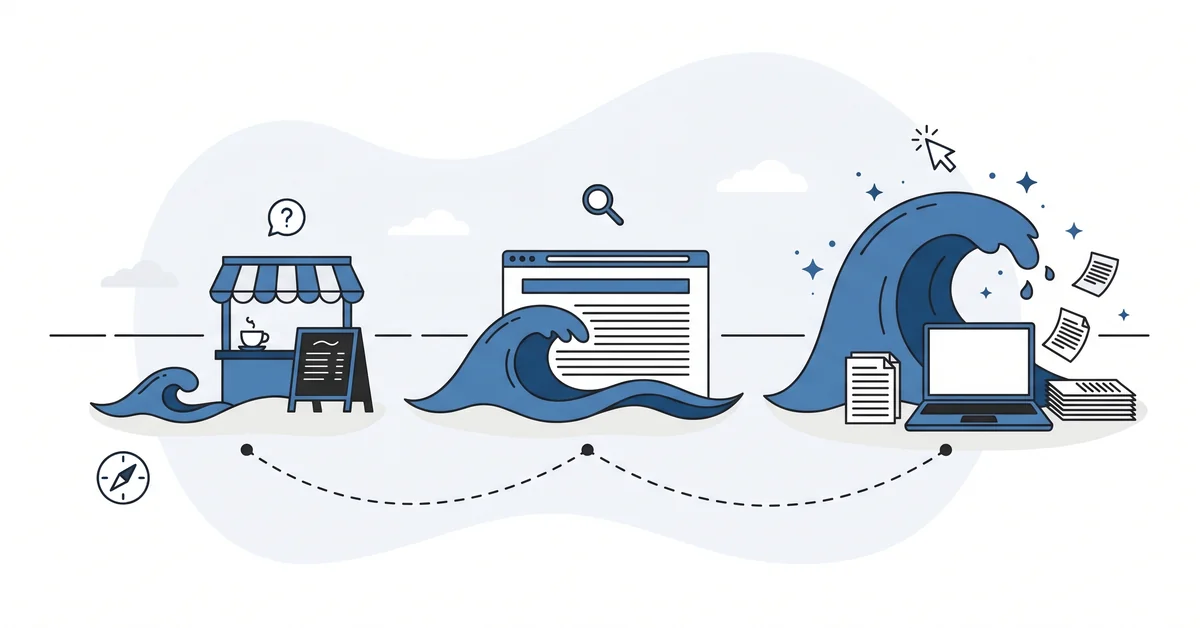
AI search is real. It is also uneven. The waves are not hitting every beach the same way.
A few months back, I sat with two business owners on the same afternoon. One ran a small local cafe. The other ran an online accounting tool.
Both had read the same scary article. Both were worried in exactly the same way.
I pulled up some data with them. The cafe was barely affected by AI Overviews at all. The accounting tool was being summarized inside AI answers and watching its blog clicks fall.
Same article. Same fear. Two completely different realities.
So how do you know which beach you are on?
How much does AI search actually replace Google for my business?
There is no single number. AI Overviews show up on roughly 13% to 25% of all Google searches in early 2026, depending on whose study you read. Inside that range, informational queries see them on close to 40% of searches, while e-commerce queries see them on about 4%. The honest answer depends on what your customers ask.
The 13% number comes from Semrush, looking at ten million keywords. The 25% number comes from Conductor, looking at almost twenty-two million U.S. queries. Both are doing real work. They just sample different things.
When you read "AI Overviews are on 48% of searches now," that usually means a U.S.-only sample, heavy on health and information topics. When you read "AI Overviews are on 13% of searches," that usually means a wider sample including many transactional categories. Neither study is wrong. Both miss your specific situation.
What matters for you is the mix. If your customers mostly ask "how does X work" — your impact is high. If they mostly ask "buy X near me" — your impact is small.
This is the first thing the headlines hide.
Why does AI search hit informational queries more than e-commerce?
AI engines are useful when a question has one good answer. WebFX data shows AI Overviews appear on 39% of informational queries and around 4% of e-commerce queries. Informational queries get the summary because that is where summaries actually help. Transactional queries still send the user to a page — the user wants to buy, not learn.
The mix is also moving. Through 2025, the share of AI Overviews triggered by informational queries fell from about 91% to 57%. Commercial and transactional queries took the difference. The system is reaching out of the "explain it to me" corner and starting to touch the "help me decide" corner.
So an online shop that sells one product line sits in a different position than a blog that explains a topic. They share a search engine. They do not share a wave.
What is happening to local search?
Whitespark’s research on local-business queries shows the local picture splits sharply by intent. Pure local-intent queries — someone typing your business name plus location — trigger AI Overviews about 15% of the time. Local informational queries — "what time does the museum open" — trigger them on roughly 92%. Local hybrid queries — "best Italian restaurant downtown that takes reservations" — trigger them on roughly 97%.
For a local business, the question is not "is AI in local search yet." The question is "which kind of local query brings my customers."
If your customers mostly type your name and address, AI is largely out of the way. If they describe their need and let Google guess, AI is most of the way in.
That split matters most when you serve one town. A small shop lives or dies on the searches that happen a few miles away. So it helps to see how AI changed local search for businesses that depend on nearby customers. The shift is not the same for a local cafe as it is for a national store.
This split inside local search is new. It was not like this a year ago.
Why are smaller sites losing more traffic than big ones?
Chartbeat data shared with Axios in March 2026 tracked publishers with 1,000 to 10,000 daily pageviews. They lost about 60% of search referral traffic over two years. Medium publishers lost 47%.
Large publishers lost 22%. Smaller sites are the most exposed because they have fewer paths to a reader outside of search.
Big sites have email lists, app users, brand recognition, and direct visitors. When search drops, the rest of the funnel softens the blow.
Small sites usually do not have that cushion. A 60% drop in search is close to a 60% drop in everything.
This is not only an AI search story. It is also a story about how fragile the small-site economy already was. AI search is making that fragility more visible.
There is one more thing worth knowing here. Brands that get cited inside AI answers see slightly higher click-through rates on the same searches, not lower.
The pain falls on sites that lose visibility entirely. It does not fall on sites that move from blue link to named source inside the answer.
Whether you become one of those named sources is partly a matter of what you write. It is also partly a matter of whether the AI engine even understands who you are. That is a longer conversation, and it sits in the next few articles.
Should I expect AI search to replace Google entirely?
Probably not — at least not in the timeframe most headlines suggest. Google’s overall share of all search slipped below 90% for the first time in mid-2024 and sat at about 89.5% in mid-2025. That is a small move, not a collapse.
Meanwhile U.S. organic search traffic was down only about 2.5% year over year as of January 2026. AI chatbot referrals to publishers — measured directly by analytics platforms — are still under 1% of total pageview referrals.
This is the disconfirming evidence most articles skip. Google is not falling apart. The big traffic losses are concentrated in publishers and informational sites, not in search as a whole.
What looks like decline at the small-site level is mostly a reshuffling. Less traffic from blue links. A small but growing share from AI citations. And a wider behavior change where many readers get their answer without clicking anything at all.
You can still build on Google. You just cannot count on it the way you used to.
Other questions worth answering
How does answer engine impact vary across industries like health, shopping, or real estate?
It varies sharply. ALM Corp’s February 2026 study across nine industries found AI Overviews on 43.6% of Science queries and 43.0% of Health queries. Shopping sits at 3.2%, Real Estate at 5.8%. News lands near 15.1%.
So your sector matters a lot. If you work in health or science, expect heavy AI involvement. If you sell physical goods, expect almost none.
Which answer engine matters most by user volume as of May 2026?
Each engine leads on a different metric:
- ChatGPT — 900 million weekly users (OpenAI, February 2026)
- Gemini — 750 million monthly users (Alphabet, Q4 2025)
- Google AI Mode — 75 million daily users (December 2025)
- Perplexity — 30 to 45 million monthly users
ChatGPT and Google’s AI surfaces cover the bulk of customer activity for most small companies.
As of early 2026, how reliably does a top organic ranking predict answer engine citation?
Less reliably than even a year ago. BrightEdge measured the overlap between top-10 Google rankings and AI Overview citations falling from about 75% in mid-2025 to 17-38% by early 2026. A separate Ahrefs Brand Radar study of 15,000 prompts found ChatGPT shares only 8% of its cited URLs with Google’s top-10. A page can hold its #1 ranking and stay almost invisible to answer engines.
Which wave is hitting your business?
Three small steps.
First, identify which query types your customers actually use — informational, commercial, transactional, or local. Most owners can guess this in five minutes if they think about the questions they hear all week.
Second, check whether AI Overviews appear for those query types in your category. Type a few of the real questions into Google and look at the top of the page. The four-surface visibility test walks through how to read chat, search, AI Overviews, and the citation graph in one short routine.
Third, decide whether your priority is appearing inside AI answers or staying strong on the blue links beneath them. The answer is rarely "do everything at once." Either path leans on linked entities AI recognizes — the engines pick up businesses they can place inside a wider graph of related people, products, and places.
Most small business owners do not need to chase AI citations on day one. They need to know which wave is hitting their beach.
If your customers mostly do transactional or local-name searches, the wave is small. Keep your normal SEO sound. Watch the data. Do not panic.
If your customers mostly ask informational questions, the wave is bigger. Start studying how to be cited inside AI answers, not only ranked beneath them.
The headline says AI is killing search. The data says it is reshaping search, unevenly, and your kind of business sits somewhere specific in that reshaping.
You do not have to fix everything this month. You have to read your own beach.
If you want a calm second opinion on which wave is hitting your business, you can contact me. No pitch. Just a clearer view of where your customers actually search.