Table of Contents
TL;DR
- Eugene Schwartz named the five awareness levels in 1966. The framework still anchors landing-page conversion craft because the right copy follows the level the buyer arrives at, not the writer’s preference.
- The five levels are most-aware, product-aware, solution-aware, problem-aware, and unaware. Each level needs a different opening sentence and a different proof shape on the page.
- Most underperforming small-business landing pages fail because the page speaks to one level and the traffic delivers three. The mismatch is invisible until somebody checks.
- The diagnosis is a one-page exercise. Read the headline aloud. Ask which level the sentence assumes. Tag three referral sources by likely level. The gap shows up in fifteen minutes.
- Pick one level for your one landing page. Send the buyers from other levels to a different page. The discipline is harder than the headline rewrite, and it is the move that actually moves the rate.
A small business runs one landing page. One offer, one headline. The traffic comes from a Google ad, a partner referral, an Instagram story, and the occasional ChatGPT recommendation.
The conversion rate sits at one percent.
The owner rewrites the headline. The rate stays at one percent. The owner tightens the button. The rate stays.
An A/B test runs on the hero image. The rate stays.
Each rewrite assumes the same buyer is reading. The traffic mix tells a different story. Five different buyers land on the same paragraph, each at a different level of awareness.
The page speaks fluently to one of them. The other four leave.
The page is not poorly written. The page is poorly aimed.
Why does a clean landing page still convert at one percent?
A landing page that converts at one percent is rarely failing on craft. The headline is fine. The button is visible. The proof is present.
The page stalls because the page assumes one kind of buyer, and the traffic delivers five.
The buyer who arrives ready to buy reads a paragraph aimed at someone three levels behind them. The buyer who has never met the problem reads a paragraph aimed at someone three levels ahead. Both leave for the same reason. The page did not meet them where they were.
The fix is not a tighter headline. The fix is the diagnosis the page never received. Most "the page does not convert" complaints trace to an awareness mismatch, not to a tactics failure.
Tactics fixes cost an afternoon. Awareness diagnosis costs an afternoon too, and most owners have never heard of it.
What does Schwartz mean by "awareness," in plain language?
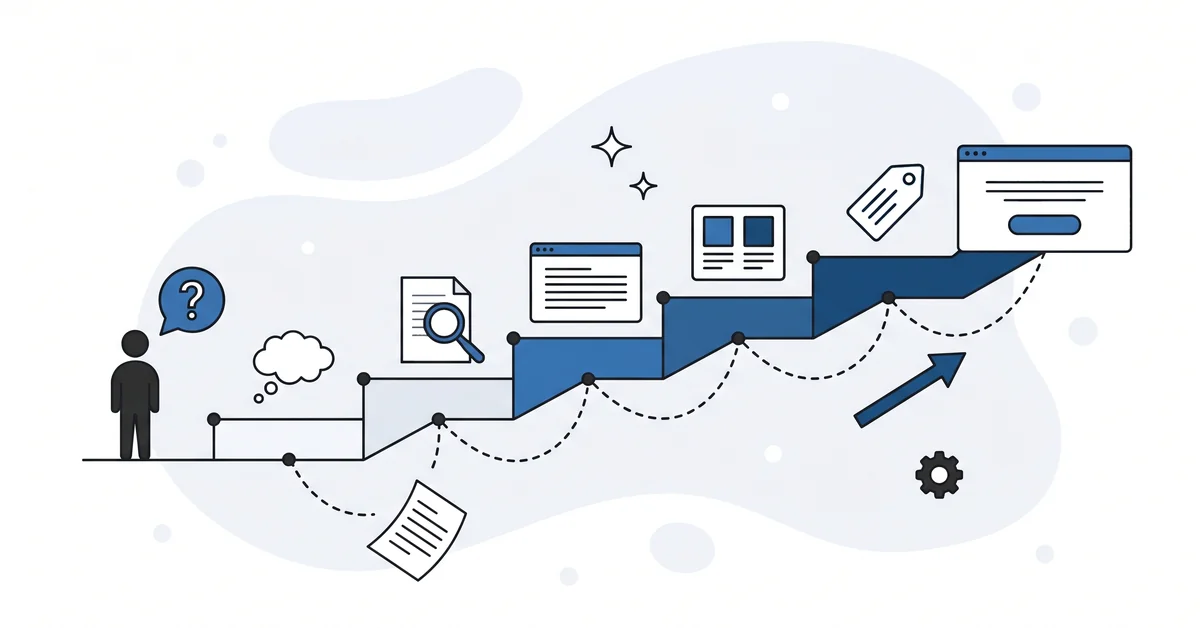
Awareness is what the buyer already knows about their problem and your offer when they arrive on the page. Eugene Schwartz introduced the five levels in his 1966 book Breakthrough Advertising. The levels are not personality types. They are positions on a path that runs from "I have no idea I have a problem" to "I am ready to buy from you specifically."
A buyer at each level needs a different opening sentence on the page. The buyer who already knows the offer wants the price. The buyer who knows the problem but not the solutions wants empathy first. The buyer who has never met the problem wants a story that names something they already feel.
Schwartz wrote for direct-mail copy. The levels apply unchanged to a 2026 landing page, because the underlying buyer behaviour has not moved. The page that lands at the right level converts at three or four percent. The page that lands at the wrong level converts at one.
How do you tell which level your buyer arrives at?
The diagnosis comes from three sources. The traffic source. The customer-support inbox. The first ten seconds on the page itself.
The traffic source tells you what the buyer was reading or searching when they clicked. A buyer arriving from a "best CRM for small business" comparison search is solution-aware. A buyer arriving from a "how do I get more leads" article is problem-aware. A buyer arriving from a brand-name search ("Acme CRM") is product-aware.
The customer-support inbox tells you which level your existing buyers tend to be at when they ask their first question. If the questions are "how do I install" the buyers were already most-aware when they bought. If the questions are "is this for me" the buyers arrived earlier on the path and the page closed them anyway.
The first ten seconds tell you what your page assumes. Read the headline aloud. Ask which level a stranger reading that sentence would have to be at to take the next step. The gap between that level and your traffic mix is the diagnosis.
What does each level actually need on the page?
Five levels, five page jobs. Each one has a default opening move that has worked across decades of testing.
Most-aware buyers want the offer. Price, guarantee, bonus, button. Skip the value proposition.
The buyer has decided. The page that pads with story loses the rate.
Product-aware buyers want comparison. Why this offer over the others they have considered. Specific differentiators with proof. Named-customer testimonials with role and company.
Solution-aware buyers want category education. Why the category is the right shape for the problem. Why this offer is the strong choice inside the category. The page that opens with the brand name (instead of the category) loses the buyer who is still placing the offer on a shelf.
Problem-aware buyers want empathy first. The pain named in their words. The cost of inaction named without exaggeration. Then the solution category.
A page that opens with the product loses the buyer who has not yet decided this category is the right shape.
Unaware buyers want a story. A scene that names something they feel but had not put into words. The product enters late, after the buyer has recognized themselves. The page that opens with the offer loses every buyer at this level, because the offer is meaningless without the recognition.
Which mismatch costs the most conversion on small-business pages?
Two mismatches show up most often on small-business pages. The first is a page written for solution-aware buyers receiving traffic from problem-aware buyers. The second is a page written for product-aware buyers receiving traffic from solution-aware buyers.
The first mismatch shows up when the founder built the page after reading three competitor sites. The page reads as a category description. "We are the leading platform for X."
The buyer arrives still asking whether a platform is the right shape for the problem. The page assumes the buyer has already answered yes. They have not.
The second mismatch shows up when the founder is proud of the offer and writes the page from inside the product. The page reads as a feature list with brand-specific names. The buyer arrives looking for the right category and is forced to learn a private vocabulary before they can decide. They leave.
Both mismatches are invisible until somebody reads the page aloud and asks which level it assumes. The fix in both cases is to add the missing layer in front of the existing copy. An empathy paragraph for the first mismatch. A category paragraph for the second.
How do you pick one level when traffic comes from many places?
Pick the level that delivers the most paying buyers. Send the rest to a different page.
Most of those buyers arrive on a phone. The level you pick has to land in the first screen, before a thumb scrolls past it. That is why reading the landing page on phones decides whether the right buyer ever sees it.
A small business with one landing page often runs a single offer for a mixed traffic source. That can work, but only when the page is built for the dominant level. The other levels need their own page or their own paragraph.
The discipline looks like this. Open a spreadsheet. List your traffic sources for the last quarter.
Tag each source by likely awareness level. Add the conversion rate.
The level with the highest paid-conversion count is the level the page should be built for. The other levels go onto a different page.
A blog post for problem-aware buyers, with a soft path to the landing page. A comparison page for product-aware buyers, linking to the main offer. A category-explainer page for solution-aware buyers, doing the education work the main page should not have to carry.
Where does AI search change the awareness mix?
AI search has shifted the awareness profile of buyers arriving on small-business landing pages. The shift is real but smaller than the headlines suggest.
Buyers from a ChatGPT or Perplexity recommendation are often further along the path than buyers from a plain Google search of the same query. The chat surface has done some of the comparison work upstream. The buyer who clicks through tends to land closer to product-aware than to solution-aware.
The opposite shift happens too. AI search introduces buyers to categories they never searched for. A buyer asking "how do I find clients without cold pitching" gets a recommendation for a niche category they had never met. The buyer arrives unaware-to-problem-aware on a page built for solution-aware traffic.
The implication is that the old "Google or social" split is no longer enough. Two buyers arriving from the same answer engine can sit at very different levels depending on the chat that recommended the page. Read the referral data more carefully than the page used to require.
Other questions worth answering
Where does Cialdini’s persuasion set fit alongside the five-stage diagnosis?
Robert Cialdini’s 1984 book Influence named seven persuasion principles. The fit with the five-stage diagnosis is layered, not parallel. Diagnosis decides which paragraph the reader meets at the top. Cialdini’s principles decide which sentence inside the chosen paragraph carries the weight.
Pick one principle per paragraph. Stacking three or four reads as salesmanship.
How does the MECLABS heuristic weight motivation against incentives?
The MECLABS Conversion Sequence Heuristic uses the formula C equals 4m plus 3v plus 2 of i minus f minus 2a. Motivation gets the highest weight at four. Value-prop strength sits next at three. Friction and anxiety subtract.
Per the 2026 Conversion copywriting research narrative, the relative weights match practitioner intuition rather than empirical study. The takeaway: motivation matters most, and the value-prop matters more than the incentive.
Why do PAS and BAB compress better than AIDA at extractable-block lengths?
Because PAS and BAB have three beats. AIDA has four. At a 50 to 150 word block, three beats fit. Four beats lose structural integrity.
PAS gives you problem, agitation, solution. BAB gives you before, after, bridge. AIDA’s attention act becomes a hook fragment when the whole arc has 50 words. The framework loses the shape that does the work.
Does the proof hierarchy shift when the offer is high-ticket B2B versus low-ticket B2C?
The hierarchy holds in shape but the ordering shifts. Specific-results proof stays at the top in both. Named-customer testimonials carry more weight in B2B because the buying committee verifies referenced peers. Cialdini’s social-proof principle does heavier work in B2C, where logo bars and aggregate ratings borrow recognition for the scanning reader.
The discipline is the same. The shelf order moves.
Which awareness check would you run on your landing page first?
Read your hero headline aloud. Ask one question. Which awareness level does this sentence assume?
If the sentence names a category the buyer already knows ("the easiest CRM for small businesses"), the page is built for solution-aware buyers. If the sentence names a brand ("Acme CRM gets you more deals"), the page is built for product-aware buyers. If the sentence names a price or an offer ("Acme CRM, free for 30 days"), the page is built for most-aware buyers.
Compare the answer with your traffic mix from the last quarter. If the bulk of your paying buyers arrived at the level the page assumes, the page is doing its job at the awareness layer. If most of your buyers arrived earlier on the path, the page is asking them to skip steps they have not taken yet.
For more on the upstream strategic frame that decides which level to aim for, see how to position yourself as a freelancer. For more on reading the buyer’s vocabulary before you write the headline, see how to identify customer pain points.
If your small-business landing page converts at one percent and you want a second pair of eyes on awareness, you can contact me here. Send the URL and one sentence on where most of your traffic comes from. I will run the three-source diagnosis and name the level the page is built for and the level your buyers actually arrive at. There is no charge and no follow-up sales call.