Table of Contents
TL;DR
- A single seed keyword produces a cluster in one LLM prompt: feed the seed, your current H1, one paragraph about your offer, and ask for five to seven subtopics plus one user-intent label per subtopic.
- Cross-check the cluster against Google autocomplete and People-Also-Ask. The language model is the scaffolding. Google’s live data is the reality check.
- LLMs cannot produce reliable search volume, keyword difficulty, or cost-per-click numbers. Keyword tools still own those measurements. The LLM only shows the shape of the cluster.
- A 2026 benchmark across 37 language models reports hallucination rates of 15-52 percent overall and 40-80 percent on open-ended generation. Verify the three subtopics the language model looks weakest on.
- The cluster becomes a pillar-plus-spoke site plan: head term is the pillar page, subtopics are spoke pages, intent labels decide the format per page.
You have one keyword that matters for your business.
"Home coffee brewing." "Small-business CRM." "Wedding photography Belgrade."
You know the keyword pays. You do not know the twenty other phrases people type when they want what you sell.
That gap is where keyword research lives. In 2019, closing the gap meant paying for a seat on SEMrush, Ahrefs, or Keyword Insights. In 2026, one LLM prompt closes most of it in about thirty seconds.
Most of it. Not all of it.
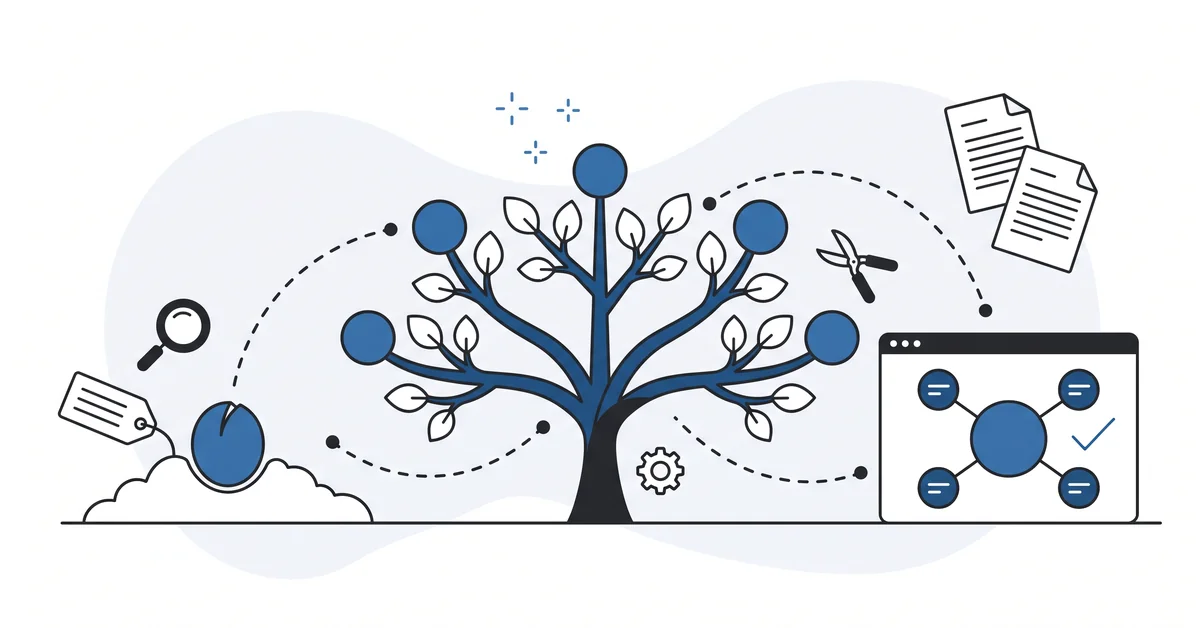
Think about planting a seed in the ground. You can see the seed. You cannot see the tree.
The LLM shows you the shape of the tree — five branches, twenty leaves, a rough outline of where the shade will fall. But you still have to prune the tree before it looks like something you would put in your yard.
The LLM grows the scaffolding. You still prune.
Why does one keyword keep you stuck?
Most site owners pick one keyword and write one page for it. Then they wonder why traffic sits flat.
Search engines reward coverage. Google’s topical authority signal fires when your site answers not just the head term but also the ten questions a reader asks right before and right after the head. "Home coffee brewing" pulls weight when the same site also covers grinders, water temperature, bean storage, and brew ratios.
One page is a leaf. A cluster is a branch. A site plan is a tree.
The LLM’s job is to show you the branches you cannot see from where you are standing.
How do LLMs turn a seed into a cluster?
Feed the language model three things. The seed keyword. Your current page’s H1. One paragraph that names who the offer is for and what makes it different.
Ask for the cluster in one prompt. Head term, five to seven supporting subtopics, one user-intent label per subtopic — informational, navigational, commercial investigation, or transactional. The search intent for keyword research walkthrough explains how each intent label maps to a different page format.
The AI model returns the cluster in a single response. Thirty seconds later, you have a draft scaffold that would have cost two hours of manual keyword-tool work in 2023.
Shai Belinsky at Similarweb calls the broader move "LLM seeding" in a January 2026 analysis. He defines it as placing your content "within the specific datasets and high-authority domains that Large Language Models trust and cite." The seed-to-cluster prompt is one tactical unit inside that broader strategy.
What does the prompt actually look like?
"You are an SEO strategist. My seed keyword is {seed}. My page’s current H1 is {H1}. One paragraph about my offer and audience: {paragraph}."
"Return a cluster: the head term, five to seven supporting subtopics, one user-intent label per subtopic. Flag any subtopic where you are under fifty-percent confident the query volume is real."
That last line — the confidence flag — catches the cluster members the language model is guessing at.
Taher Dawoodi at Basar Optimization runs a similar workflow in five steps:
- Define the seed and thematic boundary.
- Generate the keyword universe via AI.
- Cluster the output with a traditional tool like Semrush.
- Designate pillars versus supporting pages.
- Audit for cannibalization.
Same pattern. The AI model does the expansive step. The human runs the filtering step.
What does an LLM get wrong about keywords?
Three things. Search volume. Keyword difficulty. Cost-per-click.
The AI model will confidently invent all three if you do not refuse them in the prompt. It has no access to Google’s query logs or SEMrush’s index. It is guessing from training data that last saw your niche months ago.
Dawoodi puts the line directly. "ChatGPT cannot provide credible search volume or keyword difficulty metrics." LLMs cannot determine SERP intent reliably, detect cannibalization, or account for conversion rates on their own.
SQ Magazine’s April 2026 hallucination benchmark across thirty-seven language models is blunter. Open-ended generation tasks show hallucination rates between forty and eighty percent. Structured, source-constrained tasks — summarization, grounded retrieval — drop under two percent.
The seed-to-cluster task sits in the middle. It is structured enough to trust at the category level. It is open-ended enough that specific numbers inside the cluster need verification.
That is why the prompt ends with a confidence flag. You want to know which branches the AI model was stretching for.
How does the cluster become a site plan?
Six subtopics become six draft page ideas. One intent label per subtopic tells you the format.
Informational intent wants a how-to or an explainer. Commercial investigation wants a comparison. Transactional wants a service page. Navigational wants a direct landing page for the brand or tool.
Andrew Shum at SeoProfy describes the architecture as hub-and-spoke. One pillar page owns the seed. Five to seven spoke pages own the subtopics.
Each spoke addresses exactly one intent, with no topic overlap between spokes. Internal links run from the pillar out to the spokes and back.
The cluster maps cleanly onto this structure. Head term becomes the pillar. Subtopics become spokes. Intent labels become page formats.
You have a site plan you can show a writer on Monday morning.
Why still use keyword tools?
Because the language model cannot count.
Google’s autocomplete drop-down is free and live. Type your seed and let Google finish the sentence three times. The three completions are real queries with real demand.
Compare them to the AI model’s cluster. Overlap means the AI model found real territory. Gaps mean it was guessing.
People-Also-Ask is free and live and even more useful. Search the seed on Google and read the four questions Google surfaces. Those are the exact extractable answers your future page needs to carry.
For volume numbers, keyword difficulty, and CPC, you still need a tool. Semrush, Ahrefs, Keyword Insights, or the free Google Keyword Planner — pick one. The LLM is the scaffolding. The tool is the measuring tape.
One prompt cut an afternoon of manual expansion to thirty seconds. Two free cross-checks keep the thirty seconds honest.
Other questions worth answering
How often should I refresh the topical map after running this exercise?
Twice a year for most small sites. Search behavior shifts slowly, reader questions shift faster. Re-run the exercise when you launch a new offer or when traffic flattens.
Per Andrew Shum’s January 2026 SeoProfy analysis, the hub-and-spoke architecture is durable. The spokes underneath it are not.
Does the choice between ChatGPT, Claude, and Gemini change the output?
Short answer: at the margins, not in the fundamentals. ChatGPT leans verbose, Claude leans more structured, Gemini hooks into Google’s index harder than the other two.
Long answer: for a single seed all three return a workable scaffold. Pick the engine whose output you find easier to edit. The bottleneck is your filtering step, not the generation step.
What happens when two subtopics overlap on the same query?
Two pages chasing the same query split the ranking signal. Google picks one to rank and demotes the other. Drop the weaker page.
Taher Dawoodi’s February 2026 Basar Optimization workflow ends on a cannibalization audit for this reason. Fold the weaker page into the stronger one. Redirect the URL. You lose a draft idea but gain a page that actually ranks.
Should I run the same exercise for a competitor’s domain to find gaps?
Yes, with caution. Run the exercise on your competitor’s head term. Compare the two outputs side-by-side.
The overlap shows you the table-stakes coverage every page in the niche carries. The gaps show you the opening. Verify the gap subtopics against Google autocomplete before you commit a quarter of writing to them.
How should you expand one seed keyword into a cluster?
Pick your one keyword that matters most. Open your favorite AI model. Copy the prompt above.
Feed in the seed, your current page’s H1, and one paragraph about who the offer is for and what makes it different.
Read the cluster the AI model returns. Cross-check the subtopics against Google autocomplete for the same seed. Cross-check the questions against People-Also-Ask.
Verify the three subtopics you think the AI model is weakest on, using whatever keyword tool you already have. If you do not have a keyword tool, Google Keyword Planner is free and directionally reliable for one seed at a time. The keyword research without paid tools guide covers the autocomplete + People-Also-Ask method end-to-end.
What returns is your pillar-plus-cluster scaffold for the next quarter’s editorial calendar.
You planted the seed. The AI model grew the branches. Your job is to prune the tree.
If you have worked through the cluster and are unsure which subtopics are real territory versus AI-model guesses, you can contact me here. Paste the cluster and your one paragraph of context.
I will flag which branches the AI model was stretching for. I will also show where the cluster is thin and where the pillar could actually pull weight. No pitch.