Table of Contents
TL;DR
- Google Business Profile is not optional for a local business in 2026. The chat surfaces use the profile to verify a local business exists before they recommend it. A weak profile damages citation confidence across every other surface.
- 8 of the top 10 Local Pack ranking factors come directly from Google Business Profile fields, per Whitespark’s 2026 survey of 47 local-SEO practitioners. The category, address, hours, phone, description, and photos do most of the work.
- The primary category is the single most influential field. Pick the most specific sub-type that honestly fits the work. "Plumber" beats "Home Services Contractor." "Dental Implant Periodontist" beats "Dentist" when the work is specialized.
- 59% of ChatGPT queries that trigger a web lookup carry local intent. The chat surfaces typically return 3 to 5 business names per local recommendation, not the ten-result page plus map pack of legacy local search.
- The mistake that gets profiles suspended is keyword-stuffing the business name field. Use the exact legal name as it appears on your signage. The 2025 AI-driven enforcement update made automated flagging immediate.
A small bakery owner in Austin opens her phone and types her business name into Google Maps. Three results come back. None of them is her bakery.
The first result is a generic "Austin bakery" listing she does not recognize. The second is a coffee shop two suburbs over. The third is a bakery that closed in 2023.
She knows her bakery is the right answer to that search. The map does not. Six years of word-of-mouth.
Three hundred regular customers. A steady five-star review trickle on Yelp. And the map cannot find her business when a local types her own name.
The reason is upstream of the map. Her Google Business Profile was set up by a friend in 2019. The friend picked the wrong primary category and used an address that does not quite match her storefront sign.
The profile has not been touched since. Google has slowly stopped trusting the data. The chat surfaces have followed.
A Google Business Profile is the front-door sign on a brick-and-mortar shop. The chat surfaces use it to confirm the shop exists before they tell anyone to go inside. A sign that has been faded for six years signals an unclear status the engines route around.
This piece is the short version of how to set up the profile from scratch and how to fix the seven things that matter most. Eight of the top ten Local Pack factors come from Google Business Profile fields. The work is mechanical, takes a weekend at most, and pays off across every surface a local customer might use to find you.
Why does the Google Business Profile still matter when the chat surfaces answer first?
The chat surfaces use Google Business Profile data to verify a local business exists before they recommend it. That verification step is invisible to the customer. It is also invisible to most business owners. It is what determines whether the chat surface confidently includes you in the three-name reply or quietly leaves you out.
The pipeline is layered. Profile data feeds Google’s Knowledge Graph. The Knowledge Graph feeds AI Overviews.
The other engines — ChatGPT, Claude, Perplexity, Gemini — cross-reference Google’s entity data when they decide which local businesses are real. A weak profile damages citation confidence on every surface, not just on Google.
Profound’s 2025 analysis put a number on the volume of local-intent traffic at stake. 59% of ChatGPT queries that trigger a web lookup carry local intent. The chat surfaces typically return 3 to 5 business names per local recommendation. The legacy ten-result page plus map pack is gone. Each slot is more competitive than a Map Pack position — losing one matters more.
A local business in 2026 needs the profile to do three things. Confirm the business is real to Google. Match the right local queries to the right service.
Signal recency through engagement. The setup work is the foundation. The maintenance work is what keeps the engines treating the profile as live.
How do you set up a profile from scratch without paying anyone?
Go to google.com/business and sign in with the Gmail account you want to use to manage the profile. The Gmail account is permanent. The profile lives or dies with that login, so pick the address you will still have in five years.
Search for your business name in the box. If a listing already exists — often a customer or someone else added you — claim it instead of creating a new one. If no listing exists, click "Add your business to Google." Use the legal business name exactly as it appears on your storefront sign and on your business license.
No keywords, no city tags, no marketing additions. Just the name.
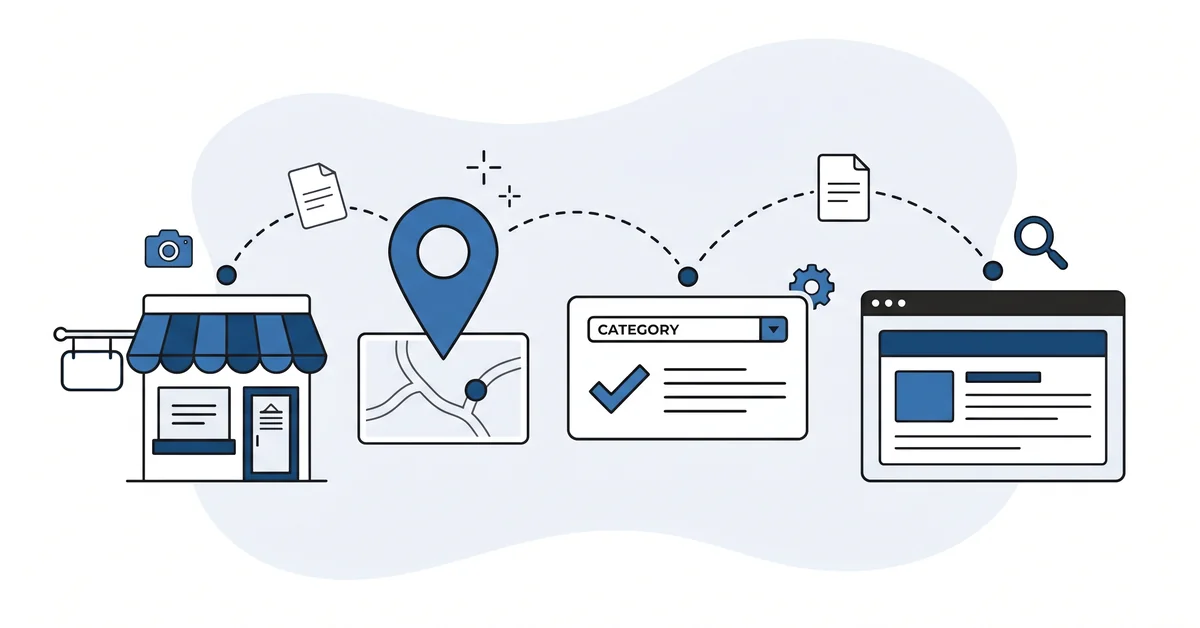
Add the address if you have a storefront customers visit. Add the service area instead if you serve customers at their location and do not run a public storefront. Pick the primary category from the dropdown — this is the single most important decision in the setup. Add the phone number, the website, the business hours.
Verification comes last. Google offers one of three methods depending on the business type. Postcard mailed to the address, automated phone call to the listed number, or video verification through the app. Pick the fastest one available.
The setup work takes thirty minutes. The verification step can take three days to two weeks. Nothing on the profile is live for the engines until the verification clears.
Which fields actually influence local rankings and which are decoration?
Whitespark’s 2026 Local Search Ranking Factors survey aggregated the opinions of 47 local-SEO practitioners across 187 factors. The result is the most authoritative practitioner answer on what actually moves the needle.
Eight of the top ten Local Pack ranking factors come directly from Google Business Profile fields. The fields that matter most are the primary category, the address or service area, business hours, phone number, business description, and the photo set. Reviews and engagement signals make up most of the rest of the top ten. Together, GBP-related signals account for roughly 32% of Local Pack and Maps ranking weight in the survey.
Other fields on the profile are useful but not decisive. Product listings, offers, services, attributes (wheelchair-accessible, free Wi-Fi, accepts crypto), and the Q&A section are engagement signals more than ranking signals. They help when they match what customers search, but they do not move rankings on their own. Spending hours building out a hundred product entries is rarely the right use of time for a small local business.
The hierarchy is worth keeping in mind during the setup. Get the top fields right first. Add the optional fields when you have time. Skip the fields that do not match anything customers actually ask about.
Why is the primary category the most important field on the profile?
The primary category is what the engines use to match the profile to specific local queries. Every other field describes the business. The category labels what kind of business it is.
Pick the most specific sub-type that honestly fits the work. "Plumber" beats "Home Services Contractor." "Dental Implant Periodontist" beats "Dentist" when the work is specialized. "Italian Restaurant" beats "Restaurant" when the food is Italian.
The chat surfaces match the named sub-type to the customer’s specific question. A generic root category puts the profile in the same pool as a thousand other generic-category profiles in the same metro area.
The trap is choosing a category that sounds bigger than the actual business. A solo plumber who picks "Plumbing Contractor" instead of "Plumber" gets matched against multi-truck commercial operators in the same searches. The profile loses to bigger competitors in queries it should never have entered. Pick the category that matches what you actually do, not what you wish you did.
Secondary categories help in specific cases. A bakery that also sells coffee can add "Coffee Shop" as a secondary. A dental implant specialist who also does general dentistry can add "Dentist" as a secondary. Pick at most two — more than that dilutes the matching signal Google uses for the primary.
How does name, address, and phone consistency across the web actually affect AI citations?
Yext’s 2025 analysis of 6.8 million AI citations turned up a striking number. Brand-managed sources — the website, directory listings, reviews, social profiles — account for 86% of citations in location-intent AI queries. That number turns name-address-phone consistency from a legacy SEO chore into an active AEO signal.
The mechanism is entity resolution. The engines see four versions of one business across the web. "Joe’s Plumbing" on your website.
"Joe’s Plumbing LLC" on Yelp. "Joe’s Plumbing Service" on the BBB listing. "Joe Plumbing" on Angi.
The engines have to decide whether all four refer to the same business. The cleaner the match across sources, the higher the engine’s confidence. The lower the match, the lower the citation rate.
The fix is not glamorous. List every place your business name appears online. The website, Google Business Profile, Yelp, BBB, Apple Maps, Bing Places, Facebook, your industry-specific directories.
Use the exact same business name on every one. Use the exact same address format. Use the exact same phone number with the same dashes or no dashes — pick one and stick with it.
The site article on local SEO basics for small businesses on a tight budget walks through the consistency check directory by directory.
A weekend of cleanup work pays for years. New listings inherit the consistency. Old listings either match or get reported and corrected through the standard "claim" or "suggest an edit" flows on each platform.
What photo and post cadence keeps the profile reading as a live business?
Three to four real photos every quarter is enough. Real means shot inside the business, by the owner or a customer, not stock images. The engines downgrade obvious stock photography. Customer-submitted photos count as user-generated content signals and appear in the profile alongside owner uploads.
The minimum photo set Google recommends is three exterior shots, three interior shots, and three product or service shots. A logo and a cover photo round out the basics. Most small businesses have these photos sitting on a phone already. The work is uploading them, not creating them.
Posts cadence is where most profiles fall behind. Google Business Profile supports updates, offers, events, and product posts. A one-line update with a photo is enough — the cadence matters more than the polish.
Reviews are the other half of a live profile. A steady trickle of recent reviews tells the engines the business is real and busy. The hard part is asking, so here is a calm way to get more Google reviews.
Posting every two weeks keeps the profile in Google’s "active" engagement bucket. Posting once a year reads as a half-abandoned profile.
The site article on local content ideas that pull nearby customers in 2026 covers the broader content cadence. The profile slots into that plan. It is not a separate marketing project. It is one piece of the local content plan.
What is the one mistake that gets a profile suspended, and how do you avoid it?
Stuffing keywords into the business name field. That is the single most common cause of suspension, and Google’s enforcement on it changed sharply in 2025.
"Joe’s Plumbing" is fine. "Joe’s Best Affordable Emergency Plumbing Austin TX" gets the profile suspended. Adding service descriptors, location modifiers, marketing phrases, or trademark symbols not on your physical signage all count as policy violations.
Sterling Sky’s 2026 analysis of 50 keyword-stuffed listings, mostly in the legal vertical, documented the enforcement pattern. Google issued warnings on 60% of violators, soft suspensions on 20%, and hard suspensions on 20%.
The 2025 enforcement update made the flagging automatic. AI-driven systems now catch keyword-stuffed names at the pre-publication stage. The window between violation and enforcement collapsed from years to days. The grace period that long-time competitors used to exploit is gone.
The fix is short. Use the legal business name exactly as it appears on your signage, your stationery, and your business license. If your trade name is "Joe’s Plumbing," that is the name. If you legally operate as "Joe Smith Plumbing LLC," either form is acceptable.
The chosen one just has to be consistent across your website and the profile. Nothing else goes in the name field. Service descriptors belong in the description. Location belongs in the address.
Other questions worth answering
How do the engines spot fake or churned review data on a dashboard?
Two checks. The engines compare review counts across platforms and watch for sudden volume spikes in 2026. A dashboard showing roughly twenty times the count of any other directory triggers an entity-confidence drop in Google’s eyes. Twenty new reviews inside two days reads as a coordinated push, not organic growth.
Why do directory listings beyond Yelp and BBB carry weight for entity verification?
Because the engines use directory profiles to resolve a single entity across the web in 2026. Most SEO plugins populate the sameAs property on your site with social URLs by default. For service businesses, the directories that pay back are Angi, Houzz, Healthgrades, Avvo, and industry-specific listings, not Twitter or Facebook.
Does an About page do different work for the engines than a dedicated owner-bio page?
Yes. The About page tells the engines what the company is and why it exists. A dedicated owner-bio page tells them who runs it and what experience backs the work. Per the 2026 reshuffling of E-E-A-T signals, Experience leads, Expertise is second, Trustworthiness is third, and Authoritativeness has dropped to last.
What changes when a service-area company has no public storefront for the engines to verify?
Three changes. The schema.org areaServed value becomes a city list or a geographic circle, not a street address. Google treats your service zone as the trust anchor in 2026, not a physical door. A plumber serving the whole Dallas metro lists Dallas, Plano, and Frisco rather than a public visit address.
Which Google Business Profile field should you fix first?
Open your profile and check the primary category. If it is the generic root category for your industry, change it. "Restaurant" becomes "Italian Restaurant." "Dentist" becomes "Dental Implant Periodontist." "Home Services Contractor" becomes "Plumber." Pick the most specific sub-type that honestly fits your work.
That single change moves more local visibility than any other ten-minute task on the profile. The category is what both the chat surfaces and the Map Pack use to match queries to your business. A more specific category puts you in a smaller and more relevant pool of competitors. The win rate inside that pool is higher than the win rate in the generic pool.
The other fields can wait a week. The category cannot. Once the category is right, the maintenance rhythm takes over. Photos every quarter, posts every two weeks, hours updated when they change, name-address-phone consistency checked once a year.
If you want a second pair of eyes on the category choice before you change it, you can contact me here. Send me your current category and one paragraph on what you actually do. I will name the sub-type I would pick, with the reasoning. No pitch.