Table of Contents
TL;DR
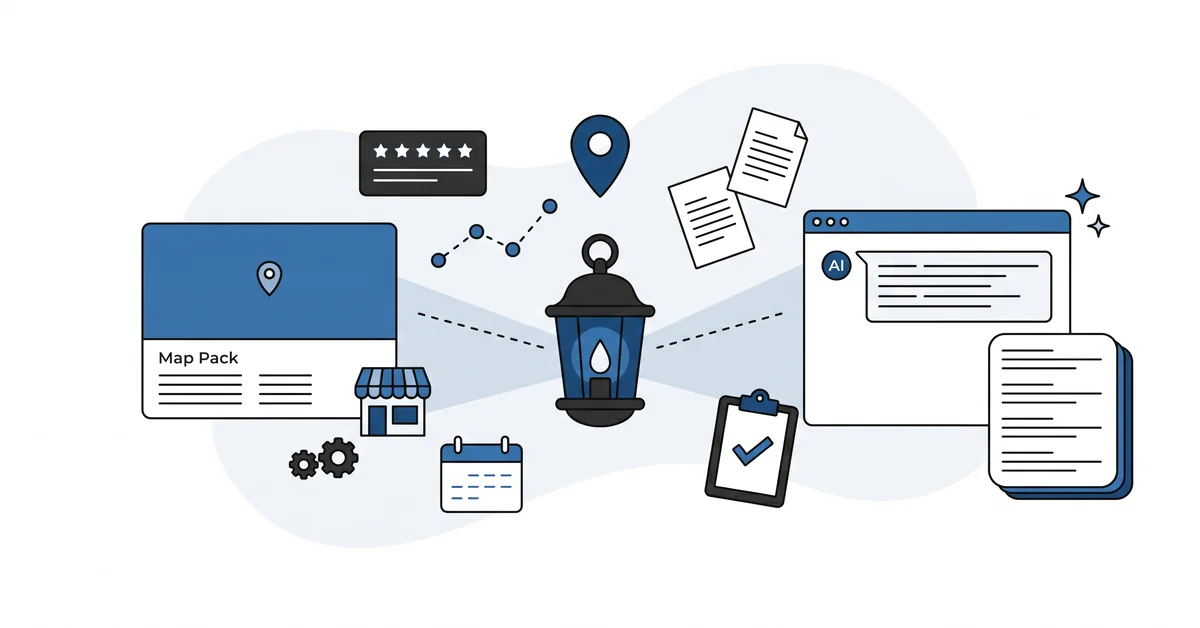
- Showing up on Google as a small local business in 2026 means showing up on three surfaces — the Map Pack, the standard organic results, and the AI-chat reply. No single surface answers every query a customer might run.
- The foundation is three free signals. A complete Google Business Profile. A website that names the location and describes the work in plain English. Consistent name, address, and phone across every directory.
- Whitespark’s 2026 survey ranks GBP-related signals at 32% of Local Pack and Maps weight. Eight of the top ten ranking factors come from Google Business Profile fields. The foundation is less work than most owners assume.
- Profound found 59% of ChatGPT queries that trigger a web lookup carry local intent. The chat surfaces typically return three to five business names per local recommendation, not the ten of a traditional results page.
- The one move to make first is fixing the primary category on the Google Business Profile. Pick the most specific sub-type that honestly fits the work. The single ten-minute change moves more visibility than any other field on the profile.
Most local-SEO advice you read in 2026 is still calibrated to a 2019 results page that no longer exists.
The page used to look the same to almost every customer. Ten blue links, a small map at the top, three featured local listings. A small business that worked the basics — a clean Google listing, a few reviews, a website that mentioned the city — could see itself on the page within a few weeks.
The page in 2026 looks different to almost every customer. The Map Pack is still there, but it sits underneath an AI Overview on roughly two of every three local searches. A different customer asks the same question in Perplexity instead of Google and never sees the Map Pack at all. A third customer asks ChatGPT and gets three names in a paragraph with no map and no links until they ask for them.
The same small business has to show up on all three surfaces because the customer no longer chooses just one. The good news is that the underlying work is the same on all three. The harder news is that "the basics" now include the Google Business Profile fields the chat surfaces use to verify your business is real. Most small businesses last touched their profile in 2018.
This piece is the short story of what showing up actually means now and which moves matter most for a small local business with no marketing budget. The work is reachable on a Sunday afternoon. The result lasts for years.
What does "showing up on Google" actually mean for a local business in 2026?
It means showing up on three surfaces, not one.
The Map Pack still hands out three names plus a small map for direct local queries like "plumber Austin" or "best dentist nearby." The standard organic results sit underneath, with the next ten or so blue links. AI Overviews and chat-style replies hand out two or three names for informational and hybrid queries. Those are the questions a customer asks while deciding between businesses, not the queries they type when they have already decided.
The same business has to be visible across all three surfaces because no single surface answers every query a customer might run.
A bakery owner who shows up only in the Map Pack loses every customer who asked Perplexity "where is the best sourdough in north Austin?" The chat reply names the three bakeries it can verify, and her listing is not one of them. A bakery owner who shows up only in the AI Overview loses every customer who tapped Maps and got three direct competitors instead.
The work to win each surface overlaps almost entirely. The same Google Business Profile, the same consistent name and address, the same recent reviews, the same well-written service pages all feed into all three surfaces. There is no separate AI checklist — there is one underlying job, done well enough that all three surfaces pick you up.
Why are your customers searching in three different places now?
A potential customer no longer types one query into one box.
They type a quick "best cafe near me" into Maps for a foot-traffic decision they have already made. They ask Perplexity "what is the most reliable plumber in central Austin" before they call. They check Google’s AI Overview before they scroll to the organic results. They look at the Map Pack underneath the Overview only if the Overview did not give them what they wanted.
Each surface answers a different shape of question. Direct queries with explicit location go to Maps and the Map Pack. Informational and comparison queries — "best," "most reliable," "cheapest near me," "open Sunday" — go to the AI surfaces. Hybrid queries flow between both depending on the customer’s mood and the device they are holding.
Profound’s 2025 analysis put a number on the volume of local-intent traffic at stake. 59% of ChatGPT queries that trigger a web lookup carry local intent. The customer is local even when the surface they are using is not labelled as a local search.
The implication is that "showing up on Google" in 2026 means showing up on the surfaces that share Google’s underlying entity data. That includes the chat surfaces that cross-reference Google’s Knowledge Graph when they decide which local businesses are real.
What is the foundation Google needs from a small local business?
Three signals, all free, all deeply boring.
A complete and active Google Business Profile. A website that names the location in the first 100 words and describes the actual services in plain English. A consistent name, address, and phone across every directory the engines crawl.
Whitespark’s 2026 Local Search Ranking Factors survey of 47 local-SEO practitioners ranks Google Business Profile-related signals at 32% of Local Pack and Maps ranking weight. Eight of the top ten ranking factors come straight from Google Business Profile fields. The foundation is less work than most owners assume and more important than most agencies want to admit.
The site article on setting up and optimizing the Google Business Profile walks through the field-by-field setup. The short version: the profile is the foundation. The website and the directory listings are the supporting structure that makes the profile credible.
A profile by itself is a claim. A profile plus a matching website plus matching directory listings is a verified entity. The chat surfaces and the Map Pack both reward the verified entity over the lonely profile.
How does your website earn its slot in the Local Pack?
One service per page, not five.
A page that tries to cover plumbing, drain cleaning, water heater repair, sewer service, and emergency calls covers none of them well. Neither the Map Pack nor the chat surface can extract a clean answer from a page that says everything about every service. The fix is to split the page into one focused page per service, even if each one is short.
A heading that mirrors a question the customer might literally type. "How much does emergency drain cleaning cost in central Austin?" is a heading. "Drain Cleaning Services" is a label. The heading the searcher might type ranks better on both surfaces and pulls a cleaner extract into the chat reply.
The town or neighbourhood named in the first paragraph, not just in the footer. Once is enough. The geo signal in the first 100 words is one of the cheapest ways to tell the engines this page belongs to a particular place.
A short FAQ at the bottom answering the three or four questions customers actually ask. The chat surfaces lift those question-and-answer pairs straight into their replies when the query is informational. The page becomes the source the engine quotes from.
A LocalBusiness identity block in the page source so the engines can verify the page belongs to a real business with a real address. Most modern SEO plugins write this block automatically once you fill in the basics.
The work takes a long afternoon to do once and a small touch-up every six months.
Why do honest reviews still pull more weight than star count?
Whitespark’s 2026 survey ranks review recency 11th among all local-rank factors.
A six-month-old five-star average matters less than three honest reviews from the last quarter. Ten real reviews from this year out-pull a hundred from three years ago on most local queries that matter for foot traffic.
Reviews you ask for in person, when the work is fresh, land at far higher rates than generic email asks weeks later. A short follow-up message the next day with the direct review link does most of the remaining work. The link matters. One click between the customer and the review form is the difference between a five-star review you got and a five-star review the customer meant to leave.
Reply to every review you already have. Including the negative ones. Especially the negative ones. A short, calm, named reply on a one-star review tells future readers more about the business than the original complaint did.
Do not buy reviews. Do not ask for "five-star reviews" — ask for honest ones. Google’s review-fraud detection has improved sharply in 2025, and the language patterns of incentivised review sweeps now get caught at the pre-publication stage.
What are the signals that say "this business is still alive"?
A profile that posted last week. Replied to last month’s reviews. Has a photo from this season. Shows the right hours for the public holiday.
Each signal is small. Together they tell Google and the chat surfaces the listing is maintained by a real person who runs a real business. The Whitespark survey identifies engagement signals as having gained ranking weight in the 2026 edition compared to prior years.
A profile last updated in 2022 reads as half-abandoned to the engines and they route around it. The competitor next door who posts a one-line update with a phone photo every two weeks moves ahead of you on engagement signals alone. The bones of your profile may be stronger. The recency wins anyway.
Two hours a quarter on the maintenance moves a small business ahead of every competitor who set up the listing in 2018 and walked away. Most of your local competitors fall in that second category. The walking-away rate among small local businesses on Google Business Profile is, in my experience, north of half.
The maintenance is unglamorous on purpose. Three new photos. One short post about the service offered or a customer outcome.
Five replies to recent reviews. One quick scan of the hours field for the next holiday. Done in under thirty minutes once you have the rhythm.
Why does the same business name everywhere matter so much in 2026?
Pick one master version of your name, address, and phone. Use it identically everywhere.
Yext analysed 6.8 million AI citations in 2025 and turned up a striking pattern. Brand-managed sources — the website, directory listings, reviews, social profiles — account for 86% of the citations in location-intent AI queries.
Inconsistencies across those sources cause the engines to lower confidence in the business as a single entity. When the website says one address and Yelp says another, the engine has to choose which version to trust. More often it treats you as two weaker entities instead of one strong one. The recommendation slot then goes to a competitor whose data lines up cleanly across the dozen directories the engine crawled.
The site article on local SEO on a tight budget walks through the directory cleanup directory by directory. The rule is one master record, copied identically. A spreadsheet with one row per directory and a Sunday afternoon of editing covers most of the citation graph the engines look at.
Other questions worth answering
How does AI Overview frequency change between simple-intent and informational-intent queries?
About 15% on simple-intent queries like ‘tacos san francisco’, versus 92% on informational-intent queries like ‘best plumber central Austin’. Those figures come from Miriam Ellis’s March 2026 Search Engine Land summary of Whitespark’s Q2 2025 local-search study. Hybrid-intent queries trigger AI Overviews 97% of the time. The simpler and more directional the query, the less likely an AI summary sits between the customer and the business.
What’s the schema difference between a service-area plumber and a single-storefront bakery?
Two distinct schema patterns apply. A service-area plumber declares areaServed as a GeoCircle or list of cities inside the LocalBusiness block. A single-storefront bakery uses one PostalAddress and skips areaServed entirely. Picking the wrong shape confuses the engines about where you actually work, which costs you the right map-pack matches.
Which directories should sit in your sameAs list alongside the social profiles?
Google Business Profile, Yelp, BBB, Angi, Houzz, and any industry directory your customers actually search. Most WordPress SEO plugins fill sameAs with just your Facebook and Instagram links, which leaves the directory URLs out. The engines cross-reference those directory URLs to confirm your business is the same entity everywhere they meet it. Adding the directory URLs takes ten minutes once you have the list.
What happens when an AI Overview is pulled from your industry entirely?
Local Pack visibility and standard organic results carry the full weight again. BrightEdge measured Google removing AI Overviews from healthcare queries between 2023 and 2025 after accuracy complaints. The business that kept its Google Business Profile current and its directory citations consistent picks up the freed visibility. The work on the foundation pays off even when the surface above it changes.
Which one local-SEO move should you make first, before anything else?
Open your Google Business Profile and check the primary category.
If it is the generic root category for your industry — "Restaurant," "Dentist," "Home Services Contractor," "Lawyer" — change it to the most specific sub-type that honestly fits your work. "Italian Restaurant," not "Restaurant." "Pediatric Dentist," not "Dentist." "Plumber," not "Home Services Contractor."
That single change moves more local visibility than any other ten-minute task on the profile. The category is what both the Map Pack and the chat surfaces use to match queries to your business. A more specific category puts you in a smaller and more relevant pool of competitors. The win rate inside that pool is higher than the win rate in the generic pool.
The other fields can wait a week. The category cannot.
If you have opened your profile and are not sure which sub-type honestly fits your work, or whether your current category is hurting your visibility, you can contact me here. Send me your current category and one paragraph on what you actually do. I will name the sub-type I would pick and the reasoning behind it. No pitch.