Table of Contents
TL;DR
- Local search has split into two surfaces in 2026. The legacy Map Pack still hands out its three Google-curated names, while AI Overviews and chat replies hand out two or three more. A small business has to be visible on both surfaces to win the visit.
- The same three free signals power both surfaces: a clear locally-named website, a hardened Google Business Profile, and real recent reviews. A 2026 Whitespark survey ranks a visible address 7th and review recency 11th among local-rank factors.
- AI Overviews surface for 68% of local queries overall but only 15% of simple-intent queries like “plumber Austin.” The Map Pack still owns the foot-traffic searches. The chat surface owns the comparison and how-to searches.
- Name, address, and phone must match identically across Google Business Profile, the website, and every third-party directory. Citations now “dominate the AI visibility scenario” per the same survey — inconsistencies cost you the recommendation slot.
- Pick the one directory listing that shows the wrong information today. Fix it this afternoon. Repeat the move three times. One quiet afternoon of citation cleanup out-performs most of what local-SEO agencies will sell you for a thousand dollars a month.
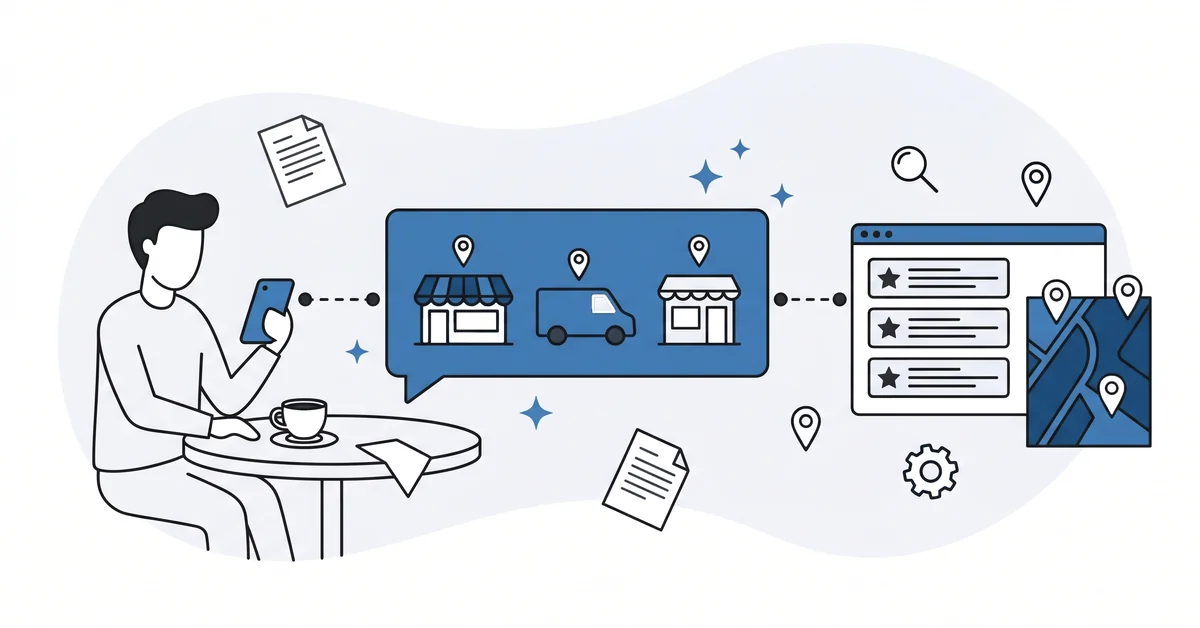
A potential customer pulls out the phone at the kitchen table and asks Perplexity for a plumber nearby. The chat returns three names. Two of them are owner-operators who pay nothing for marketing. The third is the chain franchise that spends ten thousand dollars a month.
Your local business has to be one of those three names without the ten-thousand-dollar budget.
Most of the work is free. Most of the work is the same work that has always made small local businesses show up on Google. The new layer is one extra round of attention to how the chat surfaces pick the names they hand out.
Local search used to be the phone book that listed everyone, sorted by category and by how recently you paid for a bigger ad. In 2026 it works more like asking a knowledgeable friend at the corner cafe. You ask the friend for a plumber.
The friend names two or three — the ones the friend trusts, the ones the friend has heard about. The phone book still exists. But for half your customers, the friend speaks first.
Why has local search split into two surfaces?
The Local Pack is still there. It still shows three businesses with a small map. It still drives most of the foot-traffic-shaped searches your customers run when they need a plumber today.
What changed is the second surface. AI Overviews now appear above the organic results for a large share of local queries. ChatGPT and Perplexity answer the same questions in their own apps. There is no Map Pack at all in those replies — just a few names in a paragraph.
Miriam Ellis at Search Engine Land summarised Whitespark’s 2025 study with the underlying numbers. AI Overviews surface for 68% of local searches overall, but only 15% of simple-intent queries like “tacos san francisco.” Informational-intent local queries trigger one 92% of the time. Hybrid queries — “best dentist near me for kids” — trigger one 97% of the time.
There is an inverse relationship between the two surfaces. Where the AI Overview appears, the Local Pack often does not. Where the Local Pack appears for a simple direct query, the AI Overview tends to drop out.
BrightEdge documented Google removing them entirely from healthcare provider searches between 2023 and 2025, dropping from full coverage to zero. The same pattern holds in finance.
The practical effect is that your business has to win the surface your customers actually use. Most direct local queries still surface the Map Pack first. Most informational and comparison queries surface the chat reply first. You need to be one of the names on whichever surface fires.
What still works for free in 2026?
Three things, and they have not changed at the bone level.
A clear, locally-named website. A complete and active Google Business Profile. Real, recent reviews from real customers.
Whitespark’s 2026 Local Search Ranking Factors survey ranks a visible address on your website as the 7th most influential local-rank factor. Review recency ranks 11th. Citations — mentions of your business name, address, and phone across the wider web — have grown more important year over year. Ellis frames it directly: “Both structured and unstructured citations are dominating the AI visibility scenario.”
Both surfaces draw from the same well. The Map Pack uses the Google Business Profile, your citations, and your reviews to rank you. The chat surfaces use the same Google Business Profile, the same citations, and the same reviews to decide which two or three names to mention.
There is no separate checklist for the second surface. There is one underlying job, done well enough that both surfaces pick you up.
Paid local-SEO tools accelerate the work. They do not enable it. The work is reachable on a Sunday afternoon with a notebook and a free Google account.
How do you harden your Google Business Profile without paying anyone?
Claim the listing first. Most local businesses already have one Google created automatically — you sign in with the same address and verify by postcard or video.
Match the name on your signage exactly. No keywords. No tagline.
The name field is the field most often abused, and Google routinely suspends profiles that pad it. The Whitespark commentary calls business-name keyword stuffing a suspension trigger. The rule has not loosened in 2026.
Pick the most specific category Google offers. Plumber, not LocalBusiness. Pediatric Dentist, not Dentist.
The specific category aligns your profile with the queries it actually competes for and gives both surfaces a cleaner entity match. The site article on entity SEO for small businesses covers the wider entity work the profile sits inside.
Fill in everything else. The address as it appears on your business licence. The phone as your customers actually dial it.
The hours, including holiday hours when relevant. At least nine photos — three exterior, three interior, three of the work itself. A short description in the same plain language a customer uses, capped at 750 characters with no links.
Post once or twice a month. Updates, offers, or events — the format matters less than the recency. The Whitespark survey identifies engagement signals as having gained ranking weight in the 2026 edition. A profile that posted last week reads differently to Google than one that last posted in 2024.
Reply to every review. Polite, short, named. The pattern of reply matters as much as the average score. A calm public response on a negative review signals a real human running the listing.
Total cost zero. Total time roughly two hours the first week and fifteen minutes a week after. No agency required.
Why does name, address, and phone consistency matter more than ever?
Pick one master version of your name, address, and phone — and use it everywhere.
Name as it appears on your signage. Address as it appears on your business licence. Phone as your customers actually dial it. Then the exact same triple on the website, on the Google Business Profile, on Yelp, on the chamber-of-commerce page, on the local newspaper directory, on every industry listing you can find.
Inconsistencies are not a small problem. The engines resolve a business to one master entity by cross-referencing the data they see across sources. When the website says one address and Yelp says another, the engine has to choose which version to trust.
More often it treats you as two weaker entities instead of one strong one. The recommendation slot then goes to the competitor whose data lines up cleanly across the dozen sources the engine looked at.
The site article on Google Business Profile setup covers the master-record discipline that keeps every directory citation aligned with the same source of truth.
The leading directory tools — Yext, Moz Local, BrightLocal — automate this at scale and cost real money. You do not need them on a zero-dollar budget. You need a single afternoon and a clean spreadsheet with one row per directory. The discipline is to update every row by hand when you change something.
The Whitespark survey adds an explicit AI Search Visibility category for the first time in 2026. Citation-consistent listings on authoritative directories are named as a factor the engines use to confirm a local business is real and legitimate. The signal that quietly powered the legacy Map Pack now powers the chat surfaces too.
What should your service page say so both Google and the chat surfaces read it?
One service per page. A page that tries to cover three services covers none of them well, and neither surface can extract a clean answer from it.
Use a question-shaped heading that mirrors what a customer would actually ask. “How much does emergency drain cleaning cost in central Austin?” Not “Drain Cleaning Services.” A heading the searcher might literally type ranks better on both surfaces and pulls a cleaner extract into the chat reply.
Mention the town or neighbourhood in the first 100 words. Once is enough. The geo signal in the first paragraph is one of the cheapest ways to tell the engines this page belongs to a particular place.
Name the offer in plain English. The price range if you publish prices. The hours if hours matter for the service.
The phone in the body, not just in the footer. The single clearest call-to-action — call this number, fill in this short form, walk in between these hours.
Add a short FAQ at the bottom with three or four real questions you actually hear from customers. AI Overviews and chat replies lift those question-and-answer pairs straight into the response when the query is informational. The page becomes the source the engine quotes from.
This is the second surface most small local businesses miss. The Map Pack still drives the bulk of direct local intent traffic. The informational and comparison queries — the questions a customer types when deciding between two or three businesses — get answered in the chat reply. A page written this way wins both.
How do you get the reviews that move you up?
Ask in person, when the work is fresh. Most happy customers will leave a review if you simply ask while the experience is still in their head.
Follow up the next day with one short message that includes the direct review link. The link matters. One click between the customer and the review form is the difference between a five-star review you got and a five-star review the customer meant to leave.
Reply to every review you already have. Including the negative ones. Especially the negative ones. A short, calm, named reply on a one-star review tells future readers more about your business than the original complaint did.
Recency matters more than total volume in 2026. The Whitespark survey ranks review recency at 11th — a six-month-old five-star average matters less than three honest reviews from the last quarter. Ten real reviews from this year out-pull a hundred from three years ago, on both surfaces.
Reviews are one piece of a larger picture. The whole picture is how the website, the profile, and the reviews work together. For a wider walk through how local businesses show up on Google, start there and come back to the reviews.
Do not buy reviews. Do not ask for “five-star reviews” — ask for honest ones. Google increasingly catches the language pattern of incentivised review sweeps.
The same survey identifies review-fraud detection as a signal the engines and Google both rely on. One suspended profile costs you a year of slow rebuilding.
The math is unfair on purpose. A business with twenty real recent reviews and a 4.6 average will out-rank a business with two hundred old reviews at 4.9. That holds on most local queries that matter.
Other questions worth answering
What changes for a tradesperson who drives to customers instead of running a shop?
Two things change. Your Google Business Profile becomes a service-area profile — you declare the cities or radius you serve and hide the physical address. Your website’s Schema.org LocalBusiness adds an areaServed property — a GeoCircle or list of city names. In 2026 the rest of the work matches what a storefront owner does.
Does adding LocalBusiness schema to a small site actually help with citations?
Yes — it gives the engines a machine-readable copy of your name, address, hours, phone, and geo coordinates. A 2025 Yext study of about 6.8 million AI citations found brand-managed sources account for roughly 86% of citations in location-intent AI queries. Brand-managed means the website plus listings plus reviews. The Schema.org LocalBusiness block on your site is one of those brand-managed sources.
Why is one of three slots in a ChatGPT reply harder to win compared to position three in the Map Pack?
Because the slot count collapsed from ten to three. AI chatbots typically return three to five businesses per local query, while the Map Pack still shows three plus the organic results below it. ChatGPT runs about 59% of its web-lookup queries with local intent. Each chatbot slot fights for a larger share of local-intent traffic than each Map Pack position does.
What do the Apple Maps and Bing Places entries add for a budget-constrained operator?
Both are directory citations the engines cross-reference, so each should carry the same name, address, and phone as your Google Business Profile. Bing Places and Apple Maps sit alongside the data aggregators that feed business information to downstream directories. Keeping those records consistent rounds out the citation graph the engines read in 2026. Neither moves the dial alone, but together they reinforce the single business the engines resolve you to.
Which directory listing should you fix first?
Search for your business name in Google. Look at the first page of results.
The first directory that shows your name with the wrong address, the wrong phone, or the wrong category — that is the one to fix first.
Then the second. Then the third. The exercise is mechanical and unglamorous and pays back faster than almost anything else you can do for free in an afternoon.
Most listings let you claim the entry directly. The ones that do not usually have a “suggest an edit” link. The data aggregators behind the scenes — Neustar Localeze, Data Axle, Foursquare — propagate corrections downstream over a few weeks.
You do not need to find every directory. Cleaning the top ten that show up on the first page of your own brand-name search covers most of the citation graph the engines look at.
Then walk away from the spreadsheet. Open your Google Business Profile and check that this week’s hours are right. Send a follow-up to the three customers from last month who were happy and have not left a review. Take a photo of the work you did this morning and add it to the profile.
One quiet afternoon of citation cleanup, profile maintenance, and review follow-up out-performs most of what local-SEO agencies will sell you for a thousand dollars a month. The friend at the cafe will hear your name from more directions, more recently, with more consistent details. That is how you become one of the three names the friend mentions.
If you have run through the list and are not sure which directory listing to fix first, or which review request reads as polite versus pushy, you can contact me here. Send the brand-name search results and the three message drafts you are weighing. I will flag the citation that is hurting you most and the review wording most likely to land. No pitch.