Table of Contents
TL;DR
- A potential client used to type your name into Google after a referral. In 2026 the same client often asks ChatGPT or Claude "tell me about Sarah Chen, the marketing consultant in Austin" and reads the paragraph the engine writes. Ranking your own name is the work that decides whether the paragraph is right.
- The reshuffled E-E-A-T order puts Experience first, Expertise second, Trust third, and Authoritativeness last. Domain authority correlation with visibility has dropped from roughly r=0.43 pre-2024 to about r=0.18 in the AI-search era. A small site with consistent author signals now out-cites a much larger site without them.
- Two systems read your site through different pipes. Person schema feeds Google’s Knowledge Graph through structured data. The visible content on your About page feeds the language models directly. Both layers matter — a site that has one without the other gets quoted half as often.
- The sameAs URLs that actually move the needle for a freelancer are the directory URLs, not just the social profiles. LinkedIn, your professional association directory, third-party byline pages — the engines use these to verify the same person stands behind every profile.
- Three steps this weekend will rank your name — write a one-page About bio that leads with verifiable experience, verify Person schema fires through the Rich Results Test, update the same bio across LinkedIn and any directory listing so the wording matches.
A freelance brand strategist gets a referral from a former client. The new prospect writes the strategist’s name into the chat surface. The prompt asks whether this is the right person for a Series-A SaaS positioning project.
The chat returns a paragraph. The paragraph names a different Sarah Chen. The Sarah Chen the prospect was referred to does not show up at all.
Most of the reason is mechanical, not bad luck. The right Sarah Chen had a one-line bio on her own site, no Person schema, and a LinkedIn profile that did not match. The chat surface had nothing to lift.
So it lifted the most-cited Sarah Chen on the open web instead — a publicist in another city, with stronger signals across more directories. The strategist lost the project before the second email.
Ranking your own name is the small-town front-door sign that names the person inside. The engines need consistent signals from enough sources to be confident the right person stands behind the work. Without the consistency, the engines reach for the louder Sarah Chen.
The work is small. None of it costs money. All of it pays back across every chat reply that mentions your name from now on.
This piece is the short version of what to put in place. The next prospect who asks the engines about you should read the right paragraph.
Why does your own name matter when clients ask the engines first?
The name search has not gone away. It has moved.
A potential client used to type your name into Google after a referral and read the first three results. In 2026 the same client often asks an AI chat for a one-paragraph summary and stops reading after the paragraph. The chat surface writes the paragraph from whatever it can find under your name.
If the signals are thin, the paragraph is generic. If the signals are inconsistent, the paragraph names someone else.
The legacy SEO framing — own the first page of Google for your name — still helps. The newer framing adds a deeper layer. Each chat surface independently decides which entity the name refers to, and writes the paragraph from whatever sources it trusts.
Owning the first ten Google results is no longer enough. The chat surfaces sometimes ignore the search results entirely and lift from the open web’s strongest signal.
A small SMB owner has a structural advantage here. Most large competitors do not have a single named person standing behind the work. The freelancer or solo consultant who does the dual-layer entity work owns the citation slot the larger competitor cannot occupy. The site article on portfolio SEO for freelancers walks through the case-study craft that turns the work into citation evidence.
The cost of the wrong paragraph is high. The cost of the right one is one quiet weekend.
What does the chat surface actually need to know about you?
Five facts cover most of what an engine lifts into a name-search reply.
Your full name, written exactly the same way everywhere. The work you do in plain English. The city or area you serve.
Three or four verifiable specifics about your experience, with numbers where possible. The URLs that prove the same person owns each profile.
A page that names all five in the first hundred words is the page the engines quote. A page that buries any of the five past the first scroll gets passed over. The chat surfaces are looking for a clean answer block, not a meandering bio.
The verifiable specifics are where most bios fall short. "Twelve years writing landing pages for B2B SaaS clients" is a specific. "Marketing consultant with extensive experience" is not.
Indig’s February 2026 study found cited pages use definitive statements about 36% of the time versus 20% for non-cited pages. Hedging language and vague tenure claims signal low confidence to the engines, and the engines reach for a more confident source.
The URL list is the part most freelancers skip. The list goes at the bottom of the bio as plain text or as a small linked block. Each URL points to a profile of the same person on another authoritative source.
The engines use the list to verify the entity. The customer reading the page uses the same list to verify the same thing, by clicking through.
How does the dual-layer authority model decide what gets quoted?
Two systems read your site for different jobs.
Person schema feeds Google’s Knowledge Graph through structured data. The Knowledge Graph is the source AI Overviews and several other surfaces consult when they need to verify an entity exists. Person schema with name, jobTitle, address, sameAs, and a clear @id is the bridge between your site and that graph.
The visible content on your About page and author pages feeds the language models directly. The language models read JSON-LD as raw text rather than as structured relationships. The schema gets tokenised as a string of words, not as a graph the engine traverses. So the same facts need to live in plain prose on the visible page, in addition to the JSON-LD block underneath.
The dual-layer rule is honest about the evidence. No peer-reviewed studies have specifically measured Person schema’s effect on AI citation rates. The Princeton/Georgia Tech GEO study from August 2024 tested content-level optimisations, not author signals.
Practitioner consensus strongly supports the lift. The rigorous evidence base is thin.
The honest framing is that both layers cost almost nothing to add. A site that keeps both signals up-to-date out-cites a site that has neither, in every test that has been run.
A site that has one layer without the other gets quoted less often. The structured data without visible matching content reads as a label without backing. The visible content without structured data leaves the Knowledge Graph layer empty. The site article on entity SEO for small businesses walks through the cluster-level entity work the dual-layer signal extends.
Which sameAs URLs actually move the needle for a freelancer?
The directory URLs matter more than the social profiles for most freelancers.
Your LinkedIn profile is the first one. Your professional association directory listing is the second — the AMA registry for marketers, the IABC for communicators, the AIGA for designers. Your industry registry if one exists.
Your verified profile on a third-party publication where you have a byline. Your GitHub, Behance, or Dribbble if your craft has one of those.
Most SEO plugins fill sameAs with social media URLs only — Twitter, Facebook, Instagram — and stop. Social URLs help confirm the entity exists. Directory URLs help confirm the entity is who it claims to be. The engines weight the directory URLs more heavily because the directories run their own verification.
The cross-platform consistency rule is the part most freelancers underrate. Your name, your headshot, and the first sentence of your bio should match across every URL on the sameAs list. A LinkedIn profile that calls you "Sarah Chen, marketing strategist" and an About page that calls you "Sarah J. Chen, marketing consultant" splits the entity in the engines’ eyes.
The fix is mechanical. Pick one master name and one master first sentence. Paste both across every profile. Never accept a directory’s auto-fill that changes the wording.
What should your About page do that the LinkedIn profile cannot?
The About page sets the experience-first framing in your own words on a domain you control.
LinkedIn ranks your name on its own surface and on Google’s brand-search results. Your About page on your own domain ranks your name on every other surface. The chat surfaces read your About page far more than they read your LinkedIn profile.
The LinkedIn HTML is harder to parse, and Microsoft has aggressive bot rules in front of it. Your own site’s About page is the cleanest signal you can offer.
Lead with the verifiable experience. A consultant might write "twelve years writing landing pages for B2B SaaS clients" as the opener. A clinician might write "eighteen years of clinical experience in pediatric dentistry." Whatever the specific is, put it first. Titles follow.
The reshuffled E-E-A-T order weighs experience first because risk-minimising AI systems trust verifiable experience more than self-declared titles. The shift in the data is real. The correlation between domain authority and visibility was about r=0.43 before 2024 and is about r=0.18 in the AI-search era. Less than half.
The About page is also where the verifiable specifics get room to breathe. The case studies. The named clients you can list with permission. The publications you have written for.
The talks you have given. None of these need to be exhaustive. A handful of specific items beats a long list of generic claims.
How do you fix the John-Smith problem without fabricating credentials?
Disambiguation is mechanical, not flashy.
Your name plus your city in the first paragraph of every key page. Your name plus your specific niche in the same place. "Sarah Chen, marketing strategist for B2B SaaS startups in Austin." The phrase signals the entity to every engine that crawls the page.
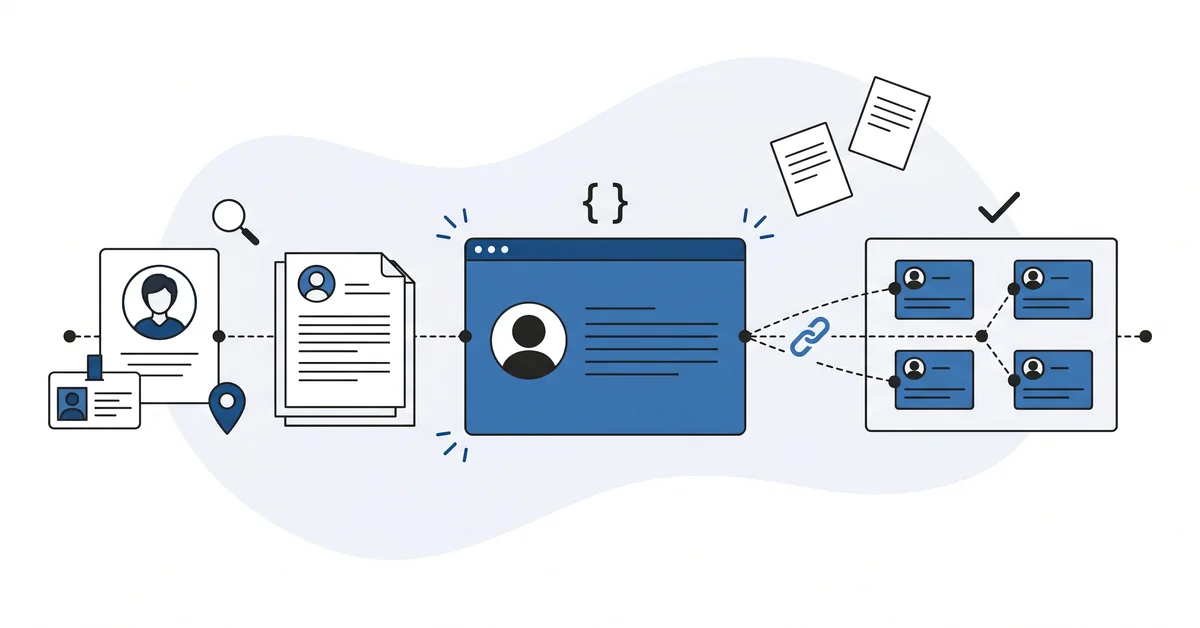
The sameAs property linking to every profile that confirms the same person owns each is the second mechanic. The engines crawl each linked URL, find the same name and the same headshot, and lift confidence in the entity.
The third mechanic is photo consistency. The same photo on the About page, the author page on the same site, the LinkedIn profile, and the directory listing. The engines use facial features as a confidence signal. Not as a primary ranker — as a tiebreaker between two entities with similar names.
None of this requires fabricating credentials. None of it requires inventing experience you do not have. The work is showing the experience you already have, consistently, across enough sources. The engines then become confident the right Sarah Chen is being recommended.
The bio honesty rule applies. If practitioner consensus says Person schema helps and the rigorous evidence is thin, your bio should reflect the same shape. Specific verifiable claims, no hedging, no overclaim.
The chat surfaces lift the bio that reads like an honest professional describing real work. The bio that reads like a marketing brochure gets passed over for the same reason an over-decorated product page does.
Other questions worth answering
How long does an updated bio take to show up in AI replies?
Plan for several weeks. As of 2026, three bands hold roughly true. Hours to days for Google’s text index. A few weeks for ChatGPT or Perplexity to incorporate the change, and weeks to months for Knowledge Graph entries to settle into citation patterns.
What happens to entity signals when you go through a professional rebrand mid-career?
Several signals shift together during a name change or rebrand. Update the bio on every owned source first — the personal site, every directory listing, every byline. As of 2026, Google and ChatGPT prefer a published note that names the old and new wording together. Plan roughly three to six months for the new wording to surface as the primary reference.
How do you handle outdated bios still living on old directories?
Update what you can reach and let the rest age out. As of 2026, most major directories let you edit your entry from a logged-in dashboard. For closed ones — defunct sites, archived pages — write the platform’s support team with a polite request. Google and ChatGPT both weight recent sources higher, so a fresh consistent set quietly outweighs stale outliers within a few crawl cycles.
Does Wikidata help solo practitioners build entity recognition over time?
Yes, especially when no Wikipedia entry exists. A Wikidata item gives Google’s Knowledge Graph a structured source it already trusts. The catch — Wikidata has notability thresholds, so a brand-new freelance brand may get reverted. Build a citation trail of independent coverage somewhere else first, then propose the item with proper references for the strongest shot at it sticking.
How should you rank your own name before your next client searches?
Three steps this weekend.
The first is the About page bio. One page. Your name, your city, your work in plain English in the first paragraph. Verifiable experience first.
Titles second. A handful of specific clients, publications, or talks underneath. The sameAs URL list at the bottom as a small block of plain links. Total time to write — about an hour for someone who has been doing the work for ten years.
The second is the schema check. Most modern WordPress SEO plugins generate Person schema from the author profile fields. Fill the fields once. Add your headshot, your jobTitle, your sameAs URLs, your @id anchored to your About page.
Then run the page through Google’s Rich Results Test to verify Person schema fires. The test is free and takes two minutes. The result is the answer to whether the schema is reaching the Knowledge Graph at all.
The third is the consistency pass. Open LinkedIn, your professional association directory listing, and any third-party byline page. Update the bio so the wording matches your About page exactly.
Same name, same headshot, same first sentence. The engines reward the consistency. Your next prospect gets the right paragraph in the chat reply.
If you have walked through the three steps and want a second pair of eyes, you can contact me here. Send me your About page URL and one sentence about your craft. I will name the one change that opens the most name-search visibility for the least extra effort. No pitch.