Table of Contents
TL;DR
- A search intent classifier reads a keyword list and labels each query by what the searcher is trying to do — learn, compare, buy, navigate. The label decides the page format. The format decides whether traffic converts.
- Fine-tuned BERT-family transformers hit 97-98 percent accuracy on benchmark datasets. A general-purpose AI model on your real keyword list lands around 85-95 percent on first pass — still fast enough to replace days of manual labelling.
- The prompt needs six things: role, taxonomy, three examples per category, the keyword list, an output shape with a confidence score per row, and a refusal instruction for ambiguous queries.
- The AI model cannot see the live SERP. When the label and the SERP disagree, Google’s ranking is the tiebreaker — reclassify the keyword to match what is actually ranking.
- Batch in fifty-keyword chunks. Hand-verify the lowest-confidence 10 percent. One classified keyword list becomes your next quarter’s content calendar.
You have a keyword list with three thousand rows.
Column A is the query. Column B is monthly volume. Column C is keyword difficulty.
There is no column for what the searcher is actually trying to do.
That missing column is search intent, and until 2024 filling it meant reading each row by hand or buying a seat on a classifier tool that cost more than your keyword-research tool. In 2026, one language model prompt does the work in under two minutes.
Not perfectly. Not for every keyword. But well enough that skipping it is malpractice.
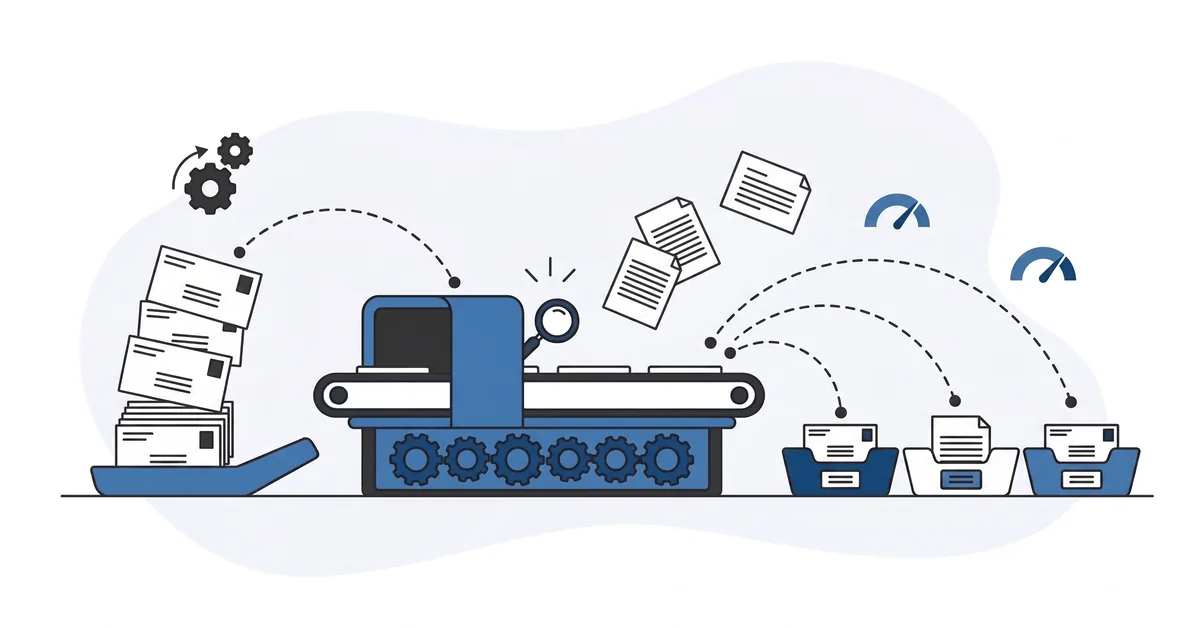
Think about the mail room of a mid-sized office building. Letters arrive in a pile. The sorting machine reads each envelope, looks at the address, and drops the letter into one of ten bins.
The machine handles volume. The humans handle judgment — they open the envelopes that matter and answer the ones that pay.
The AI classifier is the sorting machine. You are still the humans who read the letters.
Why does search intent matter more than search volume?
A high-volume keyword is worthless if your page format does not match the intent.
"Best running shoes" is a comparison query. Searchers want a shortlist with a recommendation. A product-detail page loses the click. A comparison article wins.
"Nike Pegasus 41" is a transactional query. Searchers want to buy. A comparison article loses the click. A product page wins.
Same vertical. Different intent. Different page. The keyword difficulty score tells you how hard it is to rank — the intent tells you what to write if you do.
Saood Zafar at ClickRank puts the underlying shift directly. "Modern search engines act as intent interpreters, not text matchers." If Google is interpreting, you have to classify your own keywords by what the interpreter is trying to interpret.
Can AI classify intent at scale reliably?
Fine-tuned BERT-family transformers hit 97-98 percent accuracy on benchmark datasets like ATIS and Snips. Dale Brett at FL0 reports those numbers directly in an April 2026 framework piece.
A general-purpose AI model on your real keyword list lands lower. Zero-shot classification without fine-tuning drops to roughly 85-95 percent on first pass. The gap is taxonomy match, domain familiarity, and SERP freshness — benchmark datasets were built once and frozen. Your keywords are messy, niche, and from last week.
Eighty-five percent is not perfect. It is also not the right comparison. The right comparison is "the alternative," which for most in-house teams is tagging nothing or spending three days on a manual label pass that still comes back 80 percent accurate.
The workflow that works: batch in fifty-keyword chunks, ask for a confidence score per row, spot-check the lowest-confidence 10 percent by hand.
What taxonomy should you give the AI model?
The minimum is four categories:
- Informational
- Navigational
- Commercial investigation
- Transactional
Megan Ragab at Topical Map AI frames these as the 2026 primary set. They are the same four categories Google has used internally since the Hummingbird update. They map to page types cleanly — explainer, brand landing, comparison, product or service.
The sharper version adds sub-intents. Zafar at ClickRank lists comparative, instructional, exploratory, reassurance, and problem-solving as the extended set for 2026.
"Best X for Y" is comparative. "How to do X step by step" is instructional. "Is X safe" is reassurance. "Why is X happening to me" is problem-solving.
You do not need all nine labels for most sites. Four covers the broad strokes. Six or seven is the ceiling for a general-purpose content calendar. Past that, you are adding labels the AI model cannot reliably distinguish from each other without examples on your specific domain.
Always give three example queries per category in the prompt. Without examples the AI model falls back to training-data defaults and misclassifies anything niche.
What does the classification prompt look like?
Role, taxonomy, three examples per category, keyword list, output shape with confidence score, refusal instruction.
You are an SEO analyst classifying search intent.

Taxonomy: informational, navigational, commercial investigation, transactional.

Examples:
- Informational = "how to brew coffee," "what is SEO," "best time to water plants."
- Navigational = "Netflix login," "Semrush pricing," "OpenAI blog."
- Commercial investigation = "best coffee grinder," "Semrush vs Ahrefs," "top running shoes 2026."
- Transactional = "buy Chemex carafe," "Nike Pegasus 41 order," "Semrush pro trial."

For each keyword below, return JSON with intent, confidence score 0-100, and one-line reason.
If the keyword is genuinely ambiguous, return intent="ambiguous" with a note.
The confidence-score column turns the output from a flat label into a triage queue. High-confidence rows ship. Low-confidence rows go to human review. Ambiguous rows get the SERP check.
What does AI still get wrong about intent?
SERP context the AI model cannot see.
A query can read informational but have a SERP dominated by product listings. "Protein powder benefits" looks like a learn-intent query, but the live SERP shows five shop listings and a comparison article. Google is telling you the aggregate intent is commercial — regardless of what the words say.
The AI model reads the words. Google reads the clicks. When they disagree, trust Google.
Taher Dawoodi at Basar Optimization states the limit directly. General-purpose AI models "cannot determine SERP intent reliably." The fix is not a better AI model. The fix is a verification step where the lowest-confidence keywords get a SERP check before a page format is assigned.
This is also why the taxonomy match matters. If your site sells "running shoes" and your AI model was trained primarily on B2B SaaS data, it will tag "best running shoes" as commercial investigation but miss that for your specific audience, "marathon training plan for beginners" is also commercial — it is the top-of-funnel lead magnet. The AI model needs your vertical’s flavor of examples to classify correctly.
How does intent classification change your content plan?
One classified keyword list becomes a draft editorial calendar.
Informational intent maps to explainers and how-tos. Commercial investigation maps to comparisons and reviews. Transactional maps to service and product pages. Navigational maps to direct landing pages.
Sort your classified list by intent. Count the rows per category. The distribution tells you where your content gaps are.
A site with 90 percent informational queries and 10 percent transactional is top-of-funnel-heavy and needs to build bottom-of-funnel pages to convert traffic. A site with 70 percent commercial investigation and 30 percent transactional has strong buyer intent and needs comparison and product pages, not more explainers.
The deeper walkthrough on using search intent for keyword research covers the same intent-to-format mapping at the keyword-picking stage rather than the content-plan stage.
The classifier does not tell you what to build. It tells you where you are building into thin air.
Other questions worth answering
What confidence cutoff should send a row to human review?
Roughly 70 percent confidence is the working cutoff. Anything under that line goes to a person for a quick SERP check. Around 85 percent ships without review.
The middle band — roughly 70 to 85 percent — gets a spot-check on a random sample. Dale Brett’s April 2026 FL0 framework names confidence-score calibration as the difference between a triage queue and a flat label dump.
How often should you re-run the labelling pass on a stable query list?
Once per quarter is the working baseline for a stable site, though no published benchmark fixes the exact cadence. Re-run sooner after a Google core update or when SERP-feature mix shifts in your vertical.
Megan Ragab’s January 2026 Topical Map AI guide flags that the same query can represent different intents depending on user context. Context drifts as Google’s ranking signals shift.
Does sending a query list to an external API create privacy exposure?
Yes when the list contains queries pulled from your own logs. Public phrases are fine. Customer-name queries, branded-account slugs, or internal-tool terms can leak business context.
Strip those before upload, or run a self-hosted open-weights tool on the sensitive subset. Dale Brett’s April 2026 FL0 framework names identity-matching false positives and CCPA exposure as a top failure mode in 2026 classifiers.
How do you label non-English query lists?
Three small changes do the heavy lifting. Swap example queries into the target language. Translate category labels for non-Latin scripts like Japanese or Arabic.
Megan Ragab’s January 2026 Topical Map AI guide notes user context shifts the right label, and language is part of that context. A 50-keyword smoke test on the new list confirms the calibration held.
How should you classify your top 200 keywords?
Export your top 200 keywords from Search Console — the ones your site already ranks for between positions 3 and 20. If your site does not yet rank for enough queries to fill that list, the walkthrough on keyword research without paid tools covers how to build the seed list from scratch.
Run the four-category classification prompt. Add three example queries per category from your own vertical. Include a confidence score per row.
Spot-check the lowest-confidence 20 rows against the live Google SERP. Correct any mismatches.
Sort the final list by intent. Count the rows per category. Identify the three biggest gaps between what you rank for and what your funnel needs.
You now have three page briefs ready to draft — each one targeting a gap the AI model just surfaced in under five minutes.
If you are running a classification pass and are unsure where to draw the sub-intent lines, or which rows the AI model is stretching on, you can contact me here. Paste the prompt, the confidence-score column, and the ten rows you are least certain about. I will flag which ones deserve a SERP check and which ones are safe to ship. No pitch.