Table of Contents
TL;DR
- AI Mode is a fully AI-driven Google search experience that uses query fan-out to decompose a single prompt into multiple parallel sub-queries, then synthesizes the answer. The Google Search blog announced the full US rollout in May 2025.
- Roughly 92-94% of AI Mode sessions end without an external click, per a Semrush analysis of 69 million sessions from May to July 2025 on US desktop. The writing problem changes with that number.
- The page is no longer competing for the click. It is competing for the quote. AI Mode lifts paragraphs out of pages and presents them as the synthesized answer. Clicking through is a minority outcome.
- Two structural moves carry the AI Mode citation most reliably. A clean 40-60 word answer block under each H2 and an FAQ block at the bottom that covers the fan-out tangent questions.
- The honest limit. The 92-94% figure is measured on US desktop in 2025. Behaviour on mobile and outside the US is not yet documented at the same precision.
You open Google. You tap the AI Mode tab instead of typing a normal search. You ask the question your best customer asks. AI Mode comes back with a synthesized answer made of pieces lifted from several pages, each piece attributed, each piece short, each piece extracted from the place on the page it sat.
Most of the time, you do not click any of the cited links. You read the answer in the interface. You ask a follow-up. The session ends in the AI Mode tab.
That is the writing problem this pillar is about.
A page that wants to be on the list of cited sources in AI Mode has a different job than a page optimised for a ranked search result. The page is no longer competing for the click. It is competing for the quote.
Most page templates were not designed for this. Most copy on most pages is still written for a reader who landed and is being persuaded. The rewrite below is the one that swaps the inherited assumption for the new one.
Why is AI Mode a different writing problem than ranking?
AI Mode is a fully AI-driven Google search interface that requires the user to opt in by tapping the AI Mode tab. The 2025 rollout to all US users was announced on the Google Search blog in May 2025 and confirmed full US public availability at Google I/O. The mechanism that powers it is query fan-out.
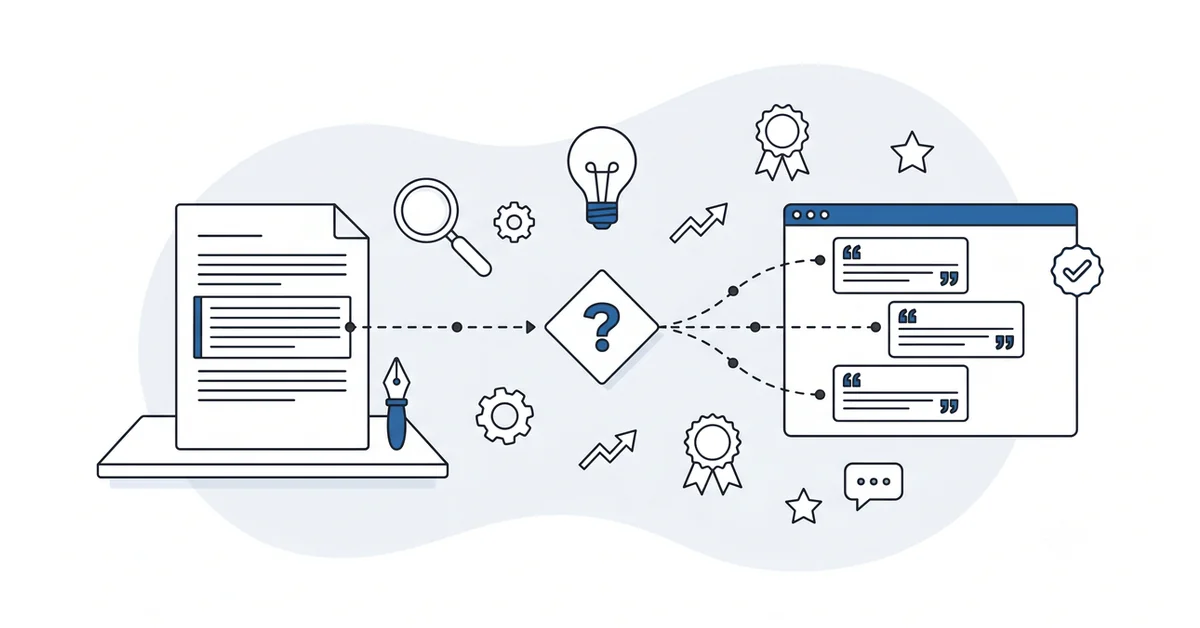
Query fan-out is the move where AI Mode takes one prompt and decomposes it into multiple parallel sub-queries. Each sub-query gets its own retrieval pass. The results synthesize into a single answer. Deep Search inside AI Mode can issue hundreds of sub-queries for one prompt to compile an expert-level report.
The writing implication is direct. A page that answers the top-line question well but has no content covering the natural sub-questions is a page that AI Mode finds for the headline lift and ignores for the rest. The richer the page is across the related sub-questions, the more sub-queries it surfaces for and the more often it appears in the cited set.
The other implication is about clicks. In July 2025, Semrush analysed roughly 69 million Google Search sessions and found that 92-94% of AI Mode sessions ended without an external click. The dataset covers US desktop from May 1 to July 5, 2025. Only 6-8% of sessions led the user to visit an external page at all.
The writing job is now the citation, not the click. The page earns presence in the answer when it gets cited. The buyer reads the cited paragraph in the AI Mode interface and forms an opinion without ever loading the page.
What does AI Mode actually carry off from a page?
AI Mode reads a page as a sequence of liftable units, the same way other answer engines do. The H1, the answer block under the H1, the H2 sections, the comparison tables, and the FAQ block at the bottom. Each is a candidate for the lift.
The unit AI Mode lifts most often is the paragraph that directly answers the implied question of a heading. A 40-60 word paragraph under a question-shaped H2. That paragraph stands alone and reads as a complete answer.
The unit AI Mode lifts second most often is the FAQ block. AI Mode runs fan-out across the natural sub-questions of the prompt. An FAQ block at the bottom of the page is the format that maps cleanly onto those sub-queries. Each Q-A pair becomes a candidate for a different sub-query lift.
The unit AI Mode lifts third most often is the comparison or scorecard table. When the prompt is commercial and asks for a side-by-side, AI Mode can quote a single row of a table as the comparison answer. A page that hosts a clean scorecard becomes a per-row citation source.
The units AI Mode tends to skip are the long meandering body paragraphs that carry the page’s argument but do not stand alone. The paragraph that opens with "as we discussed above" is unreadable once chunked. The chunker drops it.
The implication for the writer is the same shape that has shown up in every AEO post on this site. Write each section so any one paragraph can be read on its own without the rest of the page. That is the form AI Mode favours.
How should you shape a page so query fan-out catches it on the right sub-query?
A page wins AI Mode citations across more queries when its body covers the natural sub-questions of the headline topic. The discipline is to plan the H2s as a fan-out of the page’s main question, not as a tutorial outline.
Start by writing the headline question. Then list eight to twelve related questions a buyer would naturally ask if they got the headline answer.
Some are upstream of the headline (what does this even mean?). Some are downstream (how do I actually do it?). Some are tangents (does this apply to my situation?).
Group the related questions into roughly six to eight H2 sections. Each H2 is a question-shaped heading. Each section’s first paragraph is the 40-60 word answer block. Each section’s body carries the proof for that answer.
Add an FAQ block at the bottom that covers the tangent questions the body did not cover. The Q-A format matches AI Mode’s fan-out shape almost too well.
The output is a page that surfaces in the AI Mode answer for the headline question and for several of the related sub-queries. A single rewrite can earn a page citation presence across a small cluster of related prompts instead of just the one.
Which two structural moves earn the AI Mode citation most reliably?
The first move is the 40-60 word answer block under each H2. AI Mode’s lift behaviour is the same shape as other answer engines on this dimension. The block has to read as a self-contained answer. It has to live as plain paragraph prose, not inside a callout box or a blockquote.
The block is the load-bearing unit of the page. Most of the AI Mode citation work happens in those few paragraphs. The 40-60 word answer block as the load-bearing AEO unit covers the discipline at the level needed to write one cleanly.
The second move is the FAQ block at the bottom. An FAQ block of three to five tangent Q-A pairs maps onto AI Mode’s fan-out behaviour almost line for line. Each question becomes a separate retrieval target. Each answer becomes a separate lift candidate.
The FAQ block also helps AI Mode get the cite right. The Q-A format makes it harder for the AI model to misattribute or paraphrase incorrectly. The question names the prompt. The answer is the exact paragraph the engine lifts.
A third move helps in a smaller way. A scorecard table for commercial pages. AI Mode surfaces table rows on comparison queries. The discipline of writing a comparison page that AI engines actually cite is its own pillar, and the comparison page format applied to AI Mode citations is the same discipline applied to one of the highest-leverage AI Mode query types.
These three together cover most of the rewrites that move a page from invisible-to-AI-Mode to consistently-cited.
How do you write for a session that ends on the page?
The 92-94% zero-click number rewires the rest of the writing job. If the session ends in the AI Mode tab for nineteen out of twenty users, the page is not converting on first read. The page is teaching.
A page that gets cited in AI Mode is doing brand work. Each citation is a small moment where the buyer reads a paragraph attributed to the brand inside their answer. The cumulative effect is recognition. A buyer who keeps seeing the brand cited inside answers to questions they care about builds trust in the brand without ever loading the site.
The writing implication is to write paragraphs that work as small standalone calling cards. Each paragraph that might get cited should communicate the brand’s perspective in a way the buyer can read once and remember.
A paragraph that says "the practical move is X because Y, and the trade-off most teams miss is Z" is the kind of paragraph that lands as a brand signal. A paragraph that says "you can find more in our guide" does not. The first is a paragraph the buyer remembers attributed to you. The second is a paragraph the engine drops because it does not stand alone.
The page also needs an honest path for the 6-8% who do click through. Those are the buyers who needed more than the synthesized summary. They came for the full source, the interactive tool, or the verification. The page that loads after that click should reward the curiosity with depth, not with the same paragraph repeated.
The compounding pattern is a corpus of pages where every paragraph either earns a citation or earns the click-through experience. The two jobs are not in conflict. The same prose can do both if the paragraphs are written to stand alone and the rest of the page is written to deepen.
What does the honest evidence say about the limits of writing for AI Mode?
The Semrush 2025 study is the cleanest first-public view of AI Mode session behaviour available in mid-2026. It is also the only large-scale public study with disclosed methodology at that scale. Multiple limits are worth naming up front.
The dataset covers US desktop only from May 1 to July 5, 2025. Semrush notes that direct comparison with traditional search zero-click rates should be made with caution due to methodology differences. Whether the 92-94% rate holds on mobile or in non-US markets is not documented at the same precision.
AI Mode usage also grew roughly fourfold during the study period. The user population was rapidly evolving. The early adopters whose behaviour the study captures may not represent the broader population AI Mode reaches as it goes mainstream.
The agentic capabilities Google added in January 2026 (restaurant bookings, ticket purchases, local appointments) are also not in the Semrush sample. Those features change the session pattern. A buyer who completes a booking inside AI Mode is in a different relationship with the cited sources than a buyer who reads a synthesized answer and closes the tab.
The honest planning move is to treat the 92-94% number as the directional reality of mid-2025 desktop behaviour. Write as if the click is the minority outcome. Write as if the citation is the unit that compounds.
The precise multiple may move as the surface evolves. The direction has been steady for two years and is unlikely to reverse.
Which page should you rewrite first for AI Mode?
Pick the page on your site that already gets traffic from Google today. Open the AI Mode tab. Run the question that page should answer. If your page is not in the citation set, that page is the highest-leverage rewrite on the site.
Read the page. Check the answer block under the H1. If it runs longer than 60 words or sits inside a callout box, rewrite it as a plain 40-60 word paragraph that answers the headline question.
Check the H2 sections. Each one should be a question a buyer would type. The body of each section should open with a clean answer block, then carry the proof underneath.
Add an FAQ block at the bottom if the page does not have one. Pick three to five tangent questions the body did not cover. Write each Q-A pair as a standalone unit AI Mode can lift.
Push the rewrite. Wait two to four weeks for the index to catch the change. Run the AI Mode query again.
The signal you are watching for is your domain appearing in the citation set, not as the only source, and not necessarily at the top. Being in the cited set on a query your buyer runs is the bar this play asks you to clear.
A small cluster of rewritten pages compounds. Each cited paragraph is a brand impression inside someone’s answer. The corpus that holds twenty pages written this way is the corpus that starts winning the cumulative brand-recognition game inside the AI Mode interface, which is the surface most evaluation buyers will spend the next decade on.
Other questions worth answering
Does the 92-94 percent zero-click figure hold on mobile devices?
The 92-94 percent zero-click figure comes from Semrush’s 2025 analysis of roughly 69 million sessions on US desktop only. Mobile data is not yet documented at the same precision. Plan for a similar directional pull on mobile, since the interface lifts the same paragraphs. The exact number may differ.
How quickly does Google re-index a refreshed paragraph after you publish it?
Google has not formally published the lag time, so plan on roughly two to four weeks for an established domain as a working estimate. Watch for your domain appearing in the cited set on the prompt your buyer asks. Run the same prompt weekly and log the result. The catch arrives when the index does.
Which kinds of buyers belong to the 6-8 percent who do click through?
They sit inside the 6-8 percent that Semrush’s 2025 measurement flagged as wanting more than the synthesized summary. They came for the full source text, an interactive tool, or verification of a specific claim. The landing experience for that minority is the rest of the pillar. Reward their curiosity with depth, not a repeat of the quoted paragraph.
Does Deep Search reward longer or shorter answer blocks?
Deep Search runs hundreds of parallel sub-prompts to build a cited expert-level report, per the Google Search blog launch announcement from May 2025. The clean 40-60 word answer block still lifts cleanly inside that report. Longer paragraphs get fragmented. Keep the block tight and let the proof live underneath it.
How do image inputs change which paragraphs Google’s conversational tab will quote?
Google’s visual fan-out was introduced in September 2025 for image inputs. The interface performs object recognition and runs parallel prompts about the picture as a whole and about individual objects. A product photo can pull in paragraphs from brand, comparison, and reviews pages at once. Caption your images with the claim the paragraph beneath them supports.
Which page on your site should you rewrite first?
Open AI Mode. Run the question your best customer asks first. The page on your site that should be in that cited set, and is not, is the page that earns the first rewrite. One page, this Saturday, rewritten honestly against the discipline above.
If you would like a second pair of eyes on the rewrite before you push, you can contact me here. I will read the page against AI Mode and tell you which paragraphs are doing the lift work and which paragraphs are passing the chance up. The first round is free and the rewrite is yours regardless of whether we work together after.