Table of Contents
TL;DR
- Rising Google Search Console impressions no longer predict visits because AI Overviews answer the query on the results page and the searcher never clicks.
- Zero-click rates are 58 to 60% of Google searches in 2026, 83% on queries with AI Overviews, and 93% inside Google AI Mode.
- Google disclosed in April 2026 that a logging bug inflated Search Console impression counts from May 13, 2025 onward — part of the recent impression growth will disappear on correction.
- Seer Interactive measured organic CTR drop from 1.76% to 0.61% when an AI Overview appears — a 61% decline even when the page still ranks where it did before.
- Track branded search volume, AI-referral traffic in a custom GA4 channel group, and weekly citation checks across ChatGPT, AI Overviews, and Perplexity — no single metric is the full picture.
You open Google Search Console. Your impressions are up. Sometimes way up. Then you open your analytics.
Your visits are flat. Or down. Or quietly disappearing.
If you have been staring at this gap for months and wondering what changed, you are not the only one.
The relationship between "people seeing my listing" and "people visiting my site" used to be steady. It is not steady anymore.
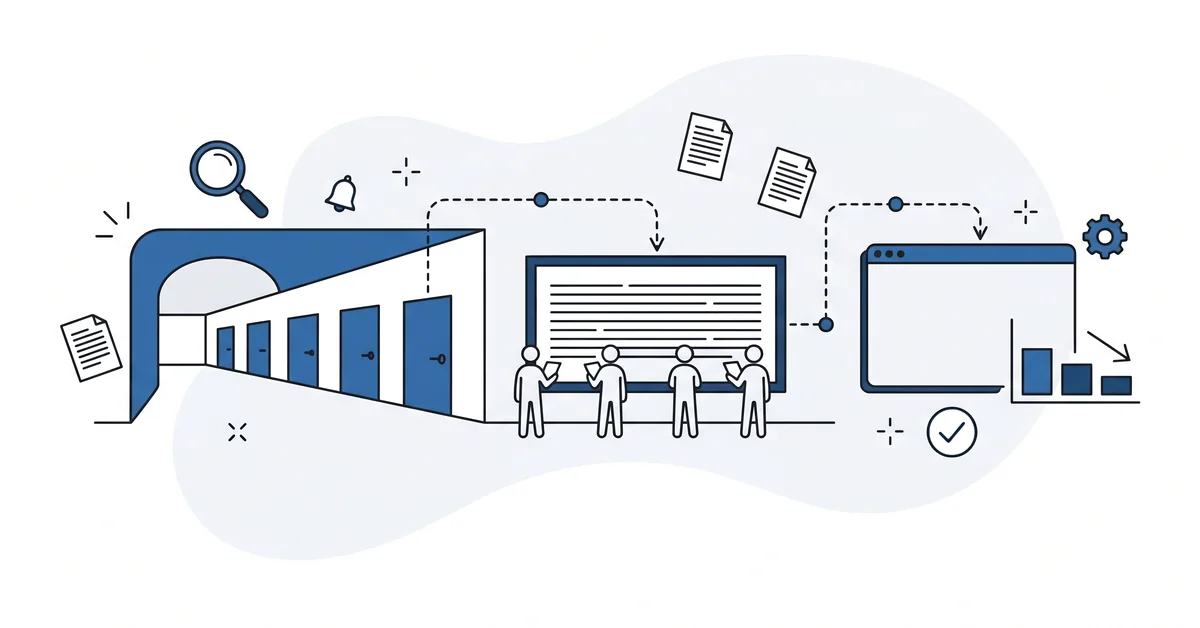
Search used to be a hallway. The most relevant pages were the doors at the front. People walked in, knocked, and came inside.
Now the answer is written on the wall of the hallway. Many people read it and turn around. The door is still there.
The lights are on. Almost nobody opens it.
Why are my Google impressions going up while my visits stay flat?
Two things are happening at once, and both are recent.
First, AI Overviews answer many queries directly on the search results page. The searcher reads the summary and never clicks anything. Your listing is still there. It is just no longer the place where the answer lives.
Second — and this is the awkward one — Google itself disclosed something in April 2026. A logging bug had been inflating Search Console impression counts since May 13, 2025. Almost a full year of over-reported numbers, now being corrected. Clicks were unaffected, which makes the gap between impressions and visits look even wider than it really is.
Put together, the old equation — "more impressions equals more visibility equals more visitors" — has been quietly wrong for a year. Some of the recent impression growth was real visibility into AI-summarized queries. Some of it was a bug. Either way, it does not turn into clicks the way the old kind did.
How much of search now ends without a click?
Roughly 58 to 60 percent of all Google searches end without a click in 2026, depending on whose study you read. When an AI Overview appears at the top, that number climbs to about 83 percent. Inside Google AI Mode — the conversational version — around 93 percent of searches end without a click.
Most people now get their answer on the page itself.
This is not a small shift. It is the structural change of the past two years. Search used to be a doorway to other sites. For most queries, it is now a destination.
If your traffic is down and your impressions look fine, this is the first thing to look at.
Is Google Search Console counting impressions correctly?
Not entirely. There is one known accounting problem and one bigger definition problem.
The accounting problem is the April 2026 logging bug. Google has been over-reporting impressions for about eleven months — May 13, 2025 onward. The fix will reduce reported impressions across most accounts in the coming weeks, as Passionfruit documented when the bug surfaced.
If your numbers drop in May 2026, that is not your SEO collapsing. It is the dashboard finally telling the truth.
Worth noting what the bug did NOT touch: clicks were unaffected. So the gap you have been staring at — flat clicks against rising impressions — was partly real and partly inflation. Cleaner math is coming. Many sites will look like they "lost impressions" without losing visibility at all.
The definition problem is bigger. In 2024, an impression meant your listing was on a page somebody looked at. In 2026, an impression might mean your URL appeared inside a summary the user read and then closed.
The word looks the same. The thing it describes is not.
What does an AI Overview do to your click-through rate?
Seer Interactive ran a careful study of 3,119 queries across 42 organizations in late 2025. On searches where an AI Overview appeared, click-through rates dropped from 1.76 percent to 0.61 percent — a 61 percent decline.
Ahrefs studied 300,000 keywords. They found that position-one CTR drops between 34.5 percent and 58 percent when an AI Overview is present. The exact range depends on query type and the time of measurement.
Different studies, different methods, same direction. AI Overviews reduce clicks even when your page still ranks exactly where it always did.
So a stable ranking and a falling click-rate is not a sign you are doing anything wrong. It is a sign the page above your listing is now answering the question for you.
Is the click drop the same for every kind of business?
No. The click drop hits informational content the hardest because that is where AI Overviews appear most often. A blog post answering "how does X work" lives directly in the path of an AI summary. A product page for a specific item, or a local business page tied to a name and address, is much less exposed.
So a small online shop selling one product line is not in the same position as a content site explaining how a topic works. Both look at very different versions of the same statistic. Both might see "impressions up, clicks down" in their dashboards.
The shop is mostly fine. The content site has a real problem.
This is why averages can be misleading. The 61 percent CTR drop number is real. It is also not your number. Your number depends on what your customers actually ask.
Should I still care about impressions at all?
Yes — but as a visibility signal, not as a traffic forecast.
Impressions still tell you whether Google considers your page relevant to a query. That is useful. If your page never gets impressions for the queries you care about, you have a different problem than someone with high impressions and low clicks.
What impressions no longer do is predict how many people will actually visit you. The funnel from "seen" to "visited" has gotten much narrower. It varies by query type, by AI Overview presence, by industry, and by how well your specific listing competes against the answer block above it. The how AI engines find content walkthrough covers what shapes the retrieval decision in the first place.
If you used to forecast traffic from impressions, you need a new predictive model. If you used impressions as a rough sanity check on visibility, that is still fine. Just keep in mind that the May 2025 to April 2026 numbers were inflated. The next few months will look like a drop that is mostly a correction.
Other questions worth answering
How is a single URL counted when it appears as both an AIO citation and a regular listing?
Google counts that as one impression, not two. ALM Corp’s 2026 audit of Search Console behavior confirmed it. When the same URL appears in both the AI Overview citation list and the organic blue links, the impression logs once.
So the worry that AI Overview inclusion inflates your numbers through double-counting is wrong. The real driver of the recent impression bulge was the April 2026 logging bug.
Why does a brand cited inside an AIO earn higher CTR than a brand merely ranking?
Because the citation row inside the AI Overview is its own clickable surface. Seer Interactive’s 2025 study measured about 35% higher organic CTR for brands cited inside the AIO than for those merely ranking on the same page. Paid CTR ran about 91% higher for cited brands.
The AIO hurts every page below it but rewards the small set of pages it pulls in.
Do visitors arriving from answer engines convert better than those arriving from organic listings?
Higher. Adobe Analytics measured AI-referred visitors converting at roughly 4.4 times the rate of traditional search visitors in late 2025. They spend about 68% more time on the sites they visit.
Seer Interactive’s B2B read on Perplexity referrals was even sharper — roughly 10.5% conversion against Google organic’s 1.76% in the same period. The visit math has flipped: fewer AI visits arrive, but each one is worth more.
How do I tell real growth apart from the May 2025 to April 2026 over-count?
Two cross-checks. First, look at your click trend for the same period. Passionfruit’s April 2026 read confirmed Google never miscounted clicks during the bug. A steady click line under rising impressions tells you the click number is the more honest signal.
Second, watch the May 2026 baseline in Search Console after the correction lands. If it sits well below your old peak, the gap was the bug.
Which three signals should you track instead?
Three things, together.
First, branded search volume. Are people typing your business name into Google month over month? That is a clean signal of whether your name is becoming familiar. AI summaries can take a click away, but they cannot easily take a brand impression away.
Second, AI-referral traffic in GA4. Set up a custom channel group that catches the major AI domains — chatgpt.com, perplexity.ai, claude.ai, gemini.google.com, copilot.microsoft.com, and the others.
Without that, AI visits get hidden in your Direct or Referral buckets and you cannot see them. The setup takes about fifteen minutes inside GA4 and is free. The GA4 setup for AI traffic walkthrough covers the exact filter list and channel-group definitions.
There is a real catch: most AI mobile apps strip the referrer entirely, so even a perfect channel group will under-count true AI traffic. What you see in GA4 is the floor, not the ceiling.
Third, your actual citations. Once a week, run a few of the questions your customers actually ask into ChatGPT, Google AI Overviews, and Perplexity. See whether your business shows up. This is the only direct measurement of whether AI engines are recommending you.
No one of these three is a complete picture. All three together are. None of them lives in Search Console. That is the quiet shift this whole post is about.
The hallway has changed. The visitors who used to walk through your door now mostly read the answer on the wall and leave. The number of people in the hallway is still a useful signal. But only if you stop confusing it with the number of people who came inside.
If your dashboard is sending you mixed messages, a calm second look can help. You can contact me. No pitch. Just a clearer reading of where your visibility actually stands.