Table of Contents
TL;DR
- You have a content inventory. You have a sketch of three tiers. The question that decides whether the membership launches well is which post lives behind which gate. Most launches answer that question on gut, then re-litigate every placement once renewal data arrives six months later.
- An AI membership access tiers map reads three inputs — the content inventory exported from WordPress (titles, categories, tags, word counts, dates), the three tiers with their target prices, and a one-paragraph audience persona per tier. The chat returns a tier-to-content map. Each row names content, recommended tier, rationale, and edge-case flag.
- The three-tier structure has a clear job per tier. Free is the substantial core library that builds audience and feeds upgrade marketing. Mid is the working content most members upgrade for, and the tier where conversion happens. Premium is the high-touch anchor (live calls, early access, deep-dive courses) that captures willingness-to-pay outliers. Wbcom Designs’ 2026 production data places 10-to-15% of members on the top tier generating 30-to-40% of revenue.
- Three traps. Trusting the AI map without checking the plumbing (Ultimate Member queries to 90 seconds under load. MemberPress locks admin if licenses expire. WooCommerce Memberships needs WooCommerce Subscriptions at $239/year). Mapping by gut without renewal data. Treating the launch map as final — re-run at month three and month six against actual cancellation reasons.
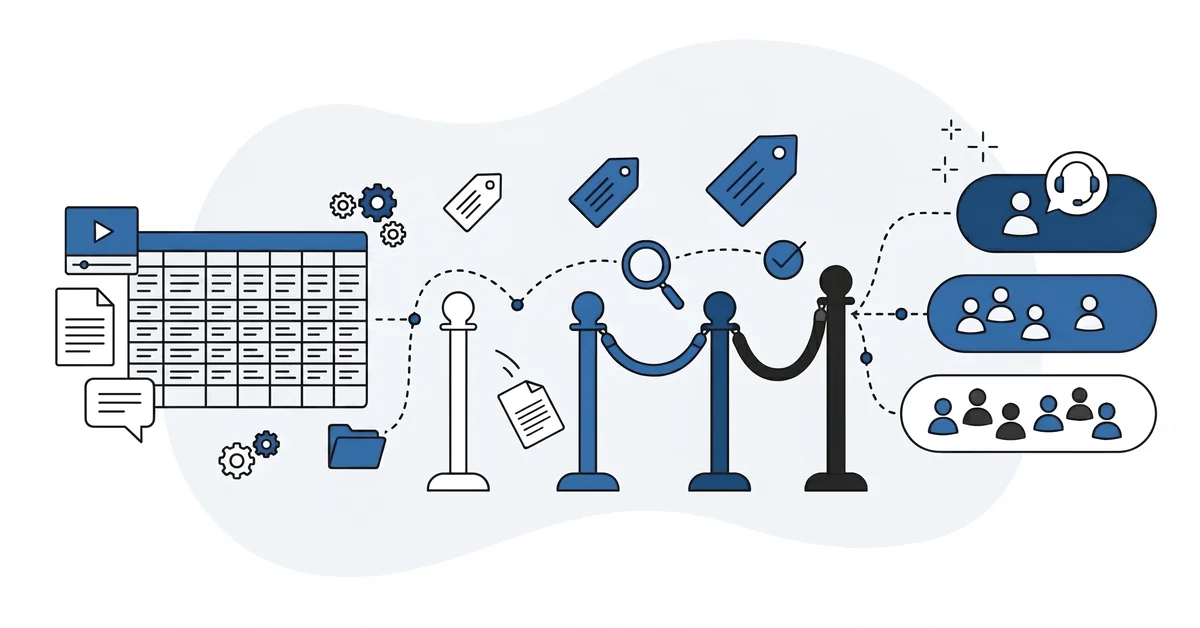
- A tier map is the velvet-rope list drawn before the club opens, not after complaints. The map says who walks past the rope, who walks up and shows their tier card, who is waved upstairs to the private level.
You have content. You have a sketch of three tiers. The question that decides whether the membership launches well is which post lives behind which gate.
Most launches answer that question on gut.
The founder writes tier descriptions that sound right on the pricing page. The free tier holds whichever posts felt like teasers. The mid tier holds the rest of the back catalog. The premium tier holds three videos that have not been recorded yet.
Six months later, renewal data arrives, cancellation reasons land in the support inbox, and every placement re-litigates itself.
This piece is about how an AI chat reads three things. Your content inventory. Your three tiers with their target prices. A one-paragraph audience persona per tier.
The chat returns a tier-to-content map you review before flipping the membership plugin’s restrict-content rules.
Why does tier-mapping fail without a content inventory?
The fail mode is gut-feel-everywhere.
The free tier overlaps the paid tier in topical depth. The mid tier holds content that the audience would have paid for, but also content the audience would have expected free. The premium tier exists mostly on paper. Conversion sits below 1% because nothing about the structure tells the prospect what they get for the upgrade.
The pattern is universal across course-and-membership launches.
Wbcom Designs’ March 2026 production guidance frames the same gap from a different direction. A free or low-cost tier feeds the paid tiers by giving prospects a taste of the community before they commit. The free tier is the on-ramp.
Without it, the paid tiers have to convert cold traffic, which most categories cannot sustain. Below 1% conversion is the threshold where adding a free tier pays back its design cost.
The placement decisions made on intuition without an inventory always re-litigate themselves once renewal data arrives.
What does an AI-drafted tier-to-content map actually do?
A spreadsheet or matrix. Each row names a piece of content (post, course module, downloadable, video, community thread). The recommended tier (free, mid, premium). The rationale for that placement.
An edge-case flag for content that sits awkwardly across the boundary.
The chat reads three artifacts. The content inventory exported from WordPress (titles, categories, tags, word counts, dates). The three tiers with their target prices. A one-paragraph audience persona per tier (who they are, what they need, what they will pay).
The output is a draft map you review before flipping the membership plugin’s restrict-content rules. The chat does the matching. The founder calibrates against renewal and cancellation data once it arrives.
The chat reads inventory and tiers. The founder reads conversation transcripts and support tickets. Both inputs matter — only one is on the chat’s side of the screen. Before the membership plugin gets to enforce these gates, the WordPress plugin evaluation check decides whether the plugin is worth mapping content into at all.
How do you turn the inventory into a tier map?
Five steps. None of them needs more than two hours.
Step 1 — export the content inventory from WordPress. Tools, Export to XML, or a CSV via WP-CLI. Capture titles, categories, tags, word counts, publication dates. The export is the single source of truth for what content exists.
Step 2 — write the three tiers with target prices. Free tier price (zero), mid tier price (the working price), premium tier price (the anchor). Write a one-paragraph audience persona per tier.
Who is the free reader. Who is the mid-tier customer. Who upgrades to premium.
Step 3 — feed the chat with one specific prompt. Paste the inventory, the tiers with prices, and the personas. Add the three-tier price-anchoring rule in one line — the high tier exists to make the middle tier feel accessible. Ask for a tier-to-content map with rationale per row, plus an "edge cases" column for content that does not fit cleanly.
Step 4 — apply the founder’s lens. Read the draft map. Mark placements that match audience research. Mark placements that contradict it.
Mark content that should be teaser-with-paywall (first 200 words free, rest mid-tier) instead of full gating. The chat does not know your support inbox, but you do.
Step 5 — export the map as the source artifact for the plugin’s restriction rules. Save the spreadsheet alongside the launch playbook. The next person reviewing the membership reads the rationale, not just the rule.
About ninety minutes from inventory to draft map.
What does a working three-tier structure look like?
Three tiers, each with a clear job.
Free tier. The substantial core library that builds audience and feeds upgrade marketing. Wbcom Designs’ 2026 guidance is plain about cadence — one significant new addition per month minimum keeps the free tier active. The free tier is not a teaser library — it is the on-ramp.
Mid tier. The working content most members upgrade for. This is the tier where conversion happens. The price sits between free and premium, and the audience persona is the engaged reader who wants weekly value. Most of the membership’s volume runs through the mid tier.
Premium tier. The high-touch content that anchors the price ladder. Live calls. Early access.
Deep-dive courses. Founder office hours. Wbcom Designs’ 2026 production data places 10-to-15% of members on the top tier generating 30-to-40% of revenue. The premium tier is small by member count and large by revenue contribution.
The structural decision is which content lives in which tier, not how many tiers exist. Three is the working number for most launches. More than three creates choice paralysis at the pricing page. Fewer than three loses the price-anchoring effect.
What can go wrong with this approach?
Three traps catch founders who already have content but no rigorous tier map. The plumbing checks belong to a separate workflow — the WordPress plugin selection workflow — and it pairs with the tier map at launch.
Trap 1 — trusting the AI map without checking the plumbing. Ultimate Member’s SQL_CALC_FOUND_ROWS queries stretched to 90 seconds under load in production audits. MemberPress locks admin access if licenses expire against an unrenewed credit card. WooCommerce Memberships requires the separate WooCommerce Subscriptions add-on at $239 per year.
The tier map assumes the plugin can serve the gates it specifies. Verify the plumbing before the launch playbook ships.
Trap 2 — mapping content by gut without renewal data. The chat reads inventory and tiers. The chat does not read your support inbox, your cancellation reasons, or your founder calls with the audience. The first map ships on the chat’s pattern-matching plus the founder’s gut. The second map ships on six months of real data.
Trap 3 — treating the launch map as the final answer. The first six months of renewal data is the calibration the chat cannot produce. Re-run the map at month three and month six. The placements that need to move usually have a clear signal in the cancellation reasons.
Read the reasons. The moves are usually obvious.
Why is the tier map a coordination artifact rather than a marketing one?
A tier map is not a marketing artifact. A tier map is a coordination artifact.
The map answers questions every membership launch faces. Where does this new course live. Should this resource be free for SEO or gated for value. Does the next live call sit in mid or premium.
Writing the answers down before the launch saves the founder from re-deciding each one in the middle of a busy week.
A defensible WordPress membership site treats the tier map as the artifact that travels with the launch. Version 1.0 ships at launch. Version 1.1 ships at month three with the data the launch could not have. Version 2.0 ships at the year mark with the renewal patterns the audience surfaced.
Other questions worth answering
How should annual billing compare to monthly pricing for a new WordPress membership site?
Two patterns hold across most launches. Annual billing reduces churn while monthly billing speeds early cash visibility. Most launches offer both with a small annual discount that signals commitment. Wbcom Designs’ March 2026 production data places 10-to-15% of members on the top tier generating 30-to-40% of revenue.
When does a free trial outperform a free permanent gate at conversion?
Short answer: when the paid offering needs hands-on engagement to demonstrate value.
Long answer: software trials and live-call memberships benefit from time-limited access. A permanent free gate wins when the audience needs to read several pieces before trusting the founder enough to upgrade. Wbcom Designs’ 2026 guidance favors the permanent free gate below the 1% conversion threshold.
How do you migrate paying customers between membership plugins safely?
Three habits limit the damage.
Run both plugins in parallel for a billing cycle before retiring the old plugin. Export the user database as CSV before switching. Verify recurring billing tokens transfer cleanly. Odd Jar’s April 2026 plugin comparison names migration nightmares as the most common failure pattern.
How should refund windows differ between monthly and annual memberships?
Two windows. Monthly subscribers do not need long refund windows because they can cancel before the next billing cycle.
Annual subscribers benefit from roughly a 30-day refund period that mirrors most SaaS norms in 2026. The founder should publish both policies before launch, on the same page that holds the pricing. Clear policy here reduces support load and protects renewal trust later.
Where should the velvet rope actually sit?
Between the substantial core library (free) and the working content the audience wants weekly (mid).
Most launches put the rope too high. The free tier is thin. The mid tier holds content that should have been free. The premium tier holds content that should have been mid.
The pricing page reads as defensive, and the conversion sits below 1%.
The next post in this series covers the WordPress membership plugin selection workflow that pairs with this map. The map says which content goes where. The plugin selection says which plumbing can implement the gates without locking the founder into the wrong renewal terms. Both decisions compound — together they replace the launch-and-pray strategy that consumes most first-time membership operators.
If you want a calm second opinion on your first tier map before you flip the plugin’s restrict-content rules, you can contact me here. Send me your content inventory, your three tiers with prices, and a one-paragraph audience persona per tier. I will read all three and tell you which placement to revisit before the launch playbook ships. There is no pitch, no upsell, and the conversation is free.