Table of Contents
TL;DR
- AI engines extract sentences that sound like answers. Hedging words make a sentence sound like thinking out loud, so the retriever skips it.
- Indig’s analysis of 11,022 verified ChatGPT citations found cited pages use definitive statements 36.2% of the time, versus 20.2% for non-cited pages (p-value 0.0).
- Honest uncertainty ("this figure comes from one study") is different from academic hedging ("it may be the case") — specific qualifiers help, vague ones hurt.
- Common hedging words to cut in top-of-section sentences: may, might, could, seems, appears, often, sometimes, tends to, one could argue, it is possible that.
- Audit one recent page by reading each H2-adjacent sentence aloud, counting the softeners, and rewriting the ten that matter most into sentences that state what you know.
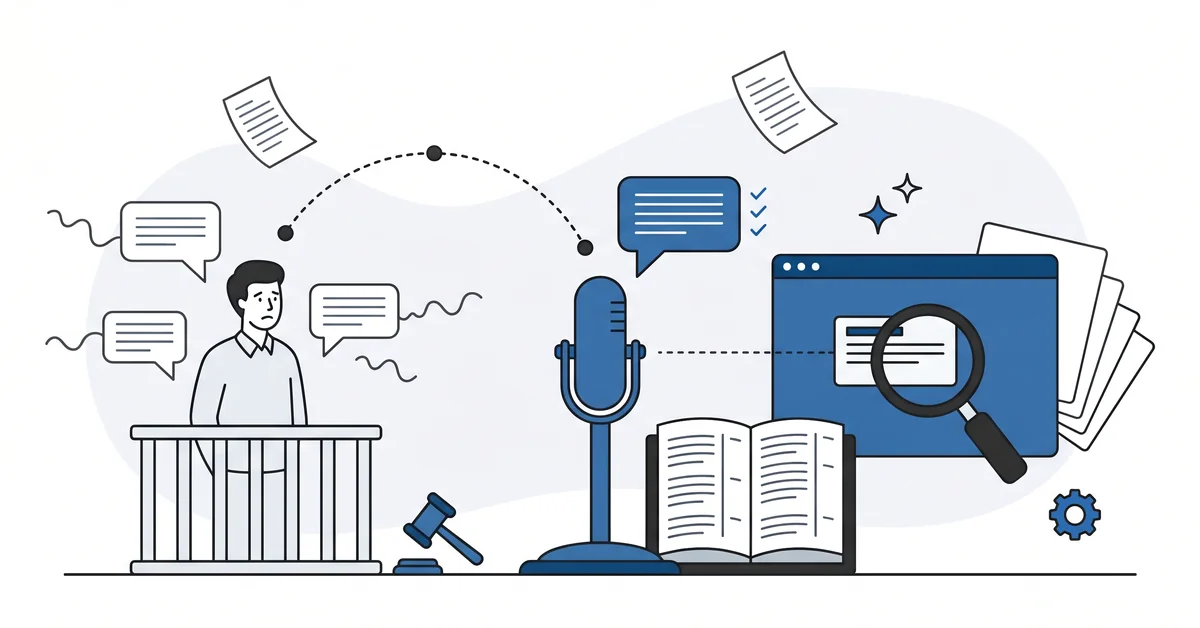
Imagine a witness on the stand. Two of them, actually. Same case, same facts.
The first witness says, "I saw him there. He was carrying a red bag. He walked in at six." Short, plain, committed.
The second witness says, "I may have seen him. It seems he might have been carrying something, possibly a bag of some kind. It could have been around six, though I am not entirely sure." Same information, different shape.
The jury remembers the first one. The lawyer quotes the first one. The news clip, if there is one, uses the first one.
AI engines are a kind of jury, and they work the same way. They read your page, decide what is worth quoting, and pull one or two sentences out to show to the person who asked a question. If your page sounds like the second witness, the AI moves on to a page that sounds like the first.
This is not a style preference. It is measurable.
Why does hedging language hurt AI citations?
AI engines extract sentences that sound like answers. A sentence that hedges does not sound like an answer. It sounds like someone thinking out loud.
When the extractor scans a page for a quotable line, it skips the thinking-out-loud sentences and lifts the ones that state what is.
Pages that speak plainly are cited. Pages that soften every claim get read, then passed over. The companion guide on answer placement in AI citations maps where in each section those definitive sentences earn their citation.
The mechanism is not mysterious. The AI is looking for a unit of prose it can paste into an answer. Hedging sentences do not paste well.
They require context, caveats, the setup before and the caveat after. A definitive sentence is portable. The AI chooses portable.
What counts as hedging?
Any word or phrase that softens a claim. May, might, could, seems, appears, often, sometimes, tends to, one could argue, it is possible that.
Academic writing teaches these as markers of intellectual honesty. In a peer-reviewed paper, they are.
But AI extractors do not read them as honesty. They read them as low confidence, and they look for a louder line somewhere else on the page.
The deeper problem is that most writers do not notice how many of these words they are using. They feel neutral. They feel safe. A sentence without them sounds blunt, maybe even a little arrogant, to an ear trained in formal writing.
That is exactly the ear you are now writing against.
What does the data actually say?
Kevin Indig analyzed 11,022 verified ChatGPT citations drawn from 1.2 million responses.
Cited pages used definitive statements 36.2% of the time. Non-cited pages used them 20.2% of the time. That is roughly twice the rate.
The p-value was 0.0, which means the pattern is very unlikely to be coincidence.
Indig defined definitive language narrowly. He looked for phrases like "is defined as" and "refers to" — constructions that name one concept cleanly in terms of another.
Not buzzwords. Not slogans. Real definitions, plainly stated.
One study is not proof. Indig is the only researcher running this kind of linguistic analysis on AI citations at scale as of April 2026. No independent replication has been published. The direction is corroborated by every practitioner guide that addresses tone, but the specific multiplier is still one data point.
That is worth saying plainly, which is itself the point of this article.
Isn’t some uncertainty honest?
Yes. Honest uncertainty and academic hedging are not the same thing.
Honest uncertainty is specific and named. It points at one limit.
Sentences like: this figure comes from one study and has not been replicated. Or: measured in January, the number may have moved since. Or: for small sites under ten thousand monthly visitors.
That kind of language signals credibility. It does not read as soft. It reads as precise.
Academic hedging is vague and reflexive. It may be the case that this could potentially influence certain outcomes. That sentence does not commit to anything. It protects the writer from being wrong by never quite saying what it means.
The extractor skips the second kind. The first kind can survive because it still carries a claim — just one with the limits named out loud.
When you audit your own writing for hedging, that is the line to draw. Keep the qualifiers that point at a specific limit. Cut the ones that just cushion the claim.
Where does the hedging habit come from?
Most writers did not choose to hedge. They were taught to.
School, university, professional training, corporate communications — all of them reward softening. A claim without qualifiers sounds arrogant in those rooms. Saying something plainly feels risky.
The habit protects the writer from being wrong. It also protects them from being cited, quoted, or remembered.
AI extractors do not care about protecting you. They care about finding a clean sentence to quote. A hedged sentence is not clean.
This is one of those moments where the thing that made you successful in one room makes you invisible in another. The ability to soften a claim in a business email is useful. The same instinct applied to a blog post costs you AI visibility every time someone searches for the answer you wrote.
How do you rewrite a hedging sentence?
Read the sentence aloud. Find every word that softens the claim. Then ask yourself the simple question: do I actually know this, or not?
If you know it, delete the softener and say what you know.
If you do not know it, delete the sentence and write one you can stand behind.
Hedging hides the difference between knowing and not knowing. Rewriting forces you to pick one. The same pick-or-cut discipline applies to H2 phrasing — the AI-friendly headings checklist extends this audit to the question-phrased headings above each section.
Here is a small example.
Before. Small businesses may benefit from adding a frequently-asked-questions section. This could potentially improve their chances of being cited in some AI engines.
After. A frequently-asked-questions section improves small-business citation in AI search. Most sites do not have one.
Same information. The second version gets cited. The first version gets skipped.
When hedging actually helps
Three cases where hedging earns its place.
First, when the evidence is genuinely thin and naming the thinness is the honest move. Writing "this is one study, not yet replicated" is more trustworthy than pretending the number is settled law.
Second, when you are describing someone else’s position and the qualifier is not yours. "He argued that X might be the case" is not your hedge — it is your accurate reporting of his hedge.
Third, when the softening is specific — in our tests, for small sites under ten thousand sessions, as of April 2026. Specific qualifiers read as precision, not hedging.
What all three have in common is that the qualifier points at a real thing. It names a specific limit. It is not there to cushion the claim. It is there to describe the claim’s actual shape.
Vague qualifiers do not do that. They just blur the sentence. Those are the ones to cut.
Other questions worth answering
Does definitive phrasing apply equally well to product comparison pages?
The lift from plain, declarative wording still holds on comparison pages, per Radyant’s March 2026 practitioner checklist. But the H2 shape flips on this surface. Lead each comparison row with a flat verdict, not a softened maybe. A definitive verdict reads as a recommendation an engine can lift cleanly.
Where on the page does the extractor look hardest for a definitive line?
Kevin Indig’s February 2026 study of 1.2 million ChatGPT responses found 44.2% of pulled passages sit in the opening third of a page. Declarative phrasing pays the most in that zone. A maybe in the opening third gets skipped twice. A maybe near the footer barely registers because the footer rarely earns a pull anyway.
What earns more lift — sharpening older posts or shipping fresh drafts?
Sharpen the older ones first, per Radyant’s March 2026 audit guidance. Pages refreshed inside 90 days earn roughly twice the pulls of stale equivalents, per practitioner consensus across recent freshness audits. A vague older post that you tighten recovers two wins. The phrasing improves, and the refresh date resets.
How does Perplexity treat soft phrasing compared to ChatGPT?
Perplexity weighs recency more heavily than the other engines, per Alev Digital’s January 2026 review. Roughly half of Perplexity pulls come from the current year alone, per widely-cited 2026 freshness audits. Soft phrasing on a recent page still gets passed over because the engine has fresh, sharper options nearby. ChatGPT tolerates older sources, so a definitive 2023 page can still earn pulls.
Is the definitive-phrasing finding settled science?
No. Kevin Indig’s February 2026 paper remains the only rigorous linguistic measurement on this question. Alev Digital’s January 2026 review of 129,000 domains corroborates the direction but does not give an independent multiplier. Treat the 36.2% versus 20.2% split as the best current reading, not a permanent law.
Which hedges should you cut first?
Open one page you wrote in the last month. Read it out loud. Count the mays and mights and coulds.
Most pages have more than the writer expects.
Pick the ten that matter most. The ones in your H2s. The ones in your opening paragraphs. The ones in the sentences you would want an AI to quote if it ever quoted anything you wrote.
Rewrite each into a sentence that states what you know. Leave the rest for another day. The first ten are where the citation lift lives.
You do not need to stop hedging forever. You need to stop hedging in the sentences you want to be quoted. That is a smaller job than it sounds.
The witness on the stand is not reckless because she speaks plainly. She is trusted because she does. Your pages are the same. If you want to be cited, you have to sound like you mean it.
If you are not sure which sentences on your site are hurting you, you can contact me. I will read one page with you and mark the places where the hedging is doing the damage. No pitch, no sign-up, no sales.